NDIS Digital Marketing: A Complete Provider Growth Strategy
Most NDIS providers we speak with did not build their first client base through a sophisticated marketing funnel. Growth often started with referrals: a support coordinator had a good experience, a family recommended the provider to someone they knew, or a local connection led to another introduction.
That can work extremely well. The problem arises when a provider wants more predictable growth. Referrals are valuable, but hard to control. If the website is hard to find, social media is inactive, enquiries aren't followed up properly, and nobody measures where new participants come from, growth becomes dependent on people already knowing the organisation exists.
That is where digital marketing should help.
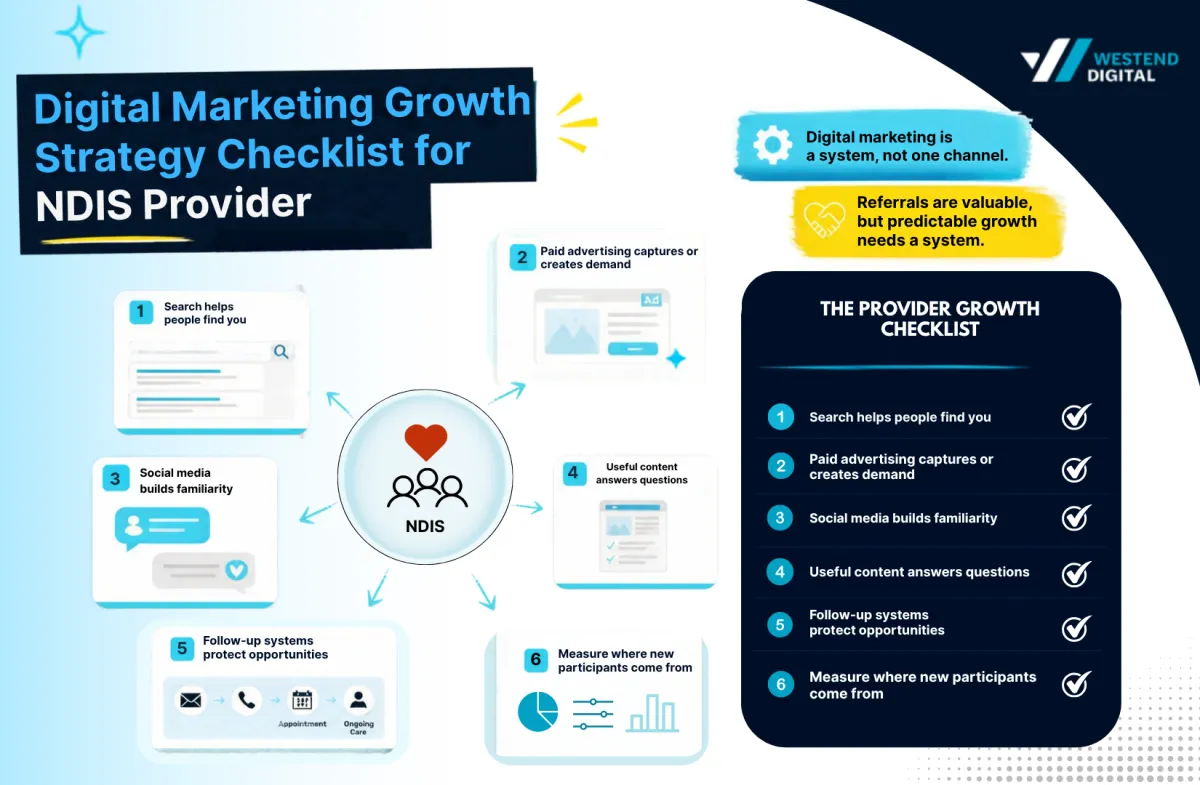
For an NDIS provider, digital marketing is not one channel. It’s a system in which search helps people find you, paid advertising captures or creates additional demand, social media builds familiarity, useful content answers questions before an enquiry, and follow-up systems stop good opportunities from disappearing after the first contact.
The key difference is that this system operates in a sector with specific rules around advertising, NDIS branding, participant privacy, and the claims providers can make.
So the right starting point is not simply:
How do we get more NDIS leads?
It is:
How do we build a reliable growth system without compromising trust, compliance or participant choice?
NDIS digital marketing: the quick answer
A strong NDIS marketing strategy normally combines several channels because each solves a different part of the participant or referral-partner journey.
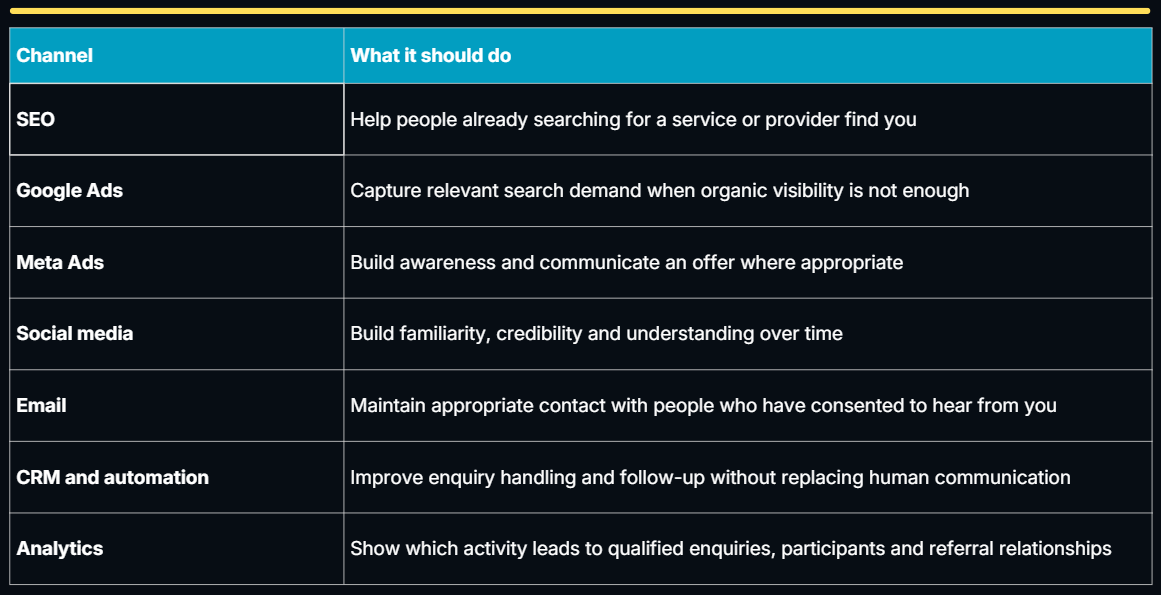
The important word is system. A provider running ads with no useful landing page has a problem. A provider publishing content but never appearing in local search has another. A provider generating enquiries but failing to follow them up has simply moved the leak further down the funnel.
Why NDIS marketing works differently
Two things make NDIS marketing materially different from marketing an ordinary local service business.
The first is the decision-making process. The person researching a provider may be the participant, but they may also be a family member, nominee, guardian, support coordinator or another person helping to evaluate options. That can make the journey more research-heavy and trust-sensitive than a simple transactional purchase.
The second difference is compliance. NDIS providers operate under Australian Consumer Law as well as NDIS-specific rules and guidance. The NDIS Code of Conduct also applies broadly across the sector, including to unregistered providers delivering NDIS supports and services.
On 4 September 2026, the NDIS Quality and Safeguards Commission reminded more than 285,000 unregistered providers that the Code of Conduct applies whether or not they choose to register. Unregistered does not mean being unregulated.
That distinction should shape the marketing before a campaign goes live.
The compliance foundation comes before the campaign
This is the part many generic "NDIS marketing tips" articles rush past. It should probably come first.
In December 2025, the Australian Government reported that a dedicated monitoring team had referred 604 instances of concerning practices to the ACCC under Australian Consumer Law and 112 instances of likely NDIS Provider Code of Conduct breaches to the NDIS Quality and Safeguards Commission. The same update reported more than $100,000 in fines arising from enforcement activity and specifically warned against phrases such as "NDIS approved", "NDIS permitted" and "100% NDIS funded".
The enforcement has continued. In June 2026, the ACCC announced that fitness-support company WeFlex had paid a $19,800 penalty after an infringement notice concerning a Facebook and Instagram advertisement that said, "If you have NDIS funding, it's covered." The ACCC was concerned that funding for the service depended on the participant's individual plan rather than being automatically covered.
That is a useful marketing lesson because the problem was not that the provider advertised. The problem was what the advertising implied.
Be precise about "NDIS approved", "funded" and "registered"
There is no general category of product or service that is automatically "NDIS approved" for every participant.
The ACCC states that whether a product or service can be funded generally depends on the participant's individual plan, needs and goals. It also warns businesses against creating the impression that products or services are endorsed or approved by the NDIS when they are not.
That means phrases such as "NDIS approved", "100% NDIS funded" and "guaranteed NDIS funding" can create serious problems.
Registration language also needs to be accurate. A business can advertise itself as a registered provider only if it is actually registered with the NDIS Quality and Safeguards Commission. Unregistered providers can still market services they are legally permitted to deliver, but they should not use wording that falsely implies registration or official affiliation.
The NDIS logo rules are more specific than they first appear
The main NDIS logo is a registered trade mark, and the NDIA says providers, people and businesses cannot use that logo without written consent.
There is a separate allowance for registered NDIS providers. Registered providers may use approved "I/we heart NDIS" and "I/we support NDIS" assets with the Registered Provider tagline. Unregistered providers cannot use those registered-provider logo packs.
The NDIS acronym can sometimes be used descriptively, but it should not be used in a way that falsely suggests affiliation, approval or endorsement. That is why you should check branding before copying it across a website, ad creative, social template, vehicle graphic, or email signature.
Privacy matters before you collect the lead
Another compliance issue is easy to overlook because it doesn't look like a marketing problem at first.
The Privacy Act small-business exemption is not universal. The Office of the Australian Information Commissioner states that a health service provider can be covered by the Privacy Act regardless of turnover, and its guidance includes disability service providers that handle health information as an example.
This matters when marketing forms ask people to describe diagnoses, support needs, health conditions or other sensitive information.
Do not collect sensitive information simply because a CRM form makes it easy to add another field. Ask what the marketing or intake team genuinely needs at that stage, how the information will be stored, who can access it, and what privacy obligations apply to the organisation.
Paid advertising needs two kinds of compliance
An NDIS advertising campaign needs to satisfy both the law and the advertising platform's own rules.
Google currently treats disabilities as a sensitive interest category, including disability-related content directed towards a person's primary carer. That has consequences for personalised advertising. This doesn’t mean that an NDIS provider cannot use Google Ads, but it does mean audience strategy cannot simply be copied from an ordinary local-service campaign.
Google Search can make sense when somebody is actively looking for a specific support or provider in a particular location. Meta can play a different role by introducing a provider before somebody actively searches, explaining a service or building familiarity through useful creative.
The same NDIS advertising rules still apply on both platforms. A social ad cannot imply guaranteed funding simply because the wording makes a strong hook, and search ad copy is not exempt from consumer law.
SEO should capture demand that already exists
When somebody is already looking for a service, organic search can be one of the most valuable places for a provider to appear.
But "NDIS SEO" should not mean creating dozens of nearly identical suburb pages and changing only the location name.
Useful SEO starts by understanding what people genuinely search for and what information they need when they reach the page. A service page should make it clear what the provider does, who the service is designed for, where it is available, how the process works and what the next step looks like.
Location pages should exist when there is something genuinely useful to say about service delivery in that location. Google Business Profile, accurate business details, reviews, internal linking and technically sound pages matter too.
The objective is not to create the maximum number of pages. It is to create enough useful information that a participant, family member or referral partner can understand whether the provider is relevant to them.
Content marketing should answer the questions people ask before they enquire
A prospective participant or family may have very practical questions: what actually happens during intake, what a service involves, which areas a provider covers, how a referral works, or what someone should prepare before a first appointment.
These are not just keyword opportunities. They are trust questions.
A provider that answers them clearly on its own website gives people a reason to stay, understand the service and return later. It also creates useful material for SEO, social media, newsletters and referral-partner communication.
One well-researched article can become a short video, an email section, several social posts and a resource a team member can send when somebody asks the same question again. That is when content begins to compound.
Social media should prove the organisation is active and human
For many providers, social media will not be the final conversion channel. That does not make it unimportant.
Someone who discovers a provider through Google, a referral or an advertisement may still check Facebook, Instagram or LinkedIn before getting in touch. They are often looking for signs that the organisation is active, credible and understandable.
In our current NDIS client work, social media management is one of the areas we handle most consistently. The useful content is rarely the hardest sell. It is usually the material that helps people understand the organisation: staff and culture, how a service works, community involvement, educational explanations, service updates and answers to recurring questions.
Participant stories can be powerful, but consent, privacy and dignity come first. The NDIS Code of Conduct requires providers to respect the privacy of people with disability, and participant images, audio or stories should only be used where the organisation has an appropriate consent basis.
Email marketing can support relationships, but consent matters
NDIS relationships are not always immediate. A family might research several providers. A support coordinator may know the organisation but not have the right referral today. A previous enquiry might become relevant again months later.
That makes email useful, particularly for educational updates, service information and referral-partner communication.
But "we already have their email address" is not automatically permission to add somebody to a marketing list.
Under Australia's Spam Act, commercial email and SMS generally require consent. Messages must also identify the sender, provide valid contact details and include a functional way to unsubscribe. A good newsletter strategy therefore starts before the newsletter is written. It starts with a proper consent process.
Marketing automation should improve follow-up, not remove the human element
An enquiry that receives no response for two days is not a marketing automation problem. It is a service problem.
Automation becomes useful after the basics are right. A CRM can help record where an enquiry came from, notify the right team member, remind staff when follow-up is overdue and send appropriate communications where the organisation has permission to do so.
It can also help distinguish between audiences. A participant enquiry should not necessarily receive the same communication as a support coordinator or referral partner.
Automation should make communication more reliable. It should not make it less thoughtful.
Website accessibility is part of the marketing experience
Accessibility should not be treated as a technical checkbox at the bottom of an NDIS website project. The audience itself makes it fundamental to the experience.
The Australian Human Rights Commission's current digital-accessibility guidance identifies WCAG 2.2 as the current international standard and recommends organisations conform with at least Level AA.
That affects practical decisions such as readable contrast, keyboard navigation, descriptive link text, accessible forms, image alternatives, captions and information structure.
A provider can spend heavily getting people to a website and still lose them because the website itself is difficult to use. That is not only an accessibility problem. It is a conversion problem.
Where should an NDIS provider start?
We would not automatically start every provider on the same channel. We would start with the gap.
If people cannot find the provider when they search for its services, investigate search visibility. If relevant search demand exists but organic rankings are weak, Google Ads may help capture some of that demand while SEO develops.
If people do not understand the service or need more familiarity before they enquire, content and social media may carry more of the workload.
If enquiries are already coming in but too many disappear after first contact, adding another advertising campaign may be the wrong priority. Fix the follow-up process first.
If referral partners know the organisation but rarely hear from it, useful relationship-focused communication may be more valuable than chasing another cold lead.
The question is not: "Which marketing channel is best for NDIS providers?"
It is: "Where is this provider's current growth system breaking down?"
That is a much more useful place to start.
A practical NDIS digital marketing audit
1. Review every public NDIS claim. Check the website, Google Ads, Meta ads, social profiles, brochures and landing pages for wording that could imply automatic funding, NDIS approval or affiliation that does not exist.
2. Verify registration and branding language. If the business says "registered provider" or uses registered-provider NDIS assets, confirm the registration status and current NDIA logo rules.
3. Check search visibility. Review service queries, local searches, Google Business Profile visibility and whether important services have useful landing pages.
4. Review paid-media targeting. Check both the creative and the platform's sensitive-category rules, particularly where disability or health information could affect targeting.
5. Audit the enquiry journey. Test forms, phone calls, CRM routing and response times from the perspective of a participant or family member.
6. Check privacy, email and SMS consent. Remove unnecessary sensitive fields and confirm how marketing contacts entered the database.
7. Check accessibility. Review forms, contrast, keyboard navigation, image alternatives, captions and the usability of important service information.
8. Measure beyond leads. Track which channels produce relevant enquiries, successful intake outcomes and valuable referral relationships rather than judging success on clicks or form submissions alone.
Frequently asked questions
⚪ Can NDIS providers advertise on Google, Facebook and Instagram?
Yes. NDIS providers can use paid advertising, but the claims in those ads still need to comply with Australian Consumer Law and relevant NDIS rules and guidance. Advertising platforms may also impose their own restrictions. Google, for example, treats disability-related content as a sensitive interest category and restricts some forms of personalised targeting.
⚪ Can an NDIS provider say its services are "NDIS approved"?
Businesses should not describe goods or services as "NDIS approved" in a way that suggests endorsement by the NDIA. The NDIA says it does not endorse or approve products or services, and regulators have specifically warned businesses about claims that imply automatic approval or funding.
⚪ Can an unregistered provider market NDIS services?
An unregistered provider can market services it is legally permitted to deliver, but it must not falsely present itself as a registered provider or imply a non-existent affiliation. Unregistered providers delivering NDIS supports and services are still subject to the NDIS Code of Conduct.
⚪ Do NDIS providers have to comply with the Privacy Act?
It depends on the organisation and the services and information involved. The normal small-business turnover exemption does not apply to businesses that qualify as health service providers. OAIC guidance specifically identifies disability service providers that handle health information as an example of organisations that may be covered.
Building growth that lasts
The strongest NDIS marketing systems are rarely the ones doing the most marketing. They are the ones where the pieces make sense together.
Search captures existing demand. Advertising fills specific gaps. Social media builds familiarity. Content answers the questions people need answered before they trust a provider. Email and CRM systems maintain appropriate relationships, rather than letting every enquiry disappear after one interaction. Analytics shows what is actually contributing to growth.
Compliance sits underneath it all, rather than being checked after the campaign has already launched.
For NDIS providers, that last point matters more than usual. Trust is not simply a brand message in this sector. It is part of the service.
Build the compliance foundation first, then build the channels around it.
That is a slower story than "launch ads and get more NDIS clients." It is also a much more durable growth strategy.
This article provides general marketing information, not legal or privacy advice. NDIS rules, platform policies and regulatory guidance can change, so providers should check the current requirements that apply to their organisation and seek professional advice where needed.
Westend Digital is a Melbourne-based digital marketing agency working with small and medium-sized businesses across trades, healthcare, professional services, and hospitality. If you are setting a budget for your next ad campaign and want a second opinion before you commit, reply to The Westend Brief or visit westenddigital.com.au.