NDIS PROVIDER ADVERTISING
Meta Ads for NDIS Providers That Build Awareness Before Families Start Searching
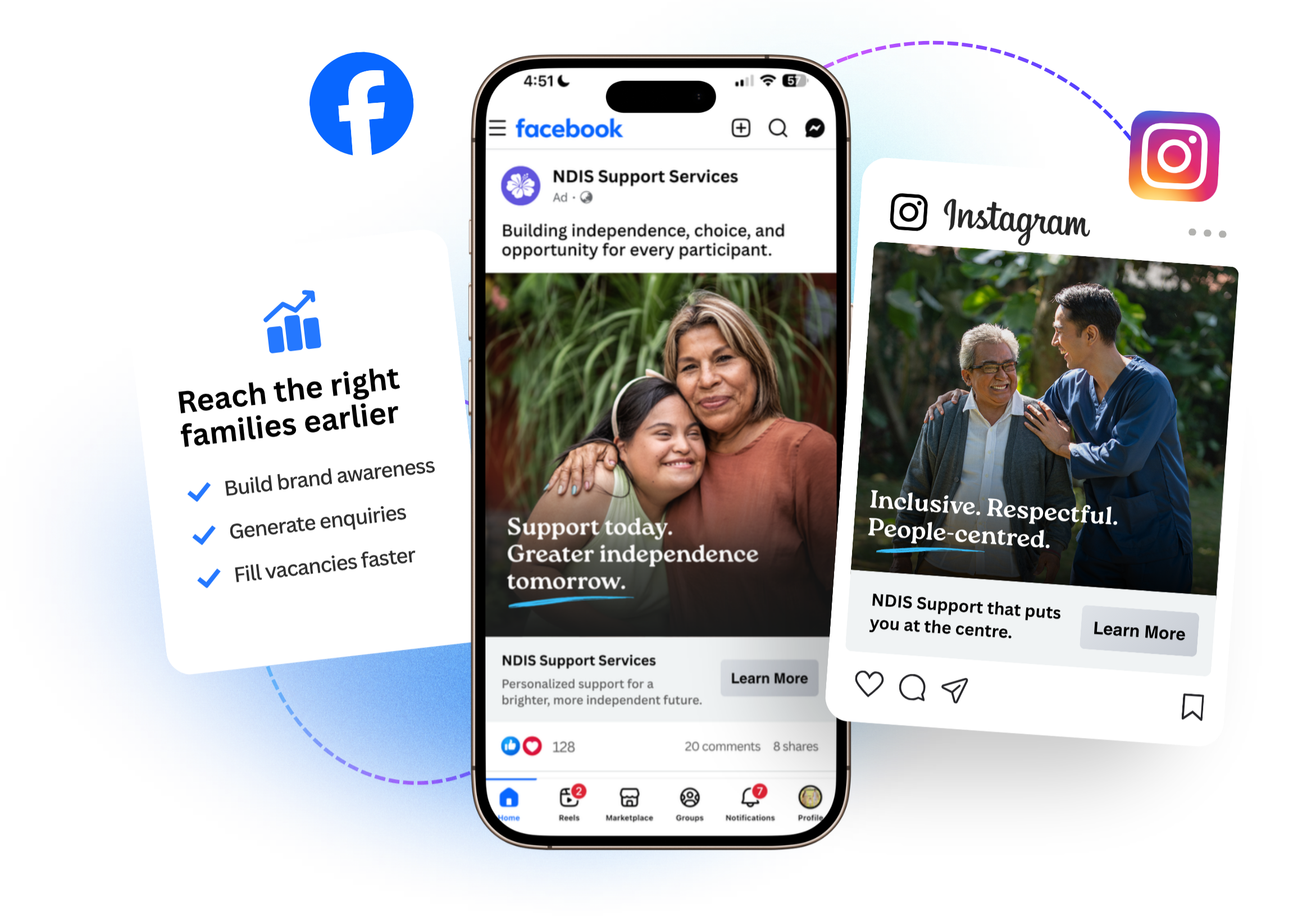
Before a family ever types a search into Google, they've usually scrolled past a handful of providers on Facebook or Instagram, watched a short video, or seen a friend's recommendation in a local group. Meta Ads put your organisation in that scroll, at the moment trust gets built rather than the moment a decision gets made.
We build Facebook and Instagram campaigns that reach participants, families, carers and coordinators before they've started actively comparing, fill SIL and SDA vacancies fast within a real catchment, and keep every ad compliant with the sector's advertising rules and with Meta's own policies for health-related content.
No lock-in contracts. No jargon-filled reports. No claims we cannot back up.
Appear at the moment participants, families and coordinators are actively comparing providers
Campaigns written to the NDIS Code of Conduct, NDIA branding rules and Australian Consumer Law from day one
Plain-English reporting: cost per enquiry by service and suburb, not vanity metrics
The NDIS Market Opportunity
The NDIS is one of the largest and fastest-moving service markets in Australia. As at 31 March 2026, 774,456 Australians had an approved NDIS plan, served by more than 276,000 active providers. That's the same market the Google Ads NDIS page describes, because it's the same scheme what changes on Meta is how people find you within it.
774,456
Australians with an approved NDIS plan
As at 31 March 2026
276,000+
Active NDIS providers in 2025
Providers vary widely in size — these figures are not a ratio
Meta's reach across Australia
Facebook + Instagram advertising reach, late 2025
Source: Meta advertising reach estimates, Australia, late 2025.
Every one of those searches is a person with funding, a need and a shortlist to build.
The question is whether your organisation is on it.
How families, carers and coordinators actually encounter a provider on social media
Nobody opens Facebook or Instagram because they need an NDIS provider. They open it to check messages, watch a video, or see what a friend posted, and a provider earns attention by interrupting that scroll with something worth stopping for.
Support coordinators
Families and carers scroll past a short video of a support worker describing a typical day, or a photo carousel from a recent community outing, and remember the name later when a decision has to be made
Participants who have already shown interest
Some people have already visited your website after a Google search, recommendation, or referral but weren't ready to get in touch. Meta remarketing ads keep your services visible by reminding them about available supports, current vacancies, or what makes your organisation different when they're ready to make a decision.
Support coordinators, plan managers and LACs
Support coordinators, plan managers and Local Area Coordinators (LACs) are less likely to discover providers directly through social media than families are. However, they often check a provider's Facebook or Instagram before making a referral. A professional and active social presence builds credibility, demonstrates community involvement, and reinforces confidence that your organisation is trusted and reliable.
Family members and carers
Often make the initial enquiry on behalf of a participant, especially for accommodation and high-support services. The person who clicks your ad is frequently not the person who will receive the support.
Decisions span weeks, not one sitting
A campaign that treats these audiences as one audience wastes money on all of them. Because NDIS decisions typically involve several people over weeks, the enquiry is the start of the process, not the end. Follow-up matters as much as the click.
How Meta Ads Help NDIS Providers Reach Families and Carers
(and When It Does Not)
Captures demand that already exists
Meta Ads builds demand rather than capturing it. Someone scrolling past a video about your SIL vacancies isn't searching for you yet, but they might be within weeks, and when they do search, they search for a name they already recognise. That's the opposite of Google Ads, which meets people at the moment they've already decided to compare providers.
The fastest feedback loop in NDIS marketing
This makes Meta Ads well suited to two specific jobs in the NDIS space: filling accommodation vacancies (SIL, SDA, STA, MTA) fast within a defined catchment, using location, age and interest signals rather than waiting for a search to happen; and building a genuine audience for community participation and social or recreational programs, where the person choosing often isn't searching with intent at all, just deciding whether your program looks like somewhere they'd want to be.
Not the right tool for everything
It's a weaker fit for services where someone already has a clear, urgent need and a decision to make now, such as allied health appointments or support coordination those searches are usually better captured on Google, at the moment the need exists. If your service mix leans that way, we'll say so in the strategy conversation and point you to Google Ads for NDIS Providers instead.

For the full comparison of when each channel suits which NDIS services, see our research article: Google Ads vs Meta Ads for NDIS Providers.
Why Most NDIS Meta Ads Campaigns Fail
Most failed NDIS campaigns do not fail because Facebook Ads or Instagram Ads does not work. They fail for four specific, avoidable reasons. Knowing them before you spend is worth more than any agency pitch.
A boosted post isn't a campaign
"NDIS" attracts enormous traffic that will never become a participant.
The blue “Boost Post” button under a Facebook post is the single most common way NDIS providers waste money on Meta. It skips proper campaign objectives, real audience control and conversion tracking, and it optimises for whatever gets the most engagement, not the most enquiries. Every campaign we build starts in Ads Manager, with an objective that matches the actual goal.
Interests get treated like keywords, and they aren't
Improve keyword and audience targetting.
Google Ads captures people who typed an intention. Meta doesn't have that signal, so broad interest targeting like “disability services” reaches enormous numbers of people who will never be eligible, in postcodes you don't service. The fix is layering a real catchment radius with narrower interest and behaviour signals, and building lookalike audiences from your own past enquirers once there's enough data to do that properly
The campaign gets edited before the algorithm can learn
Verify current exact guidance in Meta Ads Manager before publish
Meta's delivery system needs a defined run of results per ad set each week before it exits its learning phase and starts finding cheaper, better-matched people. Providers who change the budget, audience or creative every few days in response to early costs never let a campaign leave that phase, and it never gets the chance to improve.
Sensitive-category rules catch providers off guard
Providers who write about the person as support and describe the service.
Meta's advertising standards prohibit ad copy that implies something about a viewer's own health, disability or personal circumstances, even indirectly, and accounts that get classified under Meta's health and wellness policies can lose access to full pixel-based optimisation and custom or lookalike audiences. Providers who write “Are you struggling to find disability support?” get ads rejected or accounts restricted. rather than assume the viewer's situation, don't run into that problem in the first place.
Meta Ads help NDIS providers build awareness, explain services and stay visible with participants, families and support networks before they are ready to search. They are especially useful for services that benefit from education, trust and a longer decision journey, such as SIL/SDA, support coordination, allied health, behaviour support and respite. Google Search is usually better when someone already has clear intent and is actively looking for a provider, service or vacancy in a specific area.
NDIS Marketing in Practice
We’ve worked with Around the Clock Care to strengthen how their NDIS services are presented online, combining a conversion-focused website with clear service messaging, lead-generation forms and consistent Facebook and Instagram content.
The result was a stronger digital presence designed to make it easier for participants, families and support networks to understand their services and make an enquiry.
COMPLIANCE
The Rules Most NDIS Ad Campaigns Ignore
This is the section most agencies skip, and it is the one that matters most in this sector. Three separate sets of rules govern NDIS advertising. Enforcement is active, not theoretical.
NDIS Code of Conduct
Overseen by the NDIS Quality and Safeguards Commission, applying to registered and unregistered providers alike.
NDIA branding & terminology guidance
NDIA rules on the use of NDIS branding and terminology in advertising and promotional material.
Australian Consumer Law
Enforced by the ACCC, governing misleading and deceptive conduct in all advertising.
Enforcement is active
Published enforcement action has specifically included misleading "NDIS approved" claims made through Google Ads. The NDIA has referred.
concerning advertising practices referred to the ACCC by the NDIA
likely Code of Conduct breaches referred to the NDIS Commission
in fines already paid, including misleading "NDIS approved" Google Ads claims
Every campaign we build is written to those rules from day one: no guaranteed outcomes, no implied NDIA endorsement, no misrepresented availability, no pressure tactics. Compliance is not a constraint on good NDIS advertising. It is the baseline for it.
COMPLIANCE
The Rules Most NDIS Ad Campaigns Ignore
This is the section most agencies skip, and it is the one that matters most in this sector. Three separate sets of rules govern NDIS advertising. Enforcement is active, not theoretical.
Published thinking
Our research on NDIS paid advertising is published, sourced and open to challenge, including the claims we refused to repeat because they could not be verified. Judge our thinking before you pay for it.
Hands-on NDIS experience
Accommodation (SIL, SDA, STA, MTA), support coordination and allied health. We know what week two of an NDIS search campaign looks like, and why quitting there is the most expensive mistake in the sector.
Compliance first
Every ad is written to the Code of Conduct, NDIA branding rules and Australian Consumer Law before it goes live, in a sector where regulators are actively issuing fines.
Radical transparent
Your account, your data, every dollar visible, and honest advice even when the honest advice is "not yet". No invented case studies, no borrowed logos, no track record we have not earned.
If you want an agency that promises a number in the first meeting, that is not us. If you want one that can explain exactly where every dollar went and why, book the conversation.
What to Expect from Meta Ads for NDIS Providers
Meta Ads play a different role to Google Search. Rather than waiting for someone to actively search for an NDIS provider, Meta helps introduce your services while participants, families and support networks are browsing Facebook and Instagram.
Campaigns typically rely more heavily on educational creative, short-form video, service explainers and clear calls to action. The goal is to build familiarity, generate appropriate enquiries and support longer decision journeys without relying on exaggerated claims or sensitive personal targeting
Our Process
Discover
audience mapping across families, carers, coordinators and plan managers on Meta; competitor and creative audit; goal alignment by service and catchment
Strategy
Objective selection (leads, traffic, engagement, awareness) matched to service type, audience and creative plan, built around a KPI framework based on enquiries, not likes
Execute
Campaigns built in Ads Manager, not boosted posts; creative produced or sourced per service; lead forms and pixel/CAPI tracking configured, sensitive-category rules checked before launch
Report
Live dashboards and plain-English reporting, cost per enquiry by service and catchment
Refine
Let the algorithm exit its learning phase before judging it, then kill what doesn't work and scale what does
What’s Included (and What It Means for You)
Reach families and carers before they start searching: Campaign build and ongoing management across Facebook and Instagram, structured by NDIS service type and catchment
Stay out of ad rejections and account restrictions: Creative and copy checked against Meta's sensitive-category and personal attributes rules before launch, on top of NDIS Code of Conduct, NDIA branding rules and Australian Consumer Law
Fill vacancies and program spots fast: Dedicated approach for SIL/SDA/STA/MTA vacancy campaigns and community participation program promotion
Understand your results without a decoder ring: monthly reporting in plain English, cost per enquiry by service and catchment
Stop wasting spend on people you can't service: Geographic, demographic and interest targeting layered so budget reaches your actual catchment, not the whole country
Never be held hostage: full account access and ownership, everything goes with you if you leave
Know what happens after the click or the lead form: Conversion and lead tracking on every campaign, with pixel/CAPI setup done properly
Stay because it works, not because a contract says so: No lock-in, month to month
Honest Expectations
What We Will Not Promise, and What We Will
We won't promise a number of leads, a cost per enquiry, or a return on ad spend before we've seen your service mix and catchment. An agency that promises those numbers up front, in a sector actively being fined for misleading claims, should make you cautious, not confident.
What we promise instead: full visibility of every dollar and every result, honest reporting when a campaign isn't working, and a straight answer, before you spend anything, on whether Meta Ads suits your services at all or whether Google Ads, or a Google-and-Meta combination, is the better starting point.
We are a young agency. Our team’s NDIS campaign experience is real and hands-on, and we would rather show you our thinking in the open, in our published research, than dress it up as a track record we have not earned yet.
FAQs
Frequently Asked Questions
How much should an NDIS provider spend on Meta Ads?
It depends on your services, catchment and creative. Industry benchmarking for Australian Meta advertisers in 2026 puts typical costs in the region of $1 to $2.50 per click and roughly $9 to $18 per thousand impressions, with cost per lead varying enormously by industry and objective. We recommend a specific budget after the audit, once we know your services and catchment, not before.
How long does it take to see enquiries from Meta Ads?
Awareness builds before enquiries do, which is the trade-off for reaching people before they're searching. Expect a short early period while the campaign is still exiting its learning phase, and a longer view of results overall than a Google Ads campaign, where intent already exists at the click.
What's the difference between Meta Ads and Google Ads for NDIS providers?
Meta builds awareness with people who aren't searching yet. Google captures people already searching for a service. Accommodation vacancies and community participation programs usually lean Meta-first; allied health and support coordination usually lean Google-first. We've published our full research on this, with sources: Google Ads vs Meta Ads for NDIS Providers.
Do Meta Ads actually work for NDIS providers?
They can, for the right objective. In our team's experience, lead forms with qualifying questions have generated consistent enquiries for accommodation providers, and story-led creative has performed well for community participation services. As a channel for people actively searching right now, Google is usually the stronger fit.
Can Meta Ads target specific suburbs or regions?
Yes, using a location radius around your actual service area, layered with age, interest and behaviour signals. This matters in NDIS, where travel time and service boundaries are real constraints. If your campaign involves housing-style imagery for SDA or SIL vacancies, some targeting exclusions may be restricted under Meta's housing-related advertising rules; we check this before your campaign launches.
Do I need a website for Meta Ads, or can I just use lead forms?
In-platform lead forms are a legitimate starting point, and often the faster way to get a first campaign live, particularly for vacancy-driven services. A dedicated landing page usually converts leads at a higher quality once you have the volume to justify building one, because it can answer the exact question the ad raised, rather than a generic form.
Is advertising for NDIS providers allowed on Facebook and Instagram?
Yes. The NDIS Code of Conduct, NDIA branding guidance and Australian Consumer Law all apply, exactly as they do on any other channel, and Meta has its own additional advertising standards on top of that, particularly around health and disability content. Every campaign we build is checked against both. See the compliance section above.
Related Service
Explore Other Westend Digital Services
Service Locations
Meta Ads for businesses across Melbourne
Those Searches Are Happening Today,
With or Without You
More than 10,500 provider-seeking Google searches happen every month across just ten common terms, and the NDIS itself tells participants to research and compare providers online. If your organisation is not visible when they happen, the enquiry goes to a provider who is, and in a market of 276,000 active providers, someone always is.
Here is what happens next.
Book a free strategy conversation. We review your current Google visibility, tell you honestly whether Google Ads suits your service mix, and show you which services and suburbs are worth targeting first. If the honest answer is "not yet", you get that answer, and the reasons, free of charge. No pitch deck, no pressure, no lock-in.
Thirty minutes. No obligation. You leave knowing whether Google Ads is right for your services, either way.