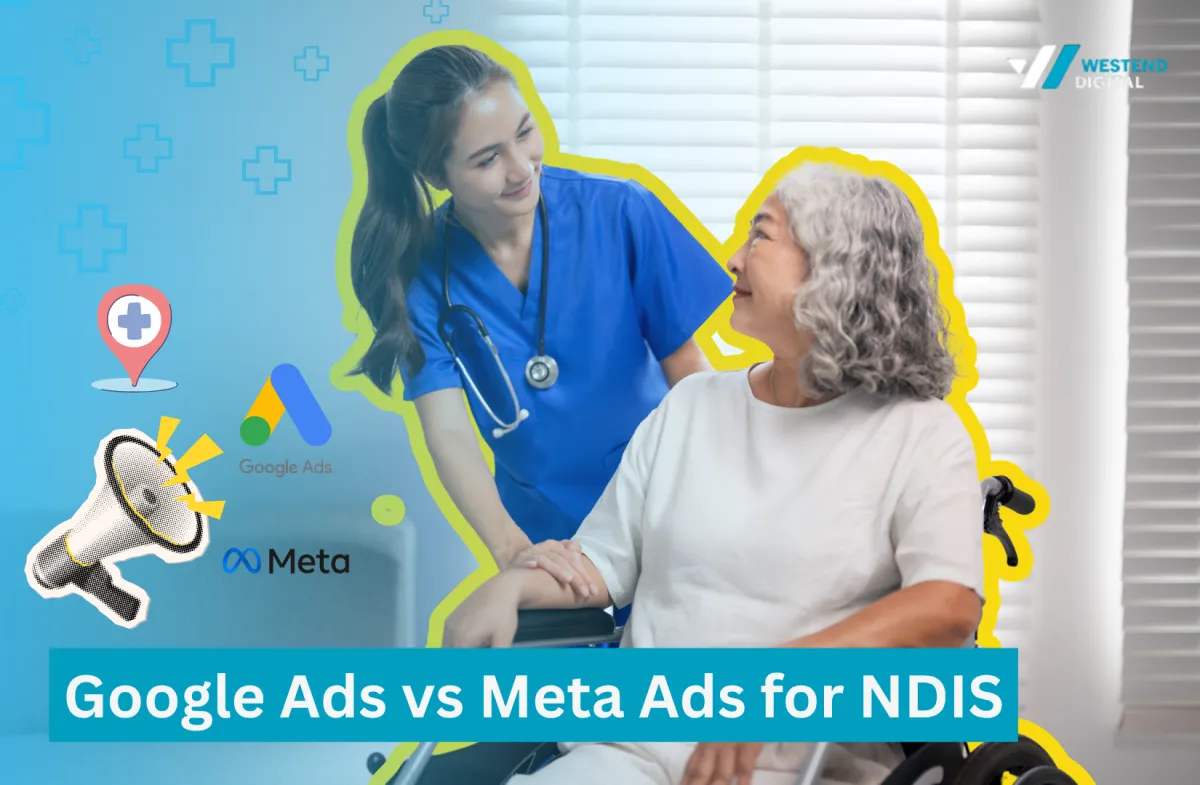
Google Ads vs Meta Ads for NDIS Providers: What the Evidence Actually Suggests
Every NDIS provider eventually reaches the same question: should we invest in Google Ads, Meta Ads, or both?
The answer seems straightforward until you start looking deeper. One agency will tell you Google Ads consistently generate enquiries. Another will argue Meta Ads are the better channel. Case studies get shared with impressive numbers attached, but many are based on individual campaigns rather than independently verified industry data.
So instead of asking who is right, we asked a different question: what does the available evidence suggest about how NDIS providers are using paid advertising, and where does real campaign experience support or challenge those observations?
Where we discuss campaign results in this article, they are clearly identified as observations from campaigns our team has managed hands-on, not industry-wide benchmarks. Where we make regulatory or cost claims, we have named the source so you can check it yourself.
Is paid advertising allowed for NDIS providers?
Yes. NDIS providers are permitted to advertise their services through channels such as Google Ads, Facebook and Instagram.
What catches providers out is not whether they can advertise. It is that three separate sets of rules apply, each with its own enforcement body:
• The NDIS Code of Conduct, overseen by the NDIS Quality and Safeguards Commission
• NDIA guidance on the use of NDIS branding and terminology
• Australian Consumer Law, enforced by the ACCC, which applies to disability service advertising the same way it applies to any other business
And this is being actively enforced, not just written down. The NDIA reports that since its targeted campaign against misleading advertising began, it has referred more than 600 instances of concerning practices to the ACCC and over 100 likely breaches of the NDIS Code of Conduct to the NDIS Commission, with more than $100,000 in fines paid as a result. In one publicised case, a national retailer was fined for advertising products as "NDIS approved" on its website and through Google Ads.
Whatever platform you choose, the standard is the same. Providers should avoid claims that:
• guarantee outcomes
• imply NDIA endorsement where none exists
• misrepresent service availability
• use misleading urgency or pressure tactics
Paid advertising does not create different compliance obligations. It simply makes your public claims more visible and easier to scrutinise.
What the industry evidence actually shows
The first thing we found is that there is limited independent research comparing Google Ads and Meta Ads specifically within the NDIS sector. Most publicly available information comes from marketing agencies sharing their own campaign experiences, platform guidance, and industry commentary.
That does not make those observations useless. When similar patterns appear repeatedly across sources that do not work together and have no incentive to agree, they provide useful direction. But they should not be confused with controlled research.
The recurring pattern is this: Google Ads generally capture existing demand. Meta Ads generally build awareness before someone actively searches.
Google Ads: capturing existing demand
Google Search Ads are most commonly associated with services where people are already looking for support: Supported Independent Living (SIL), Specialist Disability Accommodation (SDA), Short-Term and Medium-Term Accommodation (STA and MTA), Support Coordination, and allied health services such as Occupational Therapy, Physiotherapy, Speech Pathology and Positive Behaviour Support.
The reason is simple. Someone searching "NDIS occupational therapist Melbourne" or "SIL vacancies Brisbane" is already expressing intent. They may be comparing options, checking availability, or trying to understand what exists. That is fundamentally different from someone seeing a provider for the first time while scrolling social media.
FROM OUR TEAM'S CAMPAIGN EXPERIENCE: GOOGLE SEARCH
The following comes from campaigns our team has managed hands-on for NDIS providers, and should be read as campaign observation, not an industry benchmark.
One pattern that showed up repeatedly: Google Search campaigns need patience before meaningful conclusions can be drawn. Early campaigns for accommodation services (SIL, SDA, STA, MTA) generated enquiries, but many were broad and not aligned with the ideal participant profile.
Improvement came from reviewing search terms, adding negative keywords, refining geographic targeting and tightening campaign structure. After roughly four to six weeks of that optimisation, enquiry quality improved noticeably: more relevant conversations, property inspection enquiries, and stronger opportunities. Similar approaches applied to providers in other Australian states produced comparable improvements after sufficient optimisation time.
The key learning: campaign performance should not be judged in the first few weeks. Search campaigns usually need ongoing refinement before they reach the right audience.
Meta Ads: building awareness before the search starts
Meta operates differently. Someone searching Google is often actively looking for a solution. Someone scrolling Facebook or Instagram usually is not. Because of that, Meta Ads are most commonly used for building awareness, educating families and participants, promoting community programs, sharing stories and testimonials, and creating familiarity before a future need arises.
For allied health and healthcare-adjacent services, educational content and trust-building tend to play a bigger role, because people often need confidence in a provider before they are willing to make contact.
FROM OUR TEAM'S CAMPAIGN EXPERIENCE: META LEAD GENERATION
Same caveat as above: our team's own campaign experience, not a benchmark.
Results here were more varied depending on the service and approach. For one NDIS accommodation provider, both website traffic campaigns and Meta Instant Lead Forms were tested. The traffic approach generated limited enquiry volume. Instant Lead Forms generated more enquiries, although lead quality varied and required real qualification before enquiries became genuine opportunities. Adding qualifying questions inside the form helped filter out weaker enquiries before they reached the phone.
For community participation services, creative strategy mattered more than campaign structure. Content featuring authentic participant stories, testimonials and clear outcomes consistently performed better than generic promotional messaging.
The takeaway was not that Meta always outperforms or underperforms. It was that message quality and audience qualification strongly influence what you get.
Different NDIS services have different marketing journeys
One of the biggest mistakes providers make is treating the NDIS market as a single audience. Different services involve different decision-making processes.
• SIL, SDA, STA and MTA: decisions hinge on location, availability and suitability. Search-based advertising aligns well with people actively looking for accommodation options.
• Occupational Therapy and Positive Behaviour Support: specific service needs, where focused keyword targeting can reach people actively researching providers.
• Physiotherapy: enquiries can come through digital channels, but competition and search behaviour tend to push acquisition costs higher than other allied health services.
• Community Participation: usually needs more education and trust-building before someone is ready to enquire, which favours awareness channels.
The right channel depends heavily on the service, the audience, and where they are in their decision.
Understanding the NDIS participant decision journey
Unlike many industries, disability services often involve multiple people in the decision. A participant may not be the only person influencing the choice of provider. The journey typically looks like this:
A need arises. A participant, family member or support person begins researching options. Search engines, referrals, social media and community networks shape awareness. Providers are compared. Trust is built through reviews, websites, communication and reputation. Then a decision is made.
This means a lead generated from an ad is only one step in a much longer decision process. The follow-up matters as much as the click.
What it typically costs
Cost data specific to NDIS advertising is thin, so treat these as indicative rather than gospel. One Australian industry source puts NDIS-related keywords at roughly $3 to $15 per click on Google depending on service type and location, with metro markets at the higher end, and Meta clicks cheaper at roughly $1 to $5, with the trade-off that Meta leads tend to sit earlier in the decision process and need more follow-up before converting.
The more useful rule than any benchmark: know your own numbers. Your cost per enquiry only means something against what a new participant is worth to your organisation.
What we could not verify, and deliberately left out
During this research we found plenty of agencies publishing figures like "300% ROI" or "10x return on ad spend" or "hundreds of participants generated." Very few explain the campaign duration, advertising budget, service type, geographic market, or how the result was attributed. Without that context, those numbers cannot be compared to anything or evaluated at all. For that reason we have intentionally avoided repeating them.
So, Google Ads or Meta Ads?
The answer depends on the objective.
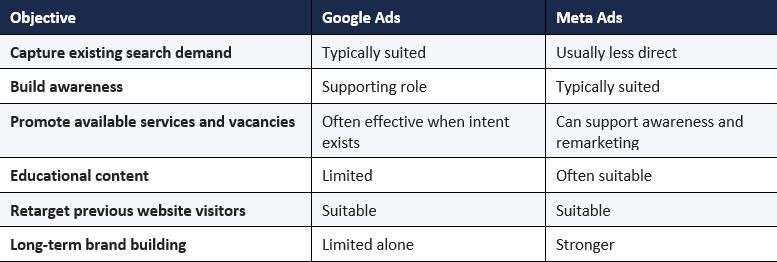
This reflects a recurring pattern, not a fixed rule. Actual results depend on service type, location, competition, website quality, creative quality, campaign management and follow-up processes.
Paid ads are not a complete marketing strategy
Paid advertising creates visibility quickly, but it is only one part of a provider’s digital presence. Think of Google and Meta Ads as the sprinters: fast off the mark, immediate visibility, but they stop producing the moment the spend stops. Search engine optimisation, reputation, useful content and a strong website are the marathon runner: slower to build, still generating enquiries long after a campaign ends. Most providers get the best result from a mix, not from picking one channel and stopping there.
Final thoughts
There is no universal best advertising platform for NDIS providers. Google is generally built to capture existing demand from people already searching. Meta is generally built to create the awareness and familiarity that lead to that search later.
The more useful question is not "which platform is better?" It is "which platform matches how the people we support actually discover and choose services?"
The best campaigns are not built around advertising channels. They are built around understanding people.
Westend Digital is a Melbourne-based digital marketing agency working with small and medium-sized businesses across trades, healthcare, professional services, and hospitality. If you are setting a budget for your next ad campaign and want a second opinion before you commit, reply to The Westend Brief or visit westenddigital.com.au.