NDIS Social Media Marketing: Is Organic Reach Really Dead?
If you manage the socials for an NDIS provider, this will sound familiar. You post something you spent real time on. A photo from a day program. A carousel explaining plan management. A staff spotlight. And then almost nothing happens. No likes worth mentioning, no comments, barely a handful of people reached, even though your page has hundreds of followers.
It is tempting to conclude that organic social media is dead, at least for a sector like NDIS where the audience is smaller and more specific than a mainstream consumer brand. The honest answer is more useful than that headline. Organic reach as it worked five years ago is dead. What replaced it rewards a different kind of content, and most NDIS providers are still posting for the old rules.
What Is Actually Happening To Organic Reach
The numbers are not a matter of opinion or bad luck. For a provider with 800 Facebook followers, the reach collapse below is the difference between roughly 130 people seeing a post and fewer than 16. No amount of caption polish fixes a distribution problem that steep.

What the industry evidence actually shows
The first thing we found is that there is limited independent research comparing Google Ads and Meta Ads specifically within the NDIS sector. Most publicly available information comes from marketing agencies sharing their own campaign experiences, platform guidance, and industry commentary.
That does not make those observations useless. When similar patterns appear repeatedly across sources that do not work together and have no incentive to agree, they provide useful direction. But they should not be confused with controlled research.
The recurring pattern is this: Google Ads generally capture existing demand. Meta Ads generally build awareness before someone actively searches.
Key takeaway
● The reach decline is real and platform-wide.
● But it is not evenly distributed, and that unevenness is exactly where the opportunity sits for a smaller, specific organisation like an NDIS provider.
Why This Is Happening: What The Algorithm Rewards
Meta has been public about the direction of its feed ranking since 2018, when it began prioritising what it calls meaningful interactions: content that sparks genuine back-and-forth between people, over content that is simply broadcast at them. The specifics below are drawn from platform data and consistent industry tracking rather than a published Meta rulebook, but the pattern holds across multiple independent analyses.
1. Video is the entry ticket, not the whole strategy
Meta's most recent feed update surfaces considerably more Reels from creators who post on the day, giving fresh short-form video a real visibility advantage over recycled content. Ignoring video means starting from a smaller distribution pool than everyone else.
2. Speed of engagement matters more than volume of followers
Posts gathering comments within roughly the first 30 to 60 minutes are shown to more people than posts gathering the same number slowly. A small, engaged page can outperform a much larger one that posts and disappears.
3. Pages are structurally disadvantaged against Groups
Facebook Pages reach roughly 1.6% to 5.9% of followers per post. Facebook Groups reach a meaningfully higher share of members, particularly with strong early engagement. Meta has a commercial incentive to keep people inside Groups, since Groups keep users on the platform longer.
4. Saves and shares now outrank likes
Carousels get less raw reach than Reels but earn more total engagement, partly because Instagram resurfaces an unengaged carousel by showing a different slide the second time. The algorithm reads saves and shares as a stronger signal of value than a quick like.
The algorithm is reading saves and shares as a stronger signal of value than a quick like.
The NDIS Complication
This is where the general social media advice needs a sector-specific lens. NDIS content is competing for attention in a space where families and carers already have somewhere better to be: private Facebook Groups built specifically for their situation.
A study of a Facebook support group for caregivers of children with complex care needs found that posts sharing emotional experience received noticeably more interaction than purely informational posts. Caregivers used the group primarily to find support from people living the same reality, not from an organisation talking at them.
Why emotional content wins
● People engage when they recognise themselves in what they're reading.
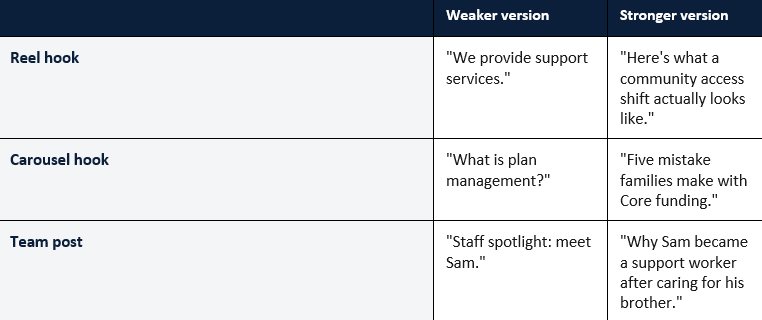
● A generic staff spotlight is easy to scroll past.
● A specific, true reason someone chose this work is not, because it gives the reader something real to relate to rather than something polished to admire.
A provider Page cannot become that Group, and should not try to. But it can learn from what pulls interaction there: real experience, specific detail, and content that treats the reader as someone who already understands the day-to-day.
Where Social Media Actually Sits In The Referral Journey
A common frustration is posting a Reel and expecting the phone to ring. It rarely works that directly. Support coordinators, Local Area Coordinators, and plan managers commonly sit between a participant and a provider, recommending services based on their own professional network and their read on service quality. Very few of these people choose a provider on the strength of a single post.
The real path
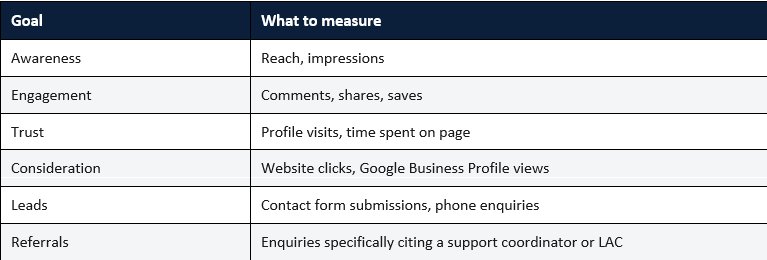
● A post builds awareness.
● A consistent, specific feed builds trust.
● Trust prompts a visit to your website or Google Business Profile.
● That either supports or undermines a referral already being considered.
● Which leads to a phone call and a service agreement.
Judge your content against its actual job in that chain, not against last week's enquiry count. Support coordinators and families frequently move from a social post straight into checking your Google Business Profile, your reviews, and your website. A strong social presence with a thin Google listing undercuts the trust you just built. Treat the two as one system.
A Content Pillar Framework, Not Just A Format List
Formats (Reels, carousels, single posts) describe how content is delivered. Pillars describe what each post is actually for. A feed built from one pillar repeated endlessly reads as promotional no matter how good the production is.
● Educational: funding and eligibility explainers, myth versus fact, how a service actually works.
● Community: local disability awareness days, community events, causes the organisation actually shows up for.
● Team culture: why staff do this work, in their own words, not a generic spotlight template.
● Participant outcomes: real progress and moments, anonymised and consented, described specifically.
● FAQ: the actual questions support coordinators and families ask before engaging.
● Disability awareness and representation: content that centres disabled voices, not just the provider's perspective on them.
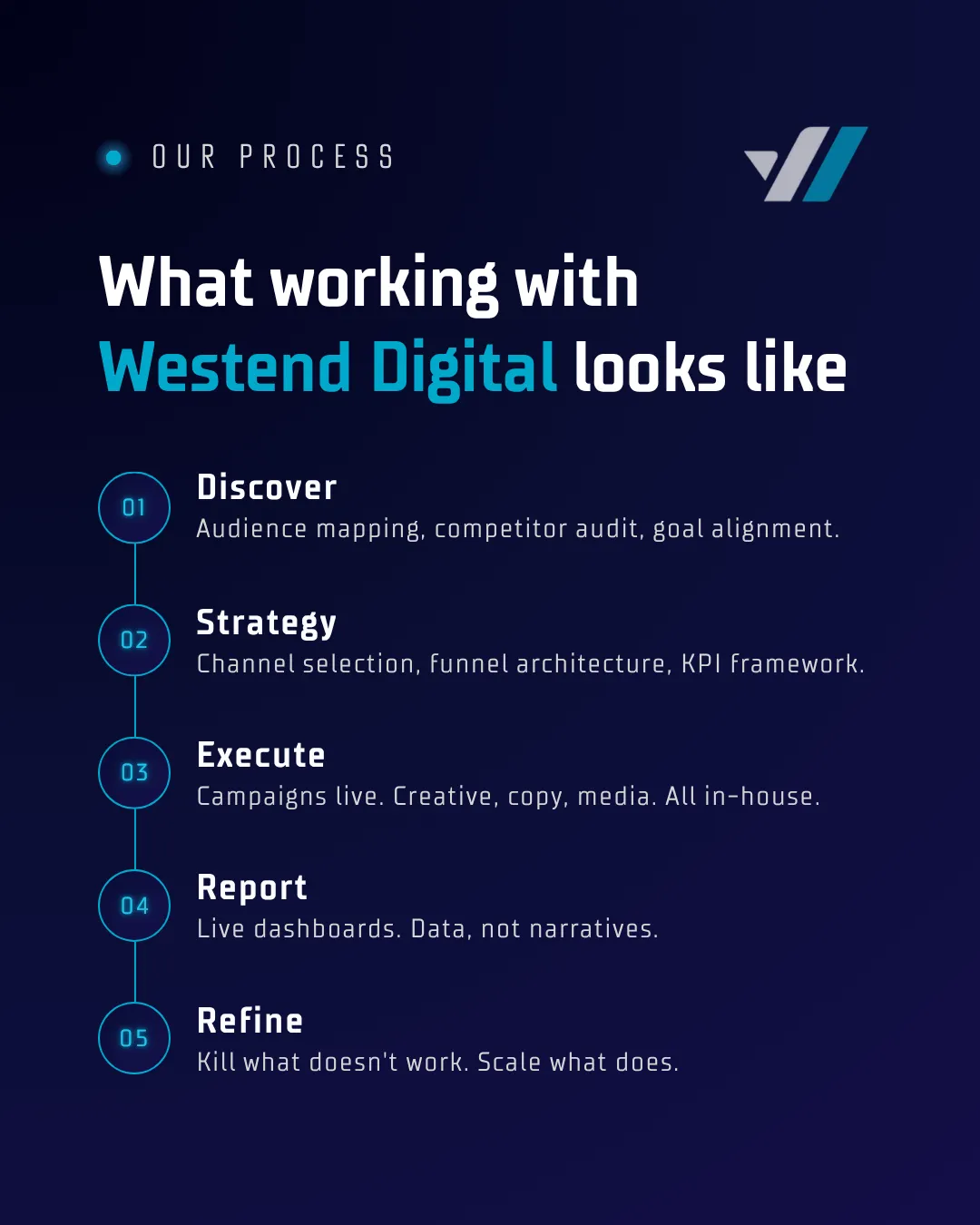
● Process and reassurance: what working with the organisation is actually like, week to week.
A simple monthly mix: two educational posts, one community post, one team culture post, one FAQ, and one participant outcome or process post.
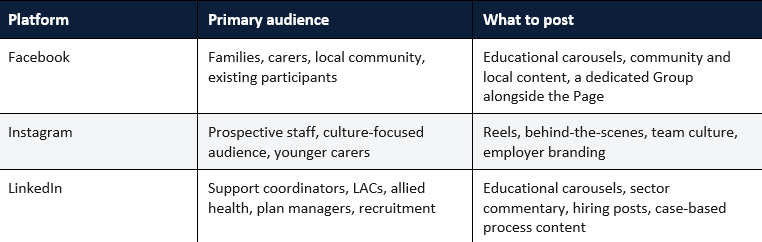
Platform Differentiation
NDIS providers are usually talking to several audiences at once, and one platform cannot do all of that work equally well.
Concrete Examples: Weak Versus Stronger
Common Mistakes NDIS Providers Make
● Posting only participant photos, with no team or process content in the mix.
● Never showing staff personalities, so the feed has no human centre.
● Treating every post as a service promotion rather than a piece of value on its own.
● Ignoring comments instead of replying quickly, the single easiest lever available.
● Posting once a month, then wondering why the algorithm has forgotten the page exists.
● Defaulting to stock imagery instead of real, consented moments from actual service delivery.
● Treating Facebook like a brochure: all output, no conversation.
Compliance: The Line This Sector Cannot Cross
NDIS marketing sits under more scrutiny than most industries. The NDIS Code of Conduct requires providers to act with honesty, integrity, and transparency, and that standard applies to advertising as much as service delivery. The term registered provider can only be used if the organisation is actually registered with the NDIS Quality and Safeguards Commission, and the NDIS logo cannot be used without written consent from the NDIA.
In November 2024, the ACCC put businesses on notice over false or misleading advertising aimed at NDIS participants, specifically flagging claims that products or services were NDIS approved when they were not. That enforcement environment has continued since.
Pre-publish checklist
● Participant consent obtained and documented, not assumed.
● Content preserves dignity and avoids tokenism; disability is represented, not used as a prop.
● No outcome guarantees or unverifiable claims about results.
● Registered provider language used only if genuinely registered.
● NDIS logo and branding used only with NDIA consent, where applicable.
Measuring What Actually Matters
Likes were never a great measure of anything. Since social media's real job in this sector is building trust that supports a referral, measure against the stage of the journey a post is actually working on.
A Few Myths Worth Retiring
● "We need thousands of followers." A smaller, specific Page or Group with real engagement reaches more of its own audience than a large, quiet one.
● "More posts always means better results." Consistency and reply speed matter more than raw frequency.
● "Professional video always wins." A genuine phone-shot moment regularly outperforms a polished, generic production.
● "Every post has to sell our services." Value-first content is what earns the trust that eventually supports a referral.
● "LinkedIn isn't useful for NDIS." It is often the most direct channel to the support coordinators and allied health professionals who influence referrals.
So, Is It Dead?
No. What is dead is the version of social media where posting consistently and looking professional was enough on its own. What replaced it rewards real engagement over raw follower count, and specificity over polish.
The providers winning on social media today are not necessarily posting more. They are posting content that reflects real people, real support, and real experiences. Algorithms change every year. Authenticity does not.
If your posts are being seen but not felt, that is a content and strategy question, not a Facebook problem. We are happy to look at what is currently going out and talk through where the gaps are, no pressure either way.
Westend Digital is a Melbourne-based digital marketing agency working with small and medium-sized businesses across trades, healthcare, professional services, and hospitality. If you are setting a budget for your next ad campaign and want a second opinion before you commit, reply to The Westend Brief or visit westenddigital.com.au.