How to Choose an NDIS Marketing Agency (12 Questions)
In the three months to 24 October 2026, Google Search Console showed Westend Digital’s website for at least 40 query variations related to NDIS marketing agencies. The query “ndis marketing agency” recorded 410 impressions; “ndis marketing agency melbourne” recorded 107. Neither query generated a click in the export we reviewed.
That is useful evidence, but it needs context. Impressions are not search-volume estimates, and the export did not include average positions. What it does show is that people are searching for an agency and, in some cases, checking whether a specific agency can be trusted.
Choosing an NDIS marketing agency is not just a marketing decision. It affects what prospective participants and families are told about your services, what information you collect, who controls your digital assets and how you measure enquiries.
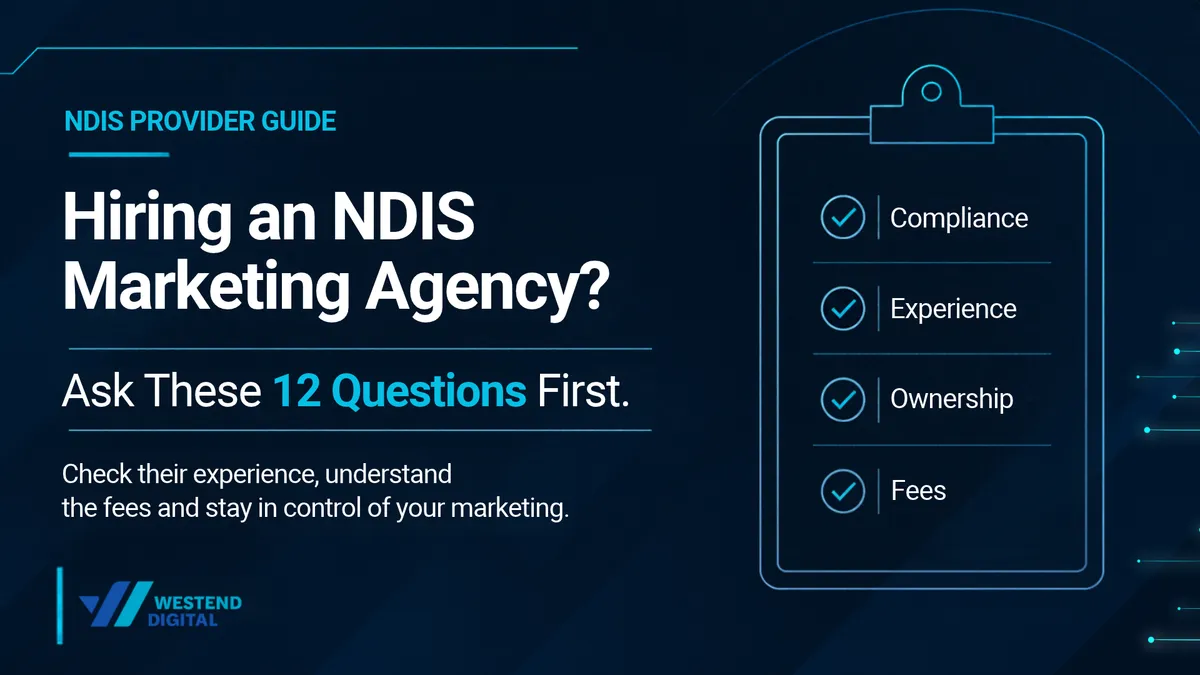
This guide gives you twelve questions to ask any agency, including us, before you sign.
The short answer
A good NDIS marketing agency should be able to:
• Identify compliance risks in your current website, ads and social content before recommending more campaigns.
• Explain how it handles participant stories, consent, reviews and sensitive information.
• Discuss offers and referral arrangements without treating every promotion as automatically acceptable.
• Show relevant work, explain who will do yours and be honest about what its results prove.
• Keep your organisation in control of its ad accounts, website, domain, analytics and paid-for content.
• Report on relevant enquiries and intake outcomes, not just reach and clicks.
• Set realistic expectations, itemise fees and explain the contract and exit process.
For an overview of our services for disability providers, visit our NDIS digital marketing hub.
Why choosing an NDIS agency needs extra care
In February 2026, the ACCC reported concerns about false or misleading claims in the NDIS market, including claims that products or services were “NDIS-approved” or eligible for funding when they were not. It said it had prioritised Australian Consumer Law compliance among NDIS-funded businesses since 2024, working with the NDIA and NDIS Commission. Bedshed and Thermomix paid infringement notices over allegedly misleading NDIS endorsement claims. (ACCC report, 10 February 2026)
NDIA guidance says the NDIS logo requires written consent and only registered providers can describe themselves as “registered providers”. The acronym is not automatically prohibited in every descriptive use, but it must not imply a false affiliation or guaranteed funding. Avoid claims such as “NDIS approved” and “100% NDIS funded”. (NDIA logo guidelines)
The National Disability Insurance Scheme Amendment (Securing the NDIS for Future Generations) Act 2026 has been enacted and includes a prohibition on certain inducements by NDIS providers. At the time of writing, the ban had not commenced and was expected in late November 2026. The Act’s commencement table lists 20 November 2026, while the Department of Health, Disability and Ageing’s current implementation timeline lists 27 November 2026. Because these official sources conflict, confirm the current position with the NDIS Quality and Safeguards Commission or the Department before relying on a date. The prohibition targets gifts or benefits reasonably likely to induce someone to engage a provider to provide, continue or increase supports, or manage plan funding. Exceptions include legitimate pricing practices, provider merchandise and other permitted conduct, so not every discount or giveaway is automatically prohibited. (Act as enacted; Department implementation timeline)
The point is not to avoid marketing. It is to check claims, offers, participant content and data collection. Outsourcing does not remove a provider’s need to check what is published in its name, and an agency may also face legal exposure depending on its role.
For a broader view of how SEO, paid advertising, social media, content and follow-up can work together, read our NDIS digital marketing growth strategy. For a channel-by-channel comparison, see Google Ads vs Meta Ads for NDIS providers. This guide focuses on how to choose an agency that can explain its decisions and show its work.
Part 1: Does the agency understand the rules?
1. “What would you change in our current marketing?”
Ask this before discussing new campaigns. Share your website, two or three recent ads and your social profiles. Ask the agency to identify the first things it would change, and why.
A strong answer checks whether the copy implies a service is “NDIS approved” or guaranteed to be funded, whether registration claims are accurate, and whether branding suggests an official relationship with the NDIA. Service availability, locations and eligibility should also be clear.
A weak answer jumps straight to “you need more ads” without checking what your marketing currently claims. Ask the agency to explain why it recommends each change and point to the relevant guidance.
2. “How do you handle participant stories, photos and reviews?”
Participant stories can help explain a service, but consent, dignity, privacy and the risk of implying a typical result all matter. Ask how consent is recorded, what uses it covers, who can access the files and what happens if someone later asks for content to be removed.
For advertising a regulated health service, the National Law prohibits testimonials about clinical aspects such as symptoms, diagnosis, treatment or outcomes. Comments about non-clinical matters, such as communication or customer service, are not automatically prohibited testimonials. The rule applies to advertising the advertiser controls; it does not cover every review about every NDIS service. (Ahpra advertising guidance)
If the agency wants to use reviews without checking the service, wording and page ownership, that is a red flag.
3. “What offers or incentives would you suggest?”
Ask how the agency checks discounts, giveaways, referral arrangements and other incentives before recommending them.
The 2026 Act creates a prohibition on certain inducements by NDIS providers. A reward designed to influence a referral or a high-value gift intended to influence provider choice should trigger a compliance review. The Act includes exceptions, so not every discount or giveaway is automatically prohibited.
When the prohibition commences in late November 2026, a contravention can carry a criminal penalty of up to two years’ imprisonment, 120 penalty units, or both. The Act also provides for civil penalties. (Act as enacted)
A good agency flags the issue and recommends legal review before launching an offer.
4. “What information will our forms and CRM collect?”
A form field about diagnosis, disability or support needs may collect health or other sensitive information. The OAIC says an organisation that provides a health service and holds health information can be covered by the Privacy Act even if it is a small business; disability service providers handling health information are one example. Not every NDIS provider is automatically covered in every circumstance. (OAIC guidance)
Ask what is needed at first contact, where it is stored, who can access it and how long it is retained. The agency should check forms and tracking so sensitive details are not sent to advertising platforms unnecessarily.
Part 2: Can the agency prove it has done this before?
5. “What NDIS work have you done, and can we see it?”
Ask for examples of relevant websites, campaigns or content and what changed. A credible case study explains scope, timeframe, baseline and measurement, and separates the agency’s work from other factors. If client confidentiality prevents public results, ask for an anonymised walkthrough or an approved reference.
The agency should also ask which audiences matter for your services. Participants, families, carers, nominees, support coordinators and plan managers can play different roles; they are not one generic “customer” group.
Advertising platforms are good at reporting what they can attribute under their tracking rules. They are not a complete map of human behaviour.
6. “Who will actually do the work?”
The person who pitches may not be the person writing ads or building landing pages. Ask who manages the account, writes copy, reviews claims, approves changes and handles urgent corrections. Ask whether any work is outsourced and, where possible, meet the people doing it.
7. “How would you decide where to start?”
Be cautious if every provider gets the same package. The starting point depends on the problem: poor visibility may call for search work; low enquiry rates may point to the page or offer; slow follow-up calls for an intake fix; and a provider at capacity may not need more leads.
Ask what the agency would do first, what evidence supports that choice and what would make it change direction.
Part 3: Will you stay in control?
8. “Who owns the accounts, website, domain, data and content?”
You should know who owns your Google Ads account, Meta business assets, analytics property, Google Business Profile, website, domain and paid-for content. The agency should receive the access it needs, not keep core assets in accounts you cannot control.
Write ownership and access into the agreement, including how tracking, creative files, landing pages and documentation will be handed over if you leave.
9. “How will you report, and what will you measure?”
Clicks and impressions do not tell you whether a campaign is producing useful enquiries. Ask to see a sample report that shows relevant enquiries by service and location, cost per enquiry, lead quality and the outcomes your team can reliably record.
Agree who records offline outcomes and how personal information is protected. Participant details should not be copied into dashboards or ad platforms simply because a field is available.
10. “What results do you promise?”
Treat guaranteed rankings or participant numbers as a warning sign. Google says no one can guarantee a number-one organic ranking. (Google Search Central)
Participant numbers also depend on your services, location, capacity, reputation, intake process and response times. Ask what work the agency will commit to, how progress will be measured and what happens if the evidence suggests the approach is not working.
Part 4: Is the contract fair?
11. “What is in the contract?”
Read the scope, minimum term, notice period, exit fees, price-change rules and how ad spend is handled. Separate management fees, content production and media spend in the quote.
For a practical explanation of how to separate the agency management fee from media spend, see our guide, Stop Confusing Your Management Fee With Your Ad Budget.
Some agencies use minimum terms; others do not. What matters is that the initial term, notice period and exit conditions are written clearly. Ask when each channel can be assessed fairly. The review window should reflect the objective, budget, conversion volume and channel. Paid ads may generate enquiries sooner, while SEO and content often take months to build visibility. Agree early indicators and review dates; “the algorithm needs more time” should not excuse missing reports.
For standard-form contracts entered into, renewed or varied on or after 9 November 2023, unfair contract terms protections can apply to small-business contracts. The threshold is met where the small-business party employs fewer than 100 people or has annual turnover of less than $10 million. Whether a term is unfair depends on the statutory test and circumstances; not every one-sided term is automatically unlawful. (ACCC guidance on the 2023 changes)
This is general information, not legal advice. Get a clause checked if it is unclear or one-sided.
12. “What happens if we leave?”
Ask for an exit checklist covering account access, website and domain credentials, content files, tracking setup, campaign history and documentation. Confirm who handles the handover, the timing and any fees. You should not have to negotiate for access to assets your organisation owns.
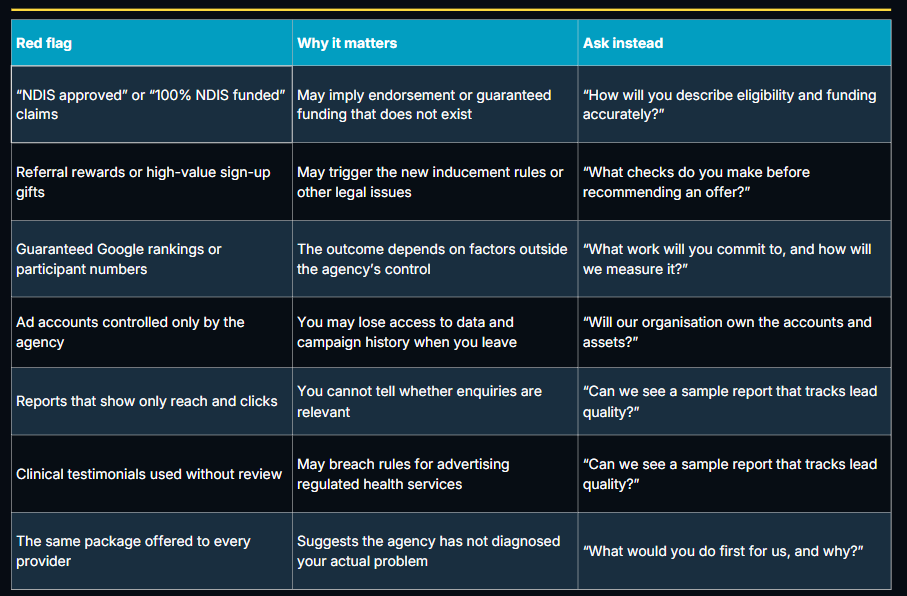
Red flags at a glance
A simple scorecard for comparing agencies
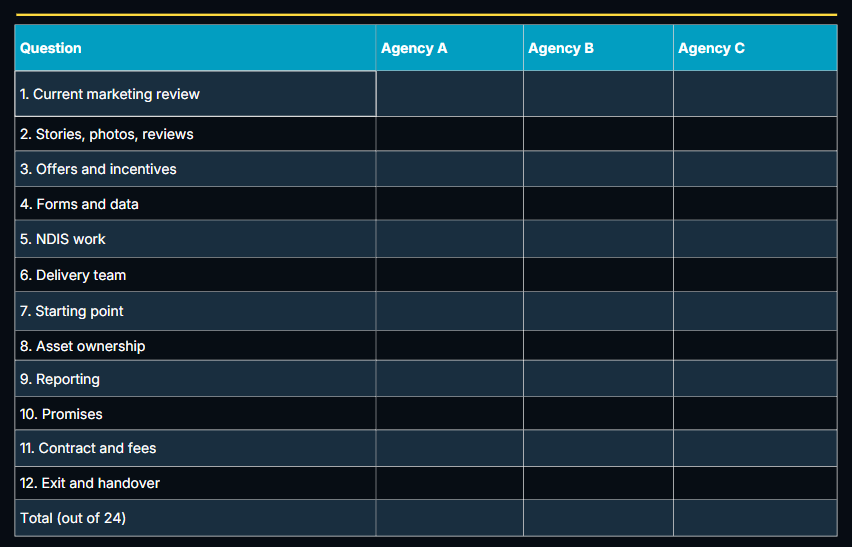
Score each agency against the twelve questions: 0 for no meaningful answer, 1 for a partial answer and 2 for a clear, specific answer. The maximum score is 24.
Treat a zero on any of questions 1 to 4 as a reason to pause and ask for stronger evidence before proceeding. Those questions cover compliance, participant content, offers and sensitive information, so a high total score should not cancel out a serious gap in one of them.
A simple scorecard for comparing agencies
Not every provider needs an agency right now.
• If you are at capacity, more marketing may create enquiries you cannot serve.
• If enquiries arrive but are not followed up, fix intake first.
• If you are smaller, an accurate website, a complete Google Business Profile and consistent local relationships may be enough.
An agency makes more sense when
How we would answer these questions
Westend Digital is based in Werribee, in Melbourne’s west. Our NDIS work includes social media, websites, SEO and Meta advertising for NDIS providers. We will explain our approach and the evidence behind it.
We don’t lock clients into contracts. What we do ask for is enough time for each channel to learn and collect data before its performance is judged. We agree the work, reporting and review points up front, so you can see progress while that happens.
Frequently asked questions
Does an NDIS marketing agency need to be NDIS registered?
Generally, a marketing agency does not need NDIS registration solely because it works with NDIS providers. Registration depends on the supports and services delivered and relevant funding arrangements. Businesses that also deliver supports should check current requirements with the NDIS Commission. (NDIS Commission)
Should I choose an NDIS-specialist agency or a general agency?
Sector experience helps, but a label is not proof. Ask each agency the same questions about compliance, work samples, measurement, ownership and who will do the work. Choose the one with specific answers relevant to your services.
Who is responsible if an agency publishes a misleading ad?
Do not assume that outsourcing removes your organisation’s responsibilities. NDIS providers must follow the obligations that apply to them, and Australian Consumer Law applies to business advertising. An agency may also face legal exposure depending on its role in making or publishing a claim. A contract can allocate tasks between the parties, but it does not make a misleading claim safe. (ACCC guidance on false or misleading claims)
How much does an NDIS marketing agency cost?
It depends on scope, channels, content requirements and ad budget. Ask for an itemised quote separating agency fees, production, technology and media spend.
Can an agency guarantee new participants?
A responsible agency should not promise a fixed participant count regardless of your capacity, location and intake process. Ask what it will deliver, what assumptions its forecast depends on and how progress will be reported.
How long before marketing shows results?
There is no universal timeframe. Paid advertising may produce enquiries sooner, while SEO and content usually take longer to build visibility. Agree review points, early indicators and decision rules before work starts.
The bottom line
The right NDIS marketing agency should make your organisation easier to find and trust without creating unnecessary risk. Use the twelve questions and pay attention to how each agency responds when you ask for evidence. Explore our NDIS digital marketing hub for an overview of how we support providers. If you want to discuss your current approach, book a free strategy conversation with Westend Digital, or review our Google Ads and Meta Ads services for NDIS providers.
This article provides general marketing information, not legal, privacy or compliance advice. Laws, commencement dates, rules and regulator guidance can change. Check the current official requirements for your organisation and seek professional advice where needed.
Westend Digital is a Melbourne-based digital marketing agency working with small and medium-sized businesses across trades, healthcare, professional services, and hospitality. If you are setting a budget for your next ad campaign and want a second opinion before you commit, reply to The Westend Brief or visit westenddigital.com.au.