
Does FAQ Schema Still Matter for AI Search in 2026?
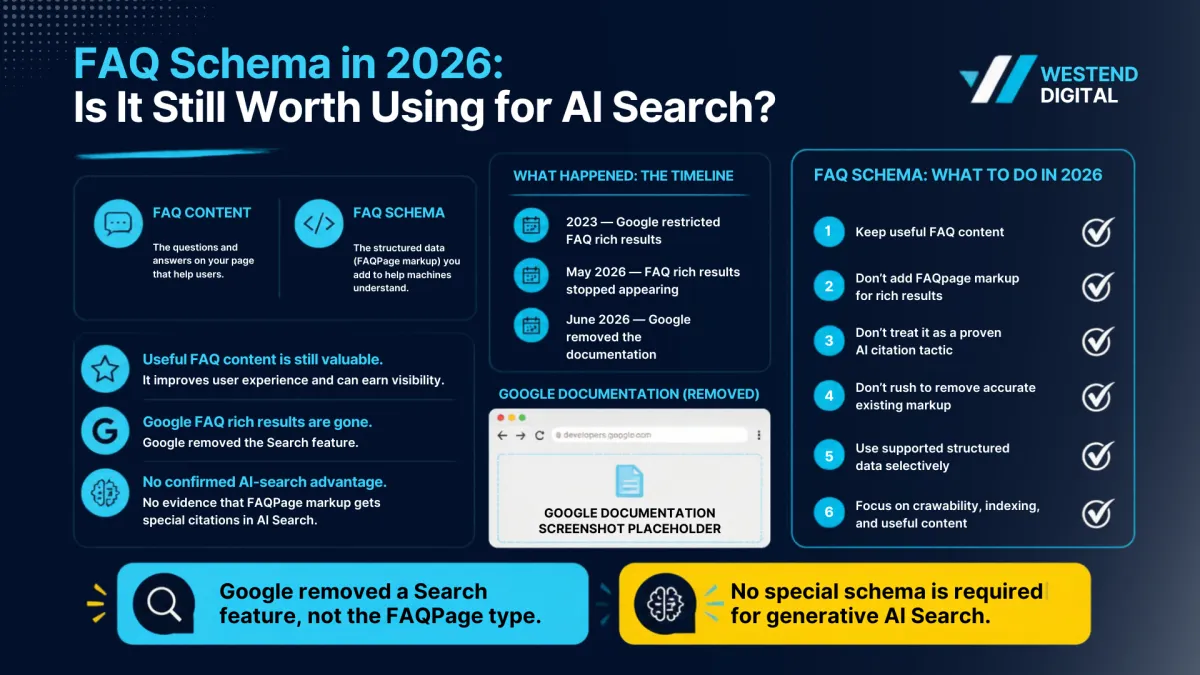
Since May 2026, two opposite claims have been circulating about FAQ schema. One says FAQ schema is dead and should be removed from every website. The other says it matters more than ever because AI systems supposedly rely on it to generate and cite answers. Neither position is well supported by what Google has actually published. The real answer is narrower. Google retired the FAQ rich result. It did not delete the FAQPage type from Schema.org. And Google's own 2026 generative-AI guidance does not identify FAQPage markup, or any other special schema type, as a requirement for appearing in AI Overviews or AI Mode. That distinction matters.
What actually changed in May 2026?
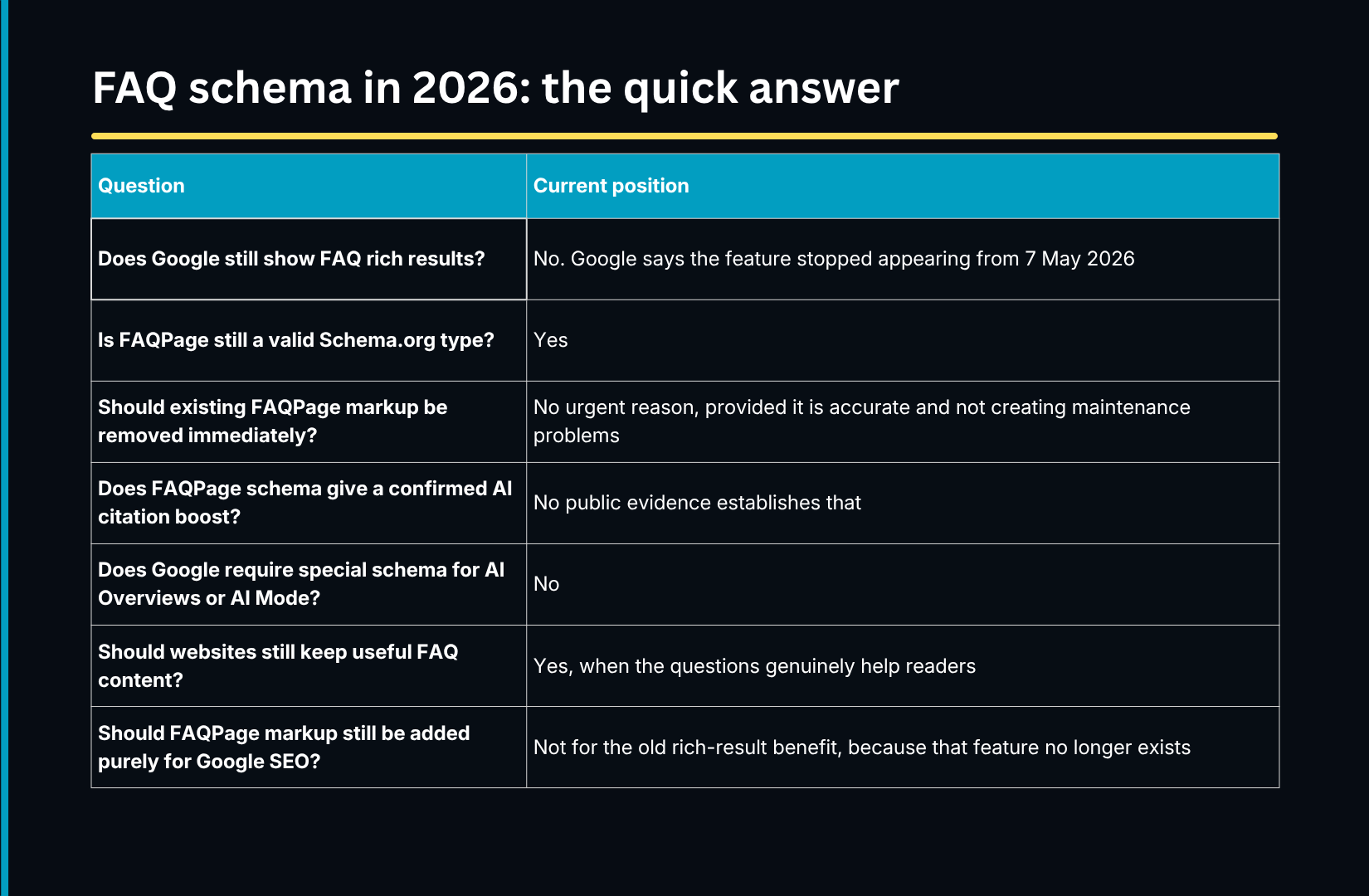
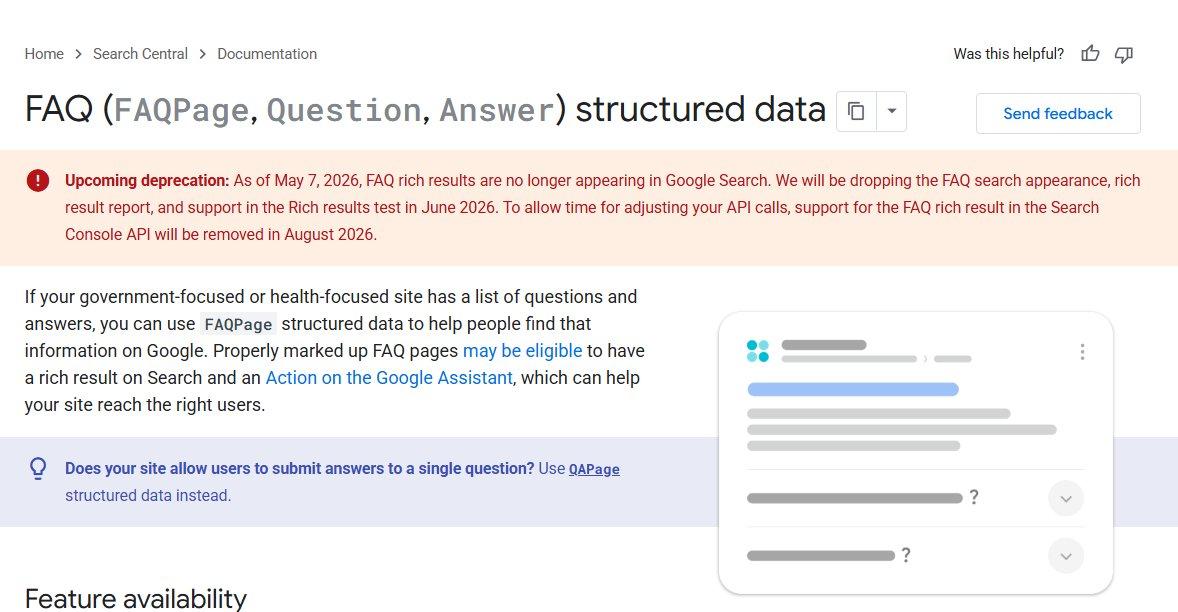
On 8 May 2026, Google added a deprecation notice to its FAQ rich-result documentation stating that the feature would no longer appear in Google Search from 7 May 2026. Then, on 15 June 2026, Google removed the FAQ rich-result documentation altogether because the feature was no longer shown in Search.
This was not a sudden reversal. Google had already sharply restricted FAQ rich results in August 2023. Before that change, FAQPage markup could produce expandable question-and-answer sections underneath a normal Google listing across a wide range of sites. In August 2023, Google limited those rich results primarily to well-known, authoritative government and health websites. At the time, Google explicitly said that sites could remove FAQ structured data if they wanted to, but there was no need to proactively strip it out because unused structured data did not cause problems for Search. The May 2026 change finished that process. FAQ rich results are now gone from Google Search altogether.
What Google did not remove
This is where the terminology becomes important. Google removed a Search feature. It did not remove the underlying FAQPage type from the Schema.org vocabulary. Schema.org still defines FAQPage as a WebPage presenting one or more frequently asked questions. As of 2026, it remains an active Schema.org type. Those are two different things. Schema.org provides a vocabulary that websites can use to describe content in a machine-readable format. Google decides which parts of that vocabulary it uses for specific Search features. Google can stop supporting a rich result without making the underlying schema type invalid. That is exactly what happened here.
So, should you remove existing FAQPage markup?
Usually, there is no urgent reason to. Google's 2023 guidance was clear that structured data it no longer uses does not create a Search problem simply by existing. If the markup is already implemented correctly, matches visible content and costs nothing to maintain, removing it is unlikely to produce any meaningful Google Search benefit.
That does not mean it has to stay forever. If the markup regularly breaks, creates maintenance work, no longer accurately represents the page, or exists only because an old SEO plugin adds it automatically, then removing it may be perfectly reasonable. The point is that you don't need a site-wide emergency clean-up just because Google retired the rich result.
Should you still add FAQPage schema to new pages?
This is where our recommendation changes. If the only reason for adding FAQPage markup is wanting the expandable FAQ result in Google, then stop. That result no longer exists.
If the only reason is that you've heard FAQ schema helps AI systems cite a site, we'd be cautious too. There is currently no established public evidence that adding FAQPage markup specifically creates an additional citation advantage in Google's generative AI features. Google's own 2026 AI-search guidance actually points in the opposite direction. It says structured data is not required for generative AI search, and that there is no special schema.org markup websites need to add to appear in AI Overviews or AI Mode. That does not mean structured data has no value. It means FAQPage markup should not be sold as a confirmed AI-search ranking or citation lever.
Does FAQ schema help with AI Overviews?
Google has now answered the broader structured-data question fairly directly. Its 2026 guide to generative AI Search says that Google's AI features are rooted in its existing Search ranking and quality systems. It also specifically warns site owners against overfocusing on structured data for generative AI Search. Google says there is no special schema.org markup required for its generative features.
So, if somebody says you need FAQ schema to appear in AI Overviews, that statement goes beyond Google's published guidance. Could Google still parse structured data when it understands a page? Of course. Google uses structured data across Search for many purposes. But that is not the same as evidence that FAQPage markup gives content extra weight inside an AI-generated answer. Those are two very different claims.
What about ChatGPT Search?
ChatGPT should not automatically be treated as if it follows Google's structured-data rules. OpenAI publishes its own guidance for website owners. Its current publisher documentation focuses on crawl access, particularly making sure OAI-SearchBot is not blocked if a publisher wants content to be discoverable, surfaced and cited in ChatGPT Search. That public guidance does not tell publishers to add FAQPage markup to improve citations.
This does not prove that structured metadata is never used internally in any context. But it is different from claiming that FAQPage schema itself improves general ChatGPT citations. We would treat that specific claim as unproven unless stronger evidence appears.
The important distinction: FAQ content versus FAQ schema
This is probably the most useful takeaway. A good FAQ section can still be valuable even if the markup surrounding it produces no rich result. Imagine a service page with four questions customers repeatedly ask: how much does the service cost, what areas do you service, how long does the process take, and what should I prepare before getting started? Those answers can improve the page by removing friction for the reader. They can also give search systems clearer information about the topic. That benefit exists whether the page contains FAQPage JSON-LD or not. The mistake is assuming the wrapper is more important than the answer inside it. It is not.
Clear question-and-answer content can still be useful for AI search
This is where the AI-search conversation becomes more interesting. Google says websites do not need to rewrite content specifically for AI systems, break pages into artificially tiny chunks or add special structured data. Its systems can understand topics, synonyms and relevant passages within normal pages. That means an FAQ section should not exist because somebody heard that AI likes questions. It should exist because the questions deserve answers. If a customer keeps asking the same thing during sales calls, intake calls, live chat or email, that is a strong candidate. If nobody has ever asked the question and it exists only because an SEO tool generated it, it is probably less useful. The content should justify the format.
Structured data still matters, just selectively
FAQ rich results disappearing does not mean structured data as a whole has become irrelevant. Google continues to support structured-data-driven Search features including Article, Breadcrumb, Product and other types in its current structured-data gallery. Structured data can still help Google understand page content and make pages eligible for supported rich-result experiences. The important word is supported. A structured-data implementation should have a reason behind it. Article or BlogPosting markup can accurately describe an editorial article. Breadcrumb markup can describe a page's place in the site hierarchy. Product markup can provide structured product information where applicable. Retiring one feature doesn’t mean every structured-data type should disappear with it.
What we would actually do in 2026
Keep genuinely useful FAQ content. If the questions help real users make decisions, understand a service or resolve uncertainty, keep them.
Do not build FAQs simply to justify adding schema. The content should exist because the question matters, not because a plugin can wrap it in JSON-LD.
Do not add FAQPage markup expecting a Google rich result. That outcome is gone.
Do not sell FAQ schema as a proven AI citation tactic. Google explicitly says no special structured data is required for generative AI Search, and current public evidence does not establish a specific FAQPage citation boost.
Do not rush to remove accurate existing markup. There is no obvious Search benefit from stripping it out simply because Google stopped displaying the rich result.
Keep investing in structured data that still serves a clear purpose. Use the schema types that accurately describe your content and support relevant Search features. If this is the kind of technical detail your own site's SEO setup could use a second look at, that is exactly what a full technical SEO audit covers.
A practical audit
If FAQ Page markup currently exists across your website, we would check five things:
1. Is the FAQ content genuinely useful? Keep useful questions even if there is no rich result.
2. Does the markup accurately match visible content? Structured data should describe what is actually on the page.
3. Was the markup implemented only for the retired Google rich result? If so, stop treating it as an SEO growth tactic.
4. Is it creating maintenance or technical problems? If yes, removing it may simplify the site.
5. Are more important schema opportunities being neglected? Focus development time on structured data that still has a clear Search or business purpose.
Frequently asked questions
Did Google remove FAQ schema?
No. Google removed the FAQ rich-result feature from Search. FAQPage remains an active Schema.org type.
Should I remove FAQPage schema from my website?
Not automatically. Google previously stated that unused structured data does not cause Search problems, although it also provides no visible Search benefit when Google does not use it. If the markup is accurate and easy to maintain, there is no urgent reason to remove it.
Does FAQ schema help content appear in AI Overviews?
Google does not identify FAQPage markup as a requirement or special optimisation for AI Overviews. Its current guidance says structured data is not required for generative AI Search and that no special schema.org markup is needed.
Does FAQ schema help ChatGPT cite a website?
OpenAI's public publisher guidance focuses on crawlability and OAI-SearchBot access for general ChatGPT Search discovery. It does not identify FAQPage markup as a requirement for citations. So, a specific FAQ-schema citation advantage should currently be treated as unproven.
The bigger lesson
The most interesting part of the FAQ-schema change is not really FAQ schema. It is what it says about how SEO tactics age. A Search feature becomes valuable. Marketers optimise for it. The tactic becomes widespread. Eventually the feature changes, becomes more restricted or disappears. That does not necessarily mean the underlying content stopped being useful. Google's 2023 restriction and 2026 retirement of FAQ rich results are a good example.
The mistake is building content because a Search feature exists. The better approach is to build content that deserves to exist anyway, then use structured data where it accurately describes that content and supports something useful.
So, should you still have FAQs? Absolutely, when customers genuinely need the answers. Should you still obsess over FAQPage markup as a Google growth tactic? No. And should you start adding it everywhere because somebody says AI systems love FAQ schema? Not without evidence. The content still matters. The old Google dropdown does not. And for AI search, the strongest public guidance we have is still much simpler than most of the sales pitch: publish useful information, make it accessible, structure it clearly, and give search systems something worth retrieving.
Is your site's technical SEO keeping up?
Structured data is one small piece of a much bigger technical picture; crawlability, indexing, site speed and how clearly your pages are organised all matter more day-to-day. If you are not sure where your site stands, book a technical SEO review with Westend Digital, and we will show you exactly what is and isn't working.
Westend Digital is a Melbourne-based digital marketing agency working with small and medium-sized businesses across trades, healthcare, professional services, and hospitality. If you are setting a budget for your next ad campaign and want a second opinion before you commit, reply to The Westend Brief or visit westenddigital.com.au.