AEO vs GEO Explained: What Google, Bing & Research Say
Every second marketing newsletter now seems to carry some version of the same warning: traditional SEO is dying, AI search is taking over, and if your business is not doing AEO or GEO it will disappear from the next generation of search.
It is a compelling story.
It is also, once you check the primary sources, considerably more modest and better defined than most of the content selling it as an urgent new discipline.
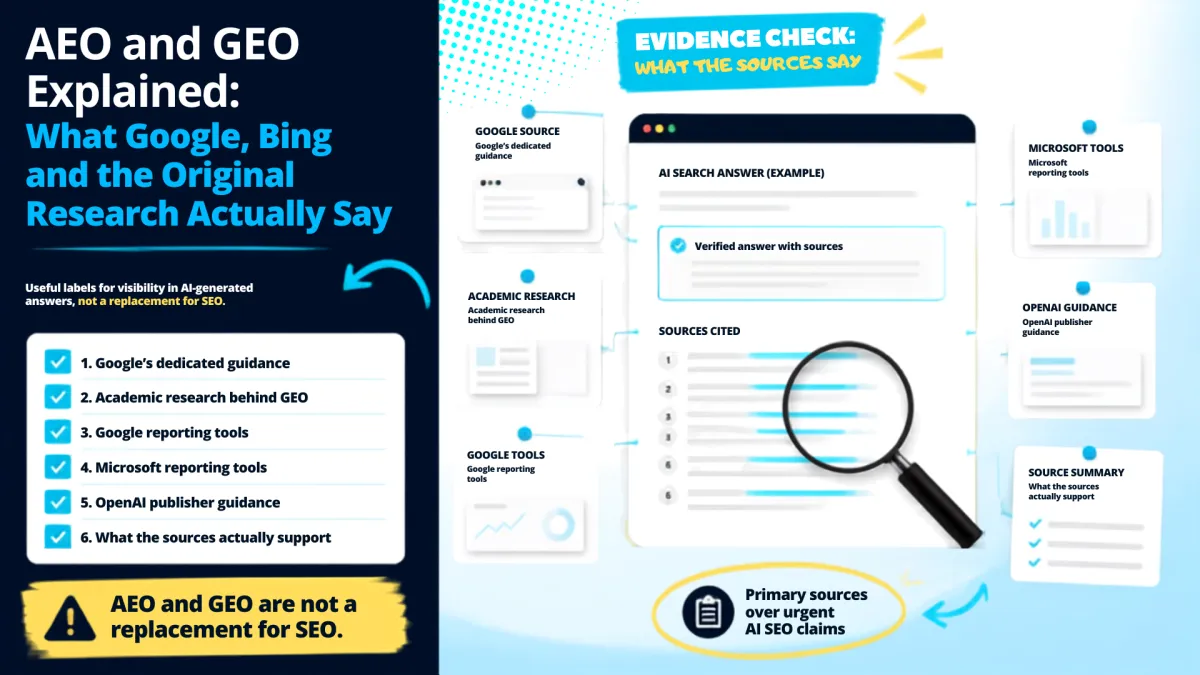
We went looking at Google's dedicated guidance, the academic research that introduced the term "generative engine optimisation", the new reporting tools from Google and Microsoft, and OpenAI's publisher guidance for ChatGPT Search.
What follows is what those sources actually support, rather than what a growing "AI SEO" services market has built on top of them.
AEO and GEO: the quick answer
AEO and GEO are useful labels for thinking about visibility in AI-generated answers. They are not a replacement for SEO.
Google now says this directly. Its 2026 guidance treats optimisation for generative AI features as part of SEO, not as a separate discipline sitting alongside it. It says the same Search ranking and quality systems remain foundational to visibility in its generative features. Google Search Central
Outside Google, the picture is less standardised. ChatGPT Search, Microsoft Copilot and other generative systems have their own crawlers, retrieval systems and reporting tools.
The useful conclusion is somewhere between "nothing has changed" and "SEO is dead."
AI search matters.
But most businesses do not need to throw away everything they know about SEO to respond to it.
What do AEO and GEO actually mean?
The two acronyms are often used interchangeably, but they come from different places.
Answer Engine Optimisation, or AEO, is a broad industry term that grew out of the featured snippet and voice-search era. It generally refers to structuring information so a search engine, assistant or answer system can identify and surface a useful response.
There is no single authoritative academic definition of AEO, which is one reason different agencies use the term differently.
Generative Engine Optimisation, or GEO, has a much more traceable origin.
Pranjal Aggarwal and colleagues introduced a formal GEO framework in research first published in 2023 and later presented at KDD 2024. Their paper looked at a different problem from traditional ranking: what happens to website visibility when the interface generates an answer from multiple sources rather than simply presenting a ranked list of links?
The researchers created a benchmark called GEO-bench and tested different ways of modifying source content to see whether those changes affected its visibility inside generated answers. GEO paper
That is a legitimate research question.
It does not follow that every tactic currently sold as "GEO" has been validated by that research.
What Google's May 2026 guidance actually settles
On 15 May 2026, Google published a dedicated guide to optimising websites for generative AI features in Google Search. The announcement explicitly discussed common AEO and GEO claims and reiterated that SEO best practices remain foundational. Google Search Central announcement
Google's core position is straightforward: optimising for its generative AI features is still part of SEO.
Its guide continues to emphasise the fundamentals that already matter for Search, including technical accessibility, useful content, page experience and content that provides something original rather than merely reproducing information available everywhere else.
Where the 2026 guide becomes particularly useful is in what Google says businesses do not need to do.
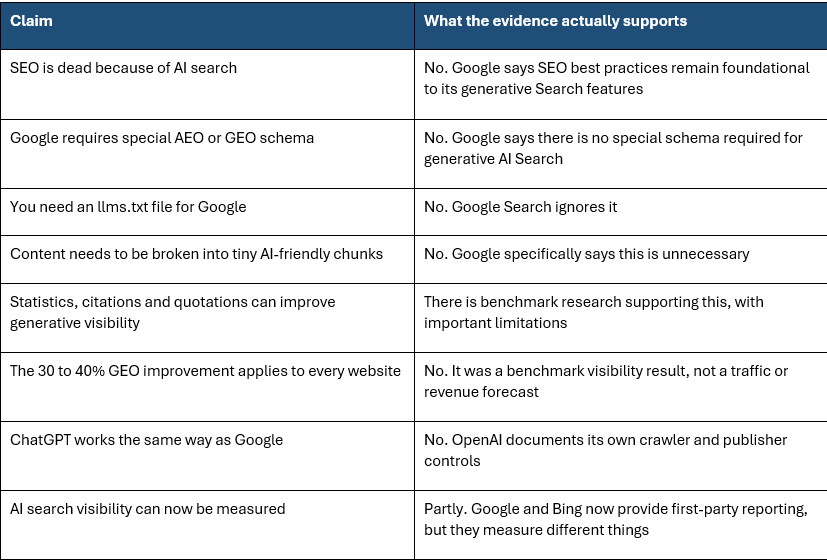
You do not need llms.txt for Google
Google says Search does not use llms.txt files for ranking or visibility, including within its generative AI features.
Google clarified this again in June 2026. Maintaining an llms.txt file for another system is fine, but it will neither improve nor damage Google Search visibility because Google Search ignores it. Google generative AI guide
That is more precise than saying businesses should never create one.
The file may have uses elsewhere.
It is simply not a Google ranking tactic.
You do not need special AI schema
There is no AEO, GEO, AIOverview or similar schema type that makes a page eligible for Google's generative features.
Google still recommends appropriate structured data as part of normal SEO where it accurately represents visible page content and supports relevant Search features.
What Google warns against is assuming structured data provides a separate shortcut into generative answers. Google generative AI guide
You do not need to break every page into tiny chunks
This is another popular recommendation Google addresses directly.
There is no requirement to break content into tiny fragments so Google's AI systems can understand it.
Shorter passages can be useful when they improve clarity for readers. That is different from turning every sentence into its own paragraph or writing unnaturally fragmented content purely for machines. Google generative AI guide
You do not need a page for every possible AI query
Google also says its systems can understand synonyms, related concepts and general meaning. A website does not need a separate page for every conceivable long-tail variation of the same question.
Genuine topical coverage is fine.
Manufacturing large volumes of pages primarily to manipulate search visibility can fall under Google's scaled content abuse policies. Google generative AI guide
That distinction matters.
Coverage is useful when the additional page genuinely serves a different need.
Producing hundreds of near-identical pages because an AI tool generated hundreds of keyword variations is something else entirely.
What Google does recommend
The recommendations are considerably less exotic than many AEO checklists suggest.
Google's 2026 guidance puts particular emphasis on valuable, original and non-commodity content. Google Search Central announcement
That can include first-hand expertise, original research, unique perspectives, useful local information, strong product information, and relevant images or video where those formats improve the answer.
The underlying principle is simple.
Give Google's systems something useful to retrieve.
A generic article assembled from the same ten points already repeated across hundreds of websites has less distinctive information to contribute than a page containing original observations, credible data, specific examples or genuine subject expertise.
Google also introduces early guidance around agentic search, including browser agents and emerging technologies such as the Universal Commerce Protocol. The company presents this as an emerging area to explore when relevant, not as something every local business suddenly needs to implement. Google generative AI guide
Measuring Google AI visibility is no longer guesswork
For a long time, one of the biggest problems with AEO and GEO was measurement.
Businesses could be told they had become "more visible in AI" without having much first-party evidence to check the claim against.
That changed in 2026.
On 3 June, Google began rolling out dedicated Generative AI performance reports in Search Console to a subset of websites. Google says the reporting became available worldwide by 31 August 2026. Google Search Console announcement
The Search report currently shows impressions from supported generative features including AI Overviews and AI Mode, with dimensions such as page, country, device and date. Google Search Console help
There is still an important limitation.
The dedicated Generative AI report centres on impressions. It does not provide the same direct click, CTR and query reporting available in the normal Search performance report.
So the reporting is useful, but it does not yet answer every question a marketer would want answered.
It tells you whether your pages are appearing.
It does not, by itself, tell you the commercial value of those appearances.
What the original GEO research actually found
Outside Google's own ecosystem, the original GEO research remains one of the most frequently cited pieces of evidence in this discussion.
The researchers tested nine interventions applied to existing source content without adding false information. Their evaluation included measures such as Position-Adjusted Word Count and Subjective Impression.
The strongest-performing interventions included Cite Sources, Quotation Addition and Statistics Addition.
The paper reported relative gains of roughly 30 to 40% on Position-Adjusted Word Count for some of these stronger methods, with smaller gains on its broader Subjective Impression measure. The researchers also found that the effectiveness of different GEO methods varied across subject areas.
The paper's overall headline finding was that GEO methods could increase source visibility by up to 40% under its benchmark. Original GEO paper
That is meaningful evidence.
It is also frequently misrepresented.
The study did not show that adding statistics to a website increases:
• organic traffic by 40%
• ChatGPT referral traffic by 40%
• AI Overview citations by 40%
• leads by 40%
• revenue by 40%
Those outcomes were not what the study measured.
It measured visibility within generated responses under its experimental framework.
That distinction matters more than the headline percentage.
Why the GEO findings still matter
The right conclusion is not that the research is irrelevant because it has limitations.
The useful conclusion is that, under the systems and benchmark tested, specific, attributable and well-written information tended to outperform generic or keyword-heavy content.
That is directionally valuable.
It also overlaps with Google's current advice in an interesting way.
The GEO research found benefits from stronger sourcing, statistics, quotations and clearer writing.
Google's current guidance emphasises original, useful and non-commodity content that provides something beyond information already repeated across the web. Google generative AI guide
Neither points towards a magical new technical layer.
Both point, in different ways, towards publishing better information
ChatGPT Search does not use Google's rules
This is where treating "AI search" as one channel becomes misleading.
Google's documentation describes Google.
OpenAI runs its own systems.
For ChatGPT Search, OpenAI's publisher guidance says public websites can potentially appear in search results and recommends allowing OAI-SearchBot if publishers want their content to be discoverable and included in summaries and snippets. OpenAI Publishers and Developers FAQ
OpenAI separately documents GPTBot in relation to potential model-training use.
That means a publisher can make different decisions about appearing in ChatGPT Search and allowing content to be used for potential training. Blocking GPTBot does not mean the publisher must also block OAI-SearchBot.
This is a real technical distinction.
It is more useful than inventing an "AI optimisation score."
OpenAI also says ChatGPT automatically adds utm_source=chatgpt.com to referral URLs, which means traffic from ChatGPT Search can be identified in analytics tools such as GA4. OpenAI Publishers and Developers FAQ
Again, that does not tell you how to guarantee a citation.
OpenAI does not publish a formula for doing that.
But it does give publishers a practical way to control discovery and measure resulting referral traffic.
Bing and Copilot provide a different type of visibility
Microsoft took a different approach to measurement. On 10 February 2026, Bing launched AI Performance in Bing Webmaster Tools as a public preview. Bing Webmaster Blog
The report shows how content is cited across supported AI experiences including Microsoft Copilot, AI-generated summaries in Bing and selected partner integrations.
Its reporting includes:
• total citations
• cited pages
• page-level citation activity
• visibility trends
• grounding queries associated with cited content
Bing is careful about what those numbers mean.
A citation does not represent a click, a ranking or user engagement. Grounding queries are grouped phrases associated with retrieval and citation activity, not necessarily the user's full original prompt. Bing AI Performance help
That distinction is important.
Bing currently provides more citation-level and grounding-query information than Google's dedicated generative AI report, while Google provides its own impression-based visibility reporting.
Neither, on its own, gives a complete picture of what AI visibility means commercially.
AI search is not one search engine
This is probably the most useful distinction for a business trying to make sense of the terminology.
"How do we show up in AI search?" is not really one question.
How do we appear in Google's AI Overviews or AI Mode?
Google's answer is rooted heavily in SEO, Search eligibility, useful content and its existing ranking and quality systems.
How do we appear in ChatGPT Search?
OpenAI has its own crawler controls and does not publish Google's ranking rules.
How do we understand visibility in Copilot or Bing AI answers?
Microsoft provides its own citation and grounding-query reporting.
There is overlap between the sensible practices for all three.
Clear information helps. Strong sourcing helps. Original knowledge helps. Technical accessibility matters.
But there is no evidence that one special schema field, heading format or AI optimisation hack controls all of these systems.
What this means for a Melbourne small business
Not every business is equally exposed to the change.
A plumber in Werribee, a physiotherapy clinic in Point Cook and a professional services firm publishing detailed industry research have very different search journeys.
A large share of traditional local search behaviour is highly transactional.
Someone searching "electrician Werribee", "physio near me" or "emergency plumber Point Cook" may already know what they need and simply want a nearby provider.
Broader questions such as:
• How much should electrical rewiring cost in Melbourne?
• What is the difference between an exercise physiologist and a physiotherapist?
• How does NDIS registration work?
• Which type of Google Ads campaign is best for a local service business?
create a very different information problem.
Those questions are more naturally suited to research, comparison and generated answers.
This does not establish that AI Overviews are unimportant for Melbourne local businesses. We have not identified robust Australian evidence that quantifies AI Overview prevalence or traffic impact across local commercial searches specifically.
It does mean a local business should be careful about abandoning proven local SEO work because someone says "AI is replacing Google."
For a local transactional business, fundamentals such as Google Business Profile optimisation, accurate business information, strong service and location pages, legitimate reviews and technical accessibility still matter.
AI search adds another discovery surface.
It does not make the existing ones disappear.
What is actually worth doing right now
The sensible response is to separate work that should already exist in a good SEO programme from work that generative search makes newly worth checking.
Work that should already be covered
Technical SEO
Make sure important pages are crawlable, indexable, mobile-friendly and technically sound.
Useful content
Answer the actual problem the customer is trying to solve rather than simply repeating a target keyword.
Appropriate structured data
Keep relevant Article, Product, LocalBusiness and other applicable structured data accurate and consistent with what users can actually see on the page. Do not invent AI-specific schema.
Internal linking and information architecture
Important pages should be easy for users and crawlers to discover and understand.
Originality
Give the page a reason to exist beyond summarising what is already available everywhere else.
Work worth adding or prioritising
Check Google Search Console's Generative AI reporting
You can now see whether pages are receiving impressions inside Google's supported generative Search features.
Check Bing Webmaster Tools' AI Performance report
If Bing and Microsoft visibility matter to your business, review cited pages, citation trends and grounding-query data rather than relying entirely on a third-party visibility score.
Check OAI-SearchBot access
If you want public pages discoverable in ChatGPT Search, make sure OAI-SearchBot is not unintentionally blocked by robots.txt or security tooling.
Add information worth citing
Replace vague claims with verifiable facts, original observations, statistics, named sources or expert commentary where they genuinely improve the page.
Make important information easy to locate
Use descriptive headings, coherent sections, comparison tables and clear topic sentences where they help the reader. That does not mean turning the article into sixty one-line paragraphs.
Build genuine subject depth
A connected body of useful content around a topic is more defensible than producing one thin page for every keyword variation an SEO tool exports.
Measure business outcomes
AI impressions and citations are interesting. Leads, bookings, sales and revenue are more important.
What we would be cautious about
Buying an AEO audit that is simply an SEO audit renamed
There is nothing wrong with an SEO audit.
There is something questionable about charging a premium because the same technical crawl has been relabelled "AI Search Readiness."
Ask what the service does differently.
Useful additional work might include crawler-access checks across relevant AI systems, Google and Bing first-party AI reporting, citation analysis, source quality, original-evidence auditing or measurement of AI referral traffic.
If the answer is simply "we add schema and rewrite your headings as questions," keep asking
Creating llms.txt because you think Google requires it
Google says it does not.
Maintaining the file for another platform or use case is fine. Presenting it as a Google AI ranking tactic is not.
Treating the GEO 30 to 40% result as a forecast
It is a benchmark result.
It is not a forecast for your website.
If somebody promises a comparable traffic increase because they will "apply GEO", ask what evidence connects their work to that commercial outcome.
Producing hundreds of pages for imagined AI questions
Google specifically rejects the idea that you need to capture every wording variation of a query and warns against scaled content created primarily to manipulate Search.
Depth is useful.
Volume for its own sake is not.
Treating AI citations as the end goal
A citation can create visibility.
It can also create no customer action at all.
Measure what happens after the citation.
Three practical questions businesses still ask
Do I need an llms.txt file?
Not for Google.
Google says Search ignores llms.txt, so creating one will not improve standard rankings or generative AI visibility in Google. Maintaining one for another system is fine if there is a genuine reason to do so. Google Search updates
Can I actually measure whether my content appears in AI search?
Increasingly, yes, but the measurement is fragmented.
Google Search Console now provides impression-based Generative AI performance reporting for AI Overviews and AI Mode.
Bing Webmaster Tools provides citation and grounding-query data across supported Microsoft AI experiences.
OpenAI adds utm_source=chatgpt.com to ChatGPT referrals, allowing resulting traffic to be identified in analytics.
No single dashboard gives you a complete cross-platform view.
Does ChatGPT use Google rankings to choose what it cites?
OpenAI does not describe ChatGPT Search as simply reproducing Google's organic rankings.
It documents its own search crawler, OAI-SearchBot, and its own publisher controls.
That means a site's performance in Google and its discoverability in ChatGPT Search should not be treated as the same measurement problem. OpenAI Publishers and Developers FAQ
Westend Digital is a Melbourne-based digital marketing agency working with small and medium-sized businesses across trades, healthcare, professional services, and hospitality. If you are setting a budget for your next ad campaign and want a second opinion before you commit, reply to The Westend Brief or visit westenddigital.com.au.