
Facebook Leads Not Booking Appointments? What to Fix
The campaign report looks fine. Forty leads. Twenty-five dollars each. You could show that to your accountant without flinching.
Then you open your calendar on Friday and count six appointments that actually happened.
The form worked and your team was busy. Yet somewhere between the form and the appointment, most leads went quiet, and Ads Manager cannot show you why.
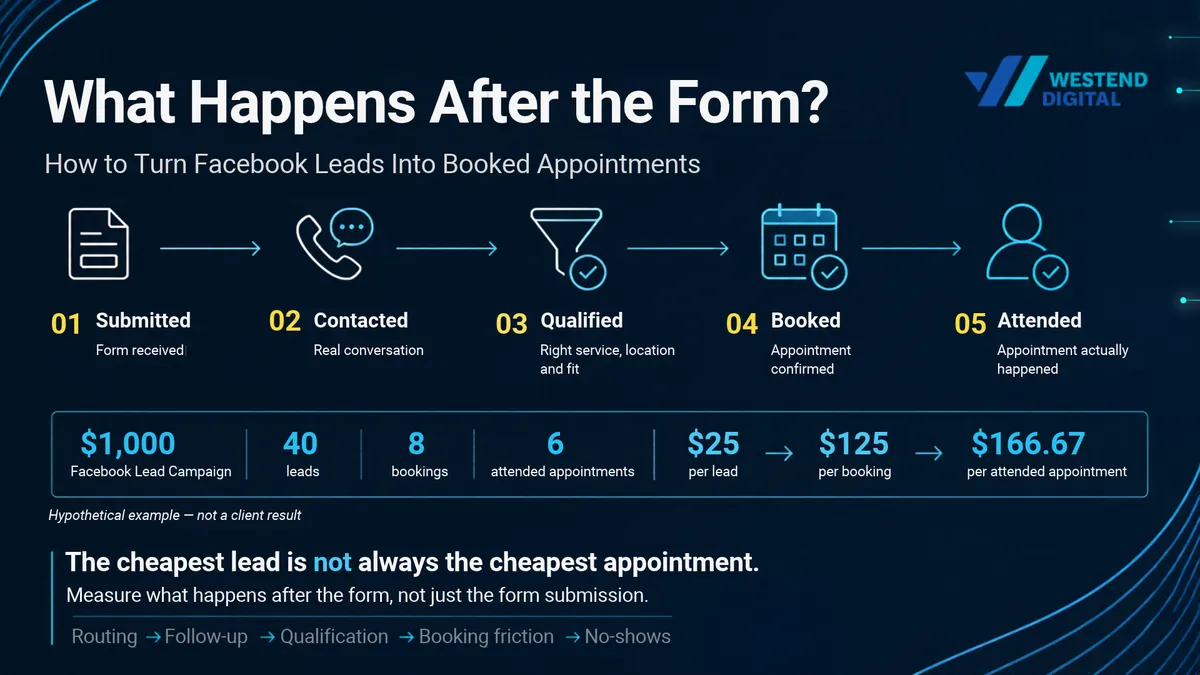
That gap is what this article tackles. Our earlier piece explains why an unanswered call is not automatically a bad lead. Here, we follow the enquiry through contact, qualification, booking and attendance, then calculate what each appointment costs.
Why are Facebook leads not turning into booked appointments?
Facebook leads often fail to become booked appointments because the form submission is treated as the finish line. The enquiry may sit in an inbox, go to the wrong person, attract someone outside your service area, involve too many booking steps, or never receive a clear confirmation and reminder.
To fix it, track five stages: submitted, contacted, qualified, booked and attended. Give each stage an owner and a follow-up target. Then calculate cost per booked appointment (ad spend ÷ confirmed bookings) and find the biggest drop-off before changing your Facebook ads.
What are the five stages after a Facebook lead form?
A “lead” means different things across teams. Agree on the stages before you measure performance.
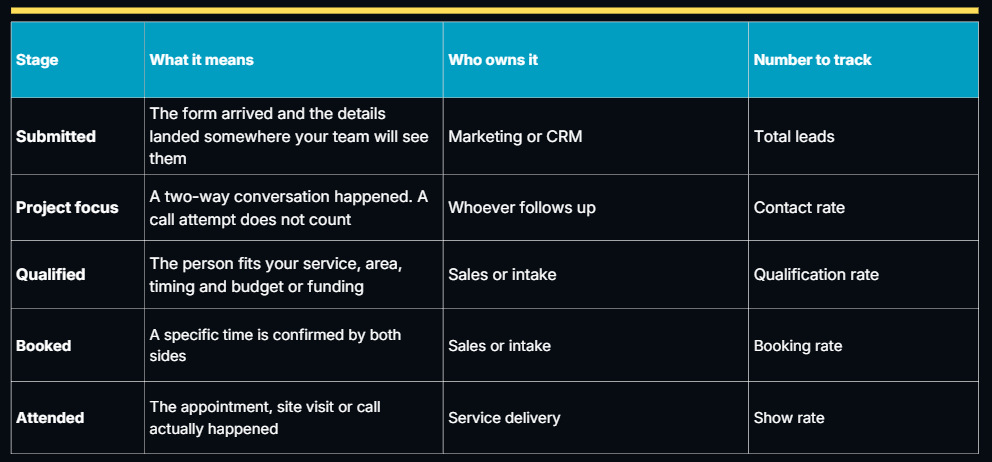
For a plumber, an appointment may be a site visit; for a clinic, a consultation; for an NDIS provider, an intake call. Define the outcome before you count it.
Separate “we tried” from “we spoke”. Thirty attempted calls and twelve conversations are different outcomes, but many reports blur them together.
How do you calculate cost per booked appointment?
Cost per booked appointment = ad spend ÷ booked appointments.
Also calculate cost per attended appointment: ad spend ÷ appointments that happened. For a fully loaded figure, include management fees and software, consistently each month.
Here is a hypothetical account spending $1,000 in a month:
Hypothetical example: $1,000 Facebook lead campaign
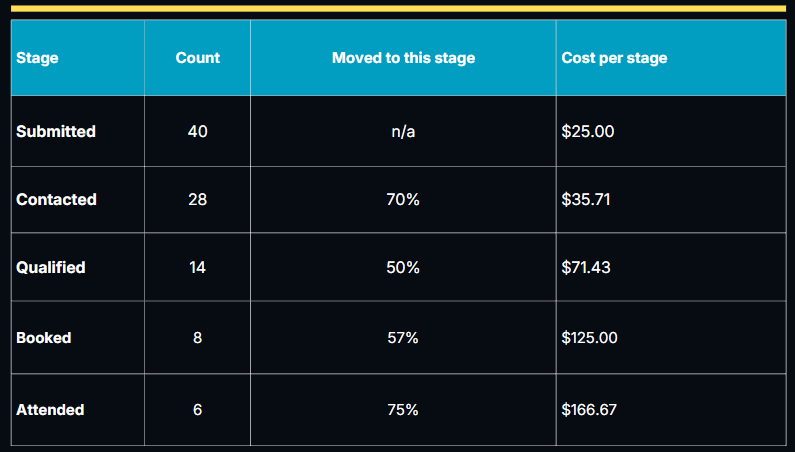
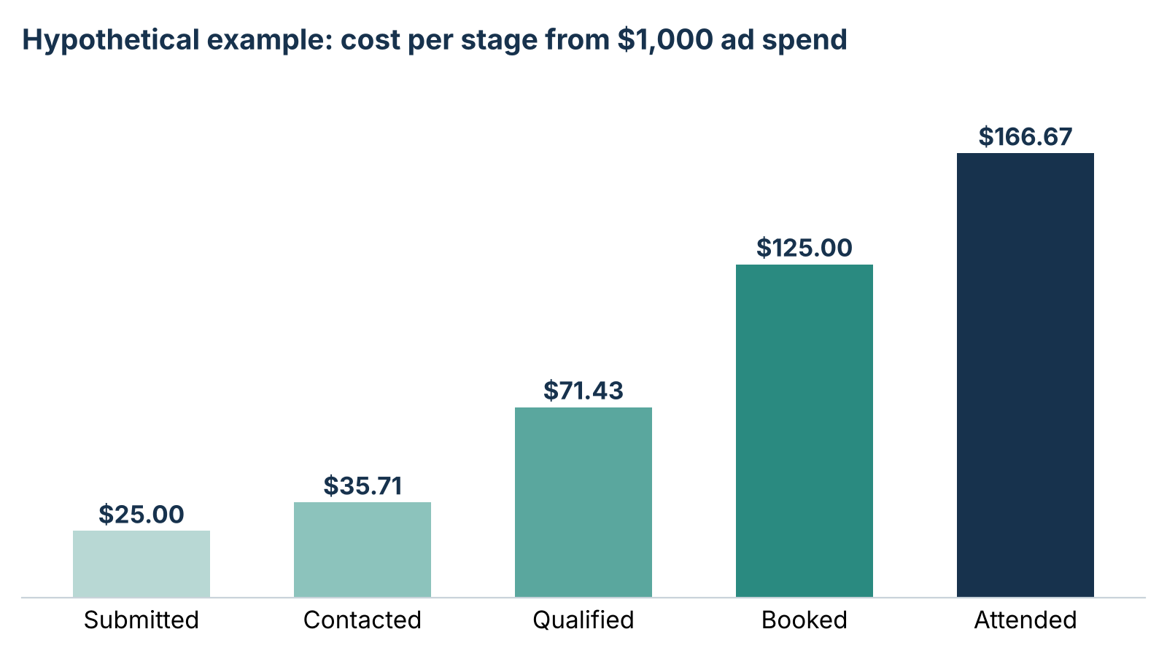
The $25 lead becomes a $167 attended appointment. One extra attendee would lower that to about $143. Achieving the same outcome through cheaper leads alone would require roughly 47 leads for the same $1,000, or $21 per lead. The cheapest improvement may be outside Ads Manager.
Cheap leads do not always mean cheap bookings. Campaign A costs $20 per lead and books 5%, or $400 per appointment. Campaign B costs $40 per lead and books 20%, or $200 per appointment. Our article on marketing numbers explains why the right metric matters.
Eight bookings is a small sample: one cancellation shifts the rate by more than 10 percentage points. Look for patterns across a few months before you rebuild anything.
From submitted to contacted: where does the lead actually go?
Before changing scripts or speed targets, check routing. Can a form sit unseen in an export or shared inbox? If someone must remember to download leads, eventually one will be missed.
A good agency flags the issue and recommends legal review before launching an offer.
A workable setup answers four questions:
• Where does each lead land, and does it keep the campaign, ad and form it came from?
• Who gets alerted, and who covers them on leave or on site?
• What is your first-contact target during business hours?
• What happens when a form arrives at 9pm on a Saturday?
Follow-up speed is widely treated as important, but older US research won’t tell you what happens with your own Facebook leads. Measure your contact rate by response-time band.
From contacted to qualified: what should you find out first?
Qualification keeps the calendar useful. Ask four things:
• Do we offer what you need?
• Are you in our service area?
• When are you hoping to get this sorted?
• Is the likely cost or funding arrangement workable for you?
Record why someone stops: wrong service or area, not ready, price or funding, no longer needed, or spam. Patterns beat vague claims that “leads have been bad lately”.
Those reasons point to fixes. Wrong area suggests targeting or form settings; confusion suggests unclear ad copy; not ready suggests a later follow-up, if they’ve agreed to hear from you. For health or disability enquiries, collect only what you need. Our NDIS growth guide explains why.
For Melbourne businesses: qualify by location and availability
For mobile trades and clinics, interest does not always mean availability. A lead may live outside your service radius, need another clinic location or be free only when your calendar is full. Track these separately from “could not contact” and “not interested”.
A hypothetical trades business serving Melbourne’s west should distinguish local enquiries from those across the city. That is a qualification and capacity issue, not automatic proof Meta sent a poor lead.
What is booking friction, and how do you reduce it?
Booking friction is anything that makes it harder to confirm a time:
• The enquiry ends with "give us a call back".
• Three days of text messages go back and forth over one time slot.
• A booking link arrives with no explanation of what the appointment involves.
• The next available time is weeks away.
• The person has to re-enter details they already gave you.
In a Mayo Clinic study of well-child appointments, 93.1% of self-scheduled visits were finalised in one step; 28.32% of staff-scheduled visits needed multiple steps. Almost 30% of self-scheduling happened outside normal hours.
But evidence on whether online booking improves attendance is mixed:
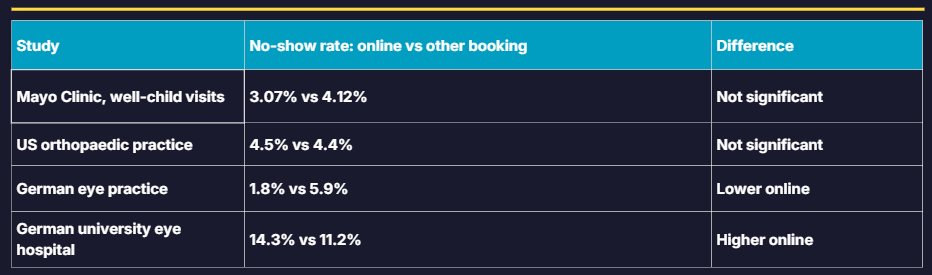
Treat self-booking as a convenience tool and judge it by your own results. One orthopaedic study found that new patients booked by staff were more likely to progress to surgery. That does not prove calls qualify better, but it is worth testing whether a conversation helps for higher-value appointments.
A practical rule of thumb:
• Simple, low-risk appointment? Let qualified people book themselves straight away.
• Considered or high-value decision? Have a short conversation, then offer two specific times.
• Need a mix? Ask one or two qualifying questions, then send the booking link only to people who fit.
How do you get more booked appointments to actually attend?
A Cochrane review of eight randomised trials (6,615 participants) found attendance of 67.8% without reminders, 78.6% with texts and 80.3% with calls. Texts cost less in the studies that measured cost.
The review was from 2013, covered healthcare, and rated the evidence low to moderate quality. It supports testing reminders, not assuming one approach will work for every business.
A simple attendance sequence looks like this:
1. Confirm straight away. Include the date, time, location or call details, and who they will meet.
2. Set expectations. Tell them what to bring, how long it takes and what happens next.
3. Send a reminder. Test the timing. We could not find strong evidence for one perfect schedule across industries.
4. Make rescheduling easy. A person who can move a booking in one tap is less likely to simply disappear.
5. Follow up no-shows the same day. Keep it friendly. People do get stuck in traffic and forget.
Keep appointment reminders factual. ACMA’s January to March 2026 report shows that messages with promotions can have a commercial purpose even when most content is factual. Purely factual messages still need accurate sender details, as ACMA’s formal warning explains. Commercial messages generally require consent, sender identification and a working unsubscribe. An enquiry does not automatically authorise marketing follow-ups. Avoid sensitive details in texts and seek advice if uncertain.
What should your CRM integration actually do?
Track a stage, owner and next action for every lead. A spreadsheet may be enough at low volume. Once leads start slipping through, a connected CRM earns its keep.
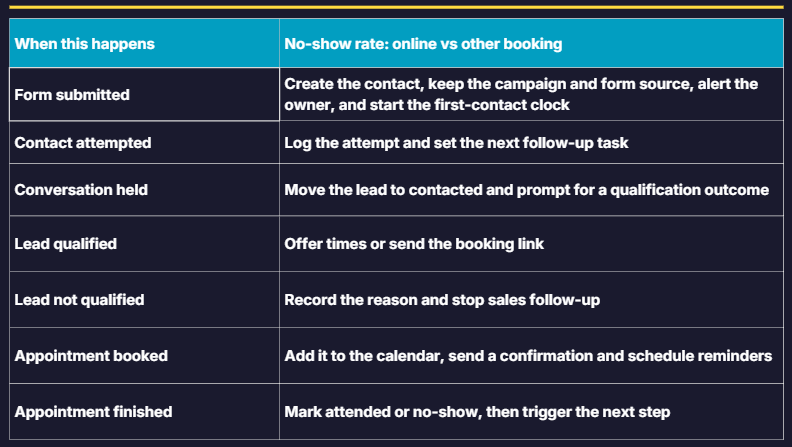
HighLevel, for example, can sync Facebook lead forms and trigger workflows. HubSpot and ActiveCampaign offer similar options. Before launch, submit test leads and check every path, including wrong numbers and no-shows.
If you need to connect forms, follow-up and reminders, that is where marketing automation helps. The goal is simple: fewer enquiries disappearing before a real conversation.
Automation supports, but cannot replace, the human conversation. An instant acknowledgement is useful; it cannot judge whether a service is the right fit.
Can your CRM tell Meta which leads were any good?
Meta can optimise for form submissions, but it does not automatically know whether a lead was contacted, qualified or booked.
A connected CRM can send each stage to Meta through Conversions API for CRM, including the original lead. Meta asks advertisers to send updates as stages change. With the Conversion Leads goal, Meta can use those signals to optimise towards later-stage outcomes.
That is stage feedback, not a verdict on the person.
This will not suit every account. At the time of writing, Meta’s documentation points to 200 leads a month, with at least 60% of leads matched to uploaded events. The stage you optimise for should sit between 1% and 40% and occur within 28 days. These requirements can change, so confirm them in Meta’s current documentation before you plan around them. See also the Conversions API for CRM guide.
With lower volumes, compare cost per booked appointment by campaign, form and ad in your CRM. That may be more useful than an integration without enough data to support optimisation.
For health and disability services, use neutral CRM stage labels such as “Booked”. Do not include diagnoses or sensitive service needs in event names.
Where are your leads dropping off?
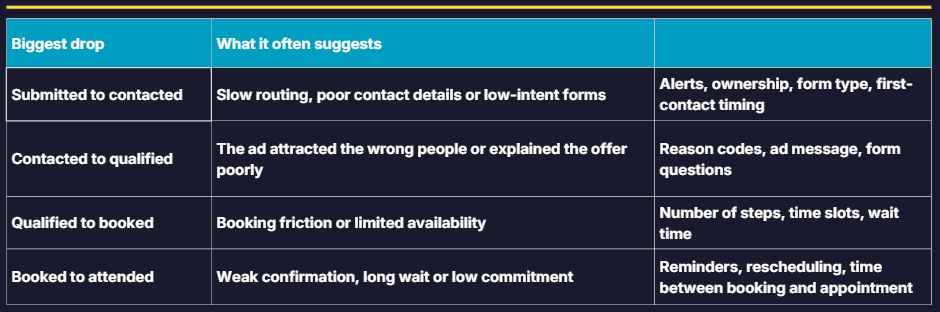
Start with the biggest drop-off; the table shows where to investigate.
Common mistakes that hide the real problem
• Counting a call attempt as contact. Your contact rate will look healthier than it is.
• Sending a booking link to everyone. You may fill the calendar with people who were never a fit.
• Judging campaigns on cost per lead alone. Cheap leads can become expensive appointments.
• Never updating stages. A CRM with old data gives you false confidence, and the same data can mislead Meta if you share it.
• Letting automation send everything. Fast is useful. Robotic is not, especially in sensitive services.
• Changing the ad before reading the funnel. You could be fixing the one stage that was working.
Your action checklist
Quick fixes you can do this week
• Write down what each of the five stages means in your business.
• Name one owner for every stage.
• Split "attempted" from "contacted" in your tracking.
• Review your last 30 leads and add a reason to each lost one.
• Write a plain booking confirmation and a reminder.
• Calculate your cost per booked and cost per attended appointment.
Real work that takes more time
• Connect your lead forms to a CRM and test each branch.
• Build a pipeline, alerts, follow-up tasks and reminders.
• Check consent, privacy and message wording for your industry.
• Report on stages by campaign, form and ad.
• Assess whether you have the volume for Conversions API for CRM.
Frequently asked questions
What is a good lead-to-appointment rate?
We could not find a reliable Australian benchmark that covers small service businesses, and rates will vary with the offer, industry and form type. Use your own last three months as the baseline, then aim to improve the weakest stage.
Should I use a Facebook instant form or a landing page?
Test both if you have the budget and judge them on cost per booked or attended appointment. A form with a higher cost per lead can still produce cheaper appointments.
Do I need a CRM to track booked appointments?
Not at the start. A carefully kept spreadsheet can work for a small number of leads. A CRM becomes more useful when several people handle enquiries, or when leads are being missed.
Do appointment reminder texts need consent in Australia?
It depends on the message. A factual reminder can be treated differently from marketing SMS, but it still needs accurate sender details (see ACMA’s formal warning). Adding a promotion or promotional link may make it commercial, triggering consent, sender-identification and unsubscribe rules. See ACMA’s spam guidance. This is general information, not legal advice.
Can Meta optimise for booked appointments?
It can optimise towards a CRM stage you define if your account meets Meta's requirements, including lead volume and a suitable conversion rate. A booked stage may fit, but that depends on your numbers.
How long should I track before making a decision?
Base it on evidence more than a set number of days. A busy account may tell you something within weeks, while a smaller one may need a few months. Fix anything clearly broken straight away.
How quickly should I follow up a Facebook lead?
Set a realistic first-contact target during staffed hours, assign an owner, and acknowledge after-hours enquiries with a clear expectation of when a person will respond. Then compare contact and booking rates by response-time band. There is no universal “five-minute rule” that guarantees an appointment.
Why are my Facebook leads cheap but not converting?
A low cost per lead measures the form submission, not whether someone fits your service or books. Check contact rate, qualification reasons, available appointment times and attendance before deciding the ad is successful or unsuccessful. A more expensive lead can still produce a cheaper booked appointment.
The number that changes the conversation
Forty leads sounds like success. Six attended appointments tells you what actually happened, and it gives you something specific to fix.
Start by defining the five stages, tracking one month and calculating cost per booking. Once you know where people stop, the next decision gets easier.
If Facebook leads are not becoming appointments, our Melbourne marketing automation team can review the journey from your Facebook and Instagram ads through to attendance. We work with businesses across Australia, without lock-in contracts. Every channel still needs time to collect data, and we agree reporting and review points upfront. Book a free strategy conversation to see where we would start.
Westend Digital is a Melbourne-based digital marketing agency working with small and medium-sized businesses across trades, healthcare, professional services, and hospitality. If you are setting a budget for your next ad campaign and want a second opinion before you commit, reply to The Westend Brief or visit westenddigital.com.au.