Why Some Meta Ads Campaigns Struggle Before They Even Launch
Sometimes you look at a Meta Ads campaign before it goes live and feel confident about it.
Other times, something does not quite sit right.
It is rarely one obvious mistake. The targeting looks reasonable. The budget is modest but workable. The offer is real.
What bothers you is usually a collection of small compromises.
One fewer creative than planned. A shorter testing window than you would like. Then a targeting change after a slow first week. A new creative shortly after that. Eventually, perhaps even a different product.
At some point, you are no longer optimising one campaign.
You are running a series of unfinished experiments, and none of them gets far enough to tell you much.
This is the story of one of those campaigns.
It was a short Meta Ads engagement with an Australian mortgage-broking business. The campaign did not perform well, and some of the responsibility sits with us.
More importantly, it taught us something about what media buyers sometimes describe as "gut feeling".
The short answer: what went wrong?
The biggest problem was not one bad audience, one weak creative or one expensive lead.
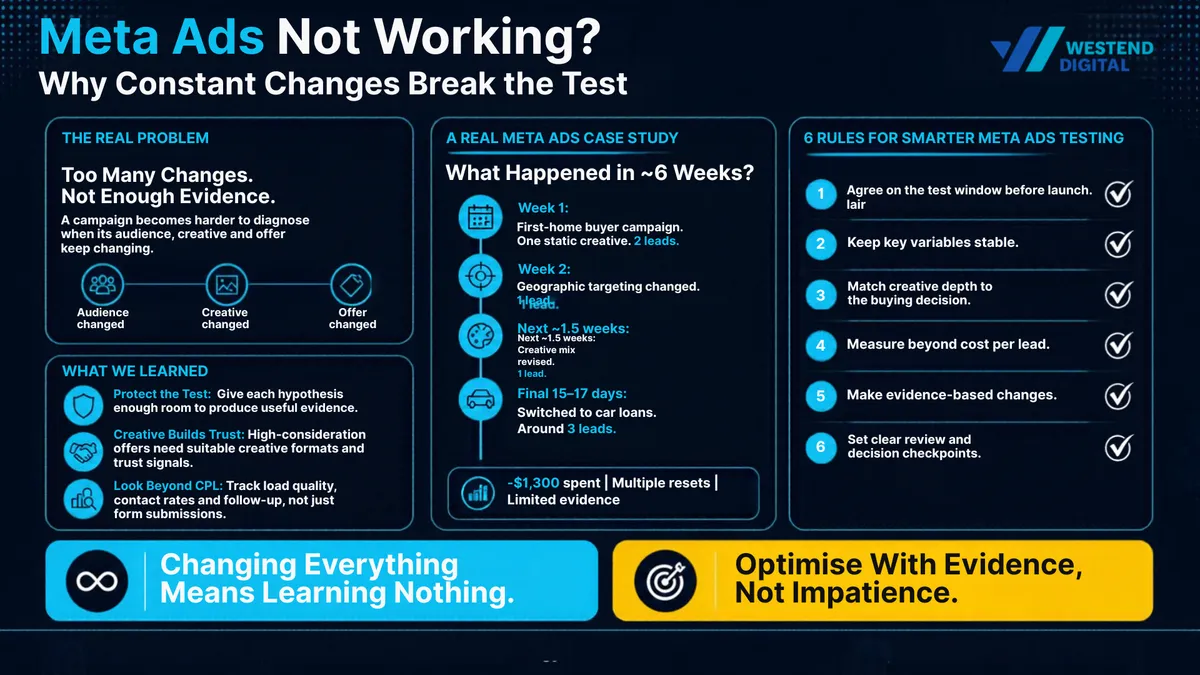
Too many important variables changed before we had enough evidence to understand which variable was causing the problem.
The audience changed. The creative changed. The format mix changed. Eventually, the product changed from home loans to car loans.
Every individual decision had a reason behind it.
Together, they made the campaign increasingly difficult to diagnose.
That distinction matters because there are really two kinds of learning happening in a Meta campaign: Meta's delivery system is learning how to distribute the ads, while the marketer and the business are trying to learn whether the audience, offer, creative and conversion process actually work.
You need to protect both.
Why did this Meta Ads campaign struggle?
A few months ago, we took on a short-term Meta Ads engagement with an Australian mortgage-broking business.
The company was already generating business through other channels. Meta was not a survival strategy. They wanted to test paid social again after earlier experiences with other agencies had left them underwhelmed.
The planned budget was approximately $900 per month.
The first campaign targeted first-home buyers using Meta instant forms. Someone could submit their details within Facebook or Instagram rather than visiting a separate landing page.
Our original creative plan included a static poster and a testimonial video.
Just before launch, the video was removed to avoid the production cost.
That was a reasonable commercial decision. We agreed to proceed.
But it was also the moment when I became less comfortable with the campaign.
Not because a missing video guarantees failure. It does not, and we will never know what that particular video would have done.
The concern was that we were asking one static image to carry a high-consideration financial decision almost entirely by itself.
What happened
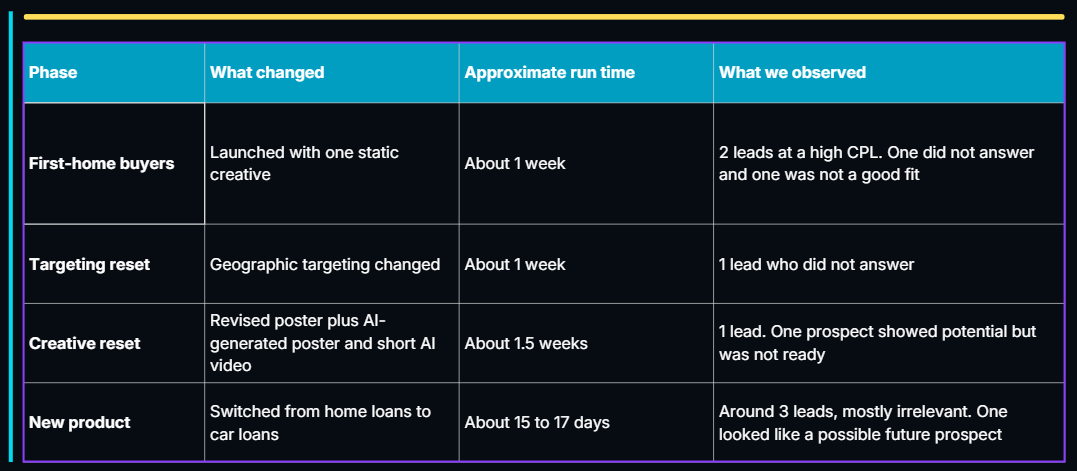
The car-loan campaign was switched off at the client's request during its third week.
Total spend across the engagement was roughly $1,300, below the amount originally available because neither campaign completed its intended run.
Those are very small numbers.
That is important.
We should not pretend a handful of leads proves a broad principle about mortgage advertising.
What the campaign does show is how quickly a small dataset becomes difficult to interpret when the conditions producing it keep changing.
What happens when you change Meta Ads too often?
Changing something in a struggling campaign is not inherently wrong.
The problem appears when several major variables change before the previous version has produced enough evidence to evaluate.
In roughly six weeks, this campaign changed its audience definition, creative mix and eventually the product being advertised.
After the targeting changed, the first week's results no longer described the campaign we were currently running.
After the creative changed, the next set of results described another version.
Once the product moved from home loans to car loans, we were effectively answering a different marketing question altogether.
By then we could no longer confidently answer:
Was the problem the audience, the message, the creative format, the offer, the lead form or what happened after the enquiry?
That is the cost of reactive optimisation.
It does not just affect performance.
It reduces what the campaign can teach you.
Meta's learning phase is not the same as learning from a campaign
Meta uses the term learning phase for the period when its delivery system is working out how best to distribute an ad set.
Its published guidance has commonly used roughly 50 optimisation events within a seven-day period as the benchmark for leaving learning, and significant edits can cause the system to re-enter that process.
But the practical behaviour is not always as mechanical as advertisers sometimes assume.
Practitioner testing has shown that changes Meta has historically described as significant do not always visibly send an ad set back into Learning. Jon Loomer, for example, documented adding a new ad to an active ad set without the learning label returning.
So I would not build this lesson around being frightened of Meta's status label.
The bigger distinction is this:
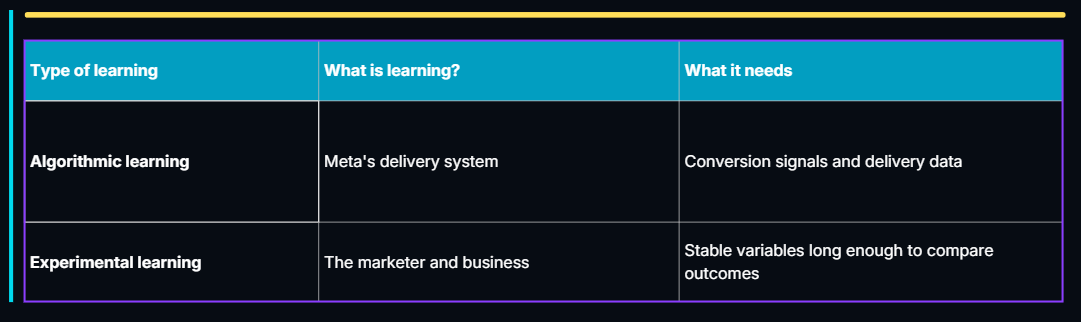
Our mortgage campaign was producing only a few leads.
It was never realistically going to generate the sort of weekly conversion volume associated with Meta's traditional learning benchmark.
But that did not mean learning was impossible.
It meant the learning we most needed to protect was our own.
Could the audience work?
Could the creative establish enough trust?
Could the offer generate the right type of enquiry?
Could the business turn those enquiries into conversations?
Those questions still needed stable conditions.
Why do high-consideration Meta Ads need more creative depth?
A home loan is not an impulse purchase.
Someone seeing a mortgage ad may still be months away from buying. They may not know their borrowing capacity. They may be comparing banks and brokers. They may already be speaking with their bank. They may also be reluctant to give financial details to a business they have never heard of.
One static poster was carrying a lot of responsibility.
The testimonial video we had originally planned could have introduced something the poster could not: another person, a recognisable situation, more context and an additional trust signal.
It also would have given the campaign a second creative format to evaluate.
We cannot claim that the video would have fixed the campaign.
We can say that removing it reduced the range of persuasion available at a point where the buying decision already required considerable trust.
That is a principle we carry into other campaigns now.
The more difficult the buying decision, the more work the creative usually needs to do.
Are poor leads always poor Meta leads?
Several leads from the campaign did not answer their phones.
It is tempting to treat that as proof that Meta produced bad leads.
Sometimes it does.
But instant forms deliberately reduce friction. The easier a form is to complete, the lower the commitment required to submit it.
For a mortgage, somebody who completes a form on Sunday evening may not necessarily be ready to have a serious financial conversation on Monday morning.
They may still become relevant weeks or months later.
That means lead generation cannot be evaluated only at the point where Meta records the form submission.
There also needs to be a system behind it: timely contact, more than one follow-up attempt, appropriate SMS or email communication, and a longer nurture path for people who are interested but not yet ready.
We are not saying the follow-up in this campaign was poor. We do not have enough evidence to make that claim.
The lesson is narrower:
One unanswered call is not enough evidence to declare a lead worthless.
And cost per lead is not the same thing as cost per qualified customer.
When does an optimisation become a new campaign?
Moving from home loans to car loans was not really an optimisation.
It was a new hypothesis.
The customer intent was different. The buying process was different. The economics were different. The qualification criteria were different. The competition and messaging were different.
After several creative rounds, the client produced a car-loan poster using ChatGPT.
The creative looked reasonable, so we used it.
But that campaign then received only around two and a half weeks before it was stopped.
A disappointing result for home-loan leads tells you very little about whether car-loan advertising can work.
The second campaign inherited the impatience created by the first campaign, even though it was answering a different question.
Where did we get it wrong?
It would be easy to turn this into a story about a client repeatedly changing the campaign.
That would be unfair.
Their concern was rational.
They were spending money. The early leads were not converting. Previous agency experiences had given them little reason to wait patiently while someone told them the algorithm needed more time.
Our responsibility was to give that concern a structure.
We did not do that firmly enough.
We lost confidence in our own testing plan and began reacting alongside the client.
Instead of defining in advance what would justify a change, we were deciding what to change after disappointing results appeared.
That is the mistake I would correct first if we ran the engagement again.
Trust should be earned before the campaign starts
None of this means a business should blindly trust an agency or freelancer with its advertising budget.
Paid advertising is an investment. Before approving a campaign, the business should understand the strategy well enough to ask why the platform is being used, what the risks and limitations are, what budget is required to test the idea properly, what success will be measured against, and what would justify changing direction.
The agency has a responsibility to explain those things clearly.
But once the strategy has been questioned, understood and agreed, the testing process also needs some protection. If every disappointing result leads to a different audience, creative or offer before enough evidence has accumulated, the business may reduce its risk emotionally while increasing it analytically.
The healthier relationship is not blind trust. It is informed trust: clear reasoning before launch, agreed checkpoints during the campaign, and changes made because the evidence justifies them.
How should a Meta Ads test be set up before launch?
For a small-budget campaign, we would now agree six things before the first dollar is spent:
1. Protect the test window
Agree how long the initial setup should run and what evidence would justify ending it early.
2. Decide which variables will stay fixed.
If audience, creative, offer and conversion process all move together, attribution becomes almost impossible.
3. Match creative depth to the buying decision
A mortgage lead and a low-cost event ticket should not begin with the same creative expectations.
4. Measure beyond the platform lead.
Track contact rate, follow-up, qualification and eventual outcomes, not only CPL.
5. Change deliberately
Every meaningful change should answer a question. If the only reason for the change is that everyone feels uncomfortable, the test probably needs more thought.
6. Agree the decision process
Before launch, decide when performance will be reviewed, who makes the final call on major changes, and what evidence is required before changing audience, creative, offer or objective.
None of this means leaving an obviously broken campaign running.
Bad tracking should be fixed immediately.
A rejected or misleading ad should be fixed immediately.
A broken form or landing page should be fixed immediately.
The point is not never change.
The point is know what you are changing and what the change is supposed to teach you.
How long should you let Meta Ads run before changing them?
There is no responsible universal answer such as "seven days" or "14 days".
The right test window depends on the daily budget, expected cost per result, conversion volume, buying cycle and how serious the observed problem is.
To take a hypothetical example, a campaign spending $500 per day can collect evidence much faster than one spending $30 per day.
Likewise, an ecommerce purchase happens on a different timeline from a mortgage enquiry.
Before launch, estimate how many meaningful outcomes the budget can realistically generate.
Then define the test around evidence, not simply elapsed time.
The exception is when you discover something clearly broken, such as tracking failure, an incorrect offer, a non-functioning form, a policy issue or creative that is obviously misleading.
Those problems should not be preserved in the name of testing discipline.
Why did a smaller event campaign give us cleaner evidence?
The contrast became much clearer in a recent Meta campaign promoting tickets for a business networking event in Victoria's Bangladeshi business community.
The budget was also small.
But the structure was much simpler.
There was one objective, one event, one ticket price, one ad set, two creative formats and a fixed campaign period.
Purchase tracking was in place from the beginning.
Once the campaign went live, we largely left the structure alone.
Confirmed ticket purchases began coming through before the full budget had been spent, and we could see a clear performance difference between the vertical video and static creative without rebuilding the campaign to find it.
We are not using that campaign to claim that event advertising works and mortgage advertising does not.
The buying decisions are completely different.
The useful comparison is the testing environment.
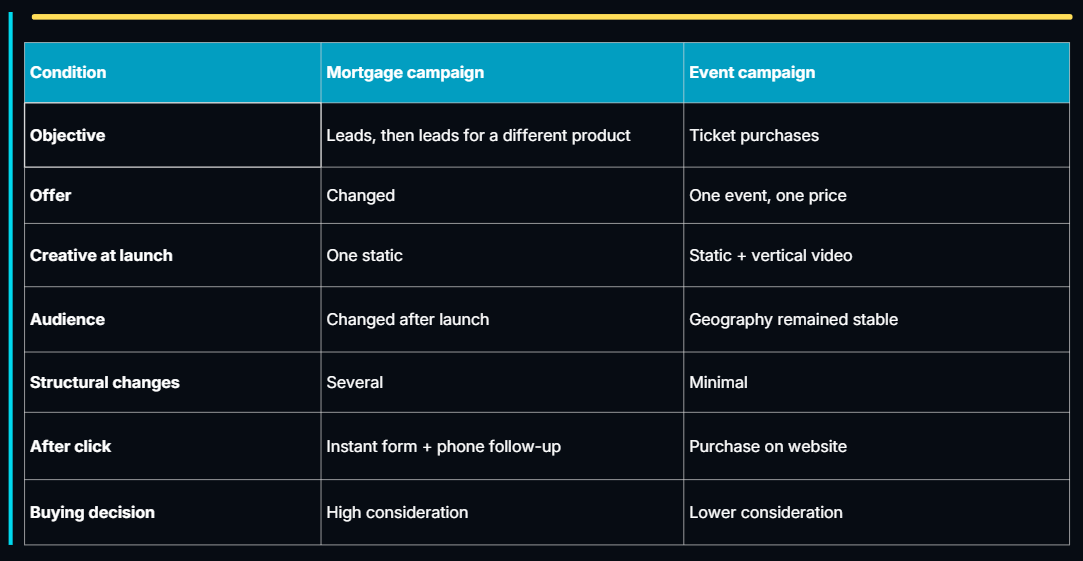
One campaign kept changing what it was testing.
The other created cleaner conditions for evidence to accumulate.
What media buyers call "gut feeling" is usually pattern recognition
Before launch, the mortgage campaign made me uneasy.
The event campaign did not.
That was not a prediction that one would fail and the other would succeed.
Experienced marketers cannot predict campaign results with certainty.
What experience does provide is familiarity with conditions.
Thin creative, a high-consideration offer, limited trust signals, a small budget, a short runway and an uncertain conversion process create a different risk profile from a campaign with one clear offer, suitable creative, measurable conversion and stable testing conditions.
Sometimes "gut feeling" is simply pattern recognition happening faster than you can explain it.
Experience does not tell you the future. It helps you recognise when a campaign has been given the conditions to succeed, fail, or at least teach you something useful.
Frequently asked questions
Does changing a Meta ad reset the learning phase?
Meta documents certain changes as significant edits that can send an ad set back into learning, including changes to targeting, creative and optimisation settings. However, real-world behaviour is not always perfectly reflected by the visible Learning label, so the more useful principle is to avoid unnecessary changes that make performance harder to interpret.How long should I wait before changing a Meta Ads campaign?
There is no fixed number of days that works for every campaign. Base the decision on budget, expected cost per result, conversion volume and the question you are testing. Define the decision criteria before launch wherever possible.Is a high cost per lead enough reason to stop a campaign?
Not by itself. Look at lead quality, conversion volume, contact rate, sales follow-up and how much data the campaign has actually produced. A high CPL may indicate a problem, but with only a few results it may not tell you which part of the campaign is responsible.How many creatives should a small Meta campaign have?
There is no universal number. The goal is to provide enough meaningful variation to test different formats or messages without spreading a small budget across so many ads that none collects useful data.
Coming in Part 2
The event campaign mentioned above is being run under very different conditions: one offer, one ad set, two creatives and one clear conversion objective.
Once it finishes, Part 2 will look at the actual numbers, including spend, confirmed ticket sales, cost per sale, revenue, video versus static performance and where Meta's reporting did or did not match the ticketing data.
That will let us move from testing principles to a real campaign outcome.
If your Meta campaign keeps changing direction
If your campaign has been edited so many times that you are no longer sure what the data is telling you, another optimisation may not be the first thing you need.
Start by clarifying what you are trying to learn, which variables should stay fixed and what evidence would justify the next change.
At Westend Digital, that is how we approach paid media strategy: not 'trust us and wait', but clear hypotheses, agreed testing conditions and decisions backed by evidence.
Book a paid media review and we can look at what should stay, what should change and whether the campaign has actually had a fair test.
Westend Digital is a Melbourne-based digital marketing agency working with small and medium-sized businesses across trades, healthcare, professional services, and hospitality. If you are setting a budget for your next ad campaign and want a second opinion before you commit, reply to The Westend Brief or visit westenddigital.com.au.