
HVAC MARKETING
Google Ads for HVAC Companies That Turn Demand Into Booked Jobs

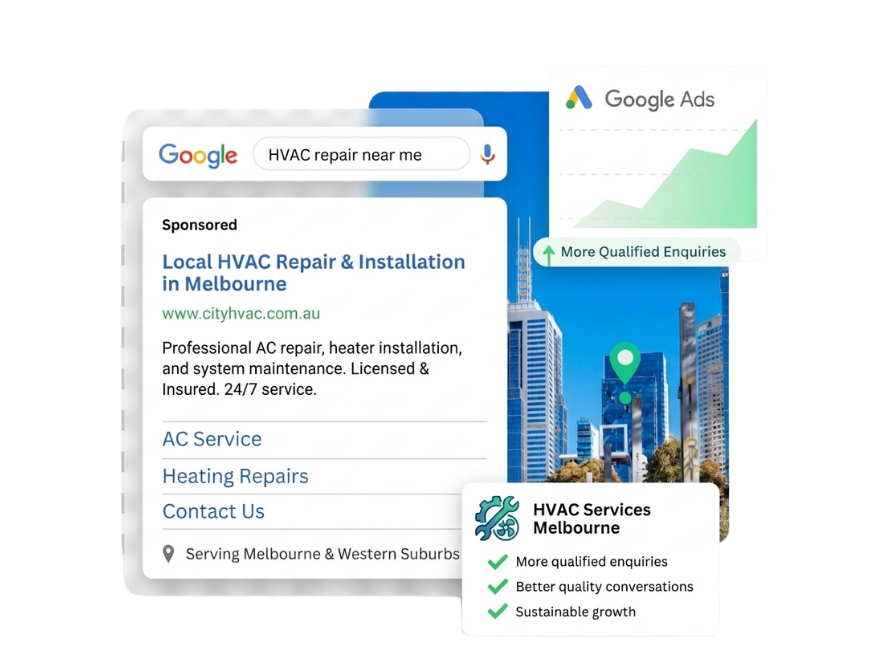
When a split system stops cooling on a hot day, customers do not casually browse. They search for an available heating and cooling specialist. Westend Digital builds Google Ads campaigns that separate urgent repairs, high-value installations and recurring maintenance enquiries - so the right lead reaches the right offer in the suburbs you can profitably service.
A broken air conditioner, a ducted-system replacement and a commercial maintenance enquiry should never be treated as the same lead. Each has different urgency, value, decision time and follow-up requirements. Effective Google Ads for HVAC businesses separates these journeys before budget is spent.
No lock-in contracts. No jargon-filled reports. No claims we cannot back up.
How HVAC Customers Actually Search
HVAC demand typically falls into four distinct search journeys. Campaigns should reflect those journeys instead of sending every click to one generic page.
Urgent heating and cooling repairs
No cooling, no heating, unusual noises, water leaks and system faults create immediate intent. These searchers want to know whether someone services their suburb, can attend soon and will answer the phone. Responsive search ads with call assets, tightly controlled locations and service-specific landing pages reduce the distance between search and conversation.
Planned replacement and new installation
Split-system, multi-split, ducted and commercial installations have a longer buying cycle. Customers compare system options, warranties, installers, reviews and quotes. These campaigns need stronger qualification, clearer service information and a landing page that supports a considered decision.
Seasonal servicing and preventative maintenance
Maintenance demand can be shaped before extreme weather arrives. Campaign budgets, messaging and offers should move with seasonal capacity rather than waiting until every competitor is bidding aggressively during a heatwave or cold snap.
Commercial HVAC enquiries.
Facilities managers, strata managers, real estate agencies and business owners search differently from homeowners. Commercial campaigns should be separated by service type, response expectations and contract value, with dedicated conversion actions and qualification questions.
The Australian HVAC Market Opportunity
Australia’s air-conditioning and heating services market is substantial, essential and highly competitive. Heating and cooling can account for 20% to 50% of the energy used in Australian homes, depending on the climate zone. When a system breaks down, performs poorly or needs replacing, Google Ads gives HVAC companies an opportunity to appear while customers are actively looking for help.
A$13.1 BILLION
Estimated size of Australia’s air-conditioning and heating services industry in 2026
Industry estimate covering installation, maintenance and repair services.
7,383
Air-conditioning and heating services businesses operating in Australia in 2025
Businesses vary in size, location and service coverage this figure represents industry scale, not advertising results.
A Campaign Structure Built for HVAC Demand
Emergency repair campaigns separated from installation, replacement and maintenance campaigns
Dedicated ad groups for split systems, ducted systems, heating, cooling, commercial HVAC and other verified services
Suburb and radius targeting aligned with real technician coverage, not an entire state by default
Responsive search ads using call assets during hours when the business can answer and service the enquiry
Negative-keyword controls for jobs, courses, DIY instructions, manuals, parts-only searches and irrelevant automotive air conditioning
Landing-page alignment so repair searches do not land on a generic installation page
Lead-quality feedback that distinguishes qualified work from wrong numbers, job seekers and out-of-area calls
A Note About Google Local Services Ads for HVAC Companies
Some prospective clients search for "Google Local Services Ads for HVAC companies." Google currently lists Local Services Ads only in selected countries and categories, and Australia is not listed as an available market in Google's current eligibility guidance. Westend Digital should not present Local Services Ads as an available Australian HVAC product unless Google confirms eligibility for the advertiser's location and category.
For Australian HVAC companies, the practical acquisition mix is currently Google Search campaigns, responsive search ads with call assets, location assets, conversion tracking and a well-managed Google Business Profile. If Local Services Ads become available, eligibility and lead quality can be assessed before recommending them.
Why Google Ads Works for HVAC Services
Capture high-intent demand
Search campaigns reach people actively looking for air conditioning repair, heating service, HVAC installation or maintenance. The campaign is built around the service they need now, not a broad audience that may need it someday.
Match spend to service capacity
Budgets, locations and schedules can be adjusted around technician availability, profitable job types and the suburbs the business can realistically cover. This helps prevent paid leads arriving when the team cannot respond or when the job is outside the service area.
Measure calls, forms and booked outcomes
Clicks are not the commercial result. Call tracking, form tracking and lead-quality feedback show which searches create genuine HVAC enquiries and which consume budget without producing suitable work.
Support local visibility
Google Ads, a complete Google Business Profile, strong reviews and locally relevant service pages work together. Paid search creates immediate visibility; local SEO and reputation build the trust customers use to decide who receives the call.
COMPLIANCE
The Rules Most NDIS Ad Campaigns Ignore
This is the section most agencies skip, and it is the one that matters most in this sector. Three separate sets of rules govern NDIS advertising. Enforcement is active, not theoretical.
NDIS Code of Conduct
Overseen by the NDIS Quality and Safeguards Commission, applying to registered and unregistered providers alike.
NDIA branding & terminology guidance
NDIA rules on the use of NDIS branding and terminology in advertising and promotional material.
Australian Consumer Law
Enforced by the ACCC, governing misleading and deceptive conduct in all advertising.
Enforcement is active
Published enforcement action has specifically included misleading "NDIS approved" claims made through Google Ads. The NDIA has referred.
concerning advertising practices referred to the ACCC by the NDIA
likely Code of Conduct breaches referred to the NDIS Commission
in fines already paid, including misleading "NDIS approved" Google Ads claims
Every campaign we build is written to those rules from day one: no guaranteed outcomes, no implied NDIA endorsement, no misrepresented availability, no pressure tactics. Compliance is not a constraint on good NDIS advertising. It is the baseline for it.
COMPLIANCE
The Rules Most NDIS Ad Campaigns Ignore
This is the section most agencies skip, and it is the one that matters most in this sector. Three separate sets of rules govern NDIS advertising. Enforcement is active, not theoretical.
Published thinking
Our research on NDIS paid advertising is published, sourced and open to challenge, including the claims we refused to repeat because they could not be verified. Judge our thinking before you pay for it.
Hands-on NDIS experience
Accommodation (SIL, SDA, STA, MTA), support coordination and allied health. We know what week two of an NDIS search campaign looks like, and why quitting there is the most expensive mistake in the sector.
Compliance first
Every ad is written to the Code of Conduct, NDIA branding rules and Australian Consumer Law before it goes live, in a sector where regulators are actively issuing fines.
Radical transparent
Your account, your data, every dollar visible, and honest advice even when the honest advice is "not yet". No invented case studies, no borrowed logos, no track record we have not earned.
If you want an agency that promises a number in the first meeting, that is not us. If you want one that can explain exactly where every dollar went and why, book the conversation.
Our Process
Discover
Audience mapping, competitor audit, and goal alignment for your service area.
Strategy
Channel selection, campaign structure, and KPI framework.
Execute
Campaigns live, creative and copy built in-house.
Report
Live dashboards and plain-English reporting, not narratives.
Refine
Kill what does not work, scale what does.
Common HVAC Advertising Problems We Fix
Many HVAC campaigns lose efficiency because the account structure does not reflect how the business operates.
Repair, replacement, installation and maintenance keywords placed in one campaign with the same message
Broad targeting that pays for enquiries outside the serviceable area
Residential and commercial leads mixed together without qualification
Generic landing pages that do not mention the system, service or suburb searched
Ads running when calls cannot be answered or jobs cannot be booked
Optimisation based on clicks and form counts rather than qualified enquiries and booked work
Our response is a transparent campaign structure connected to services, capacity and commercial outcomes. We do not invent HVAC case studies, promise a fixed number of leads or present industry benchmarks as guaranteed results.
Honest Expectations
What We Will Not Promise, and What We Will
We will not promise you a number of enquiries, a cost per lead, or a return on ad spend. In a sector where regulators are actively fining businesses for misleading claims, an agency that guarantees outcomes should worry you.
What we promise instead: full visibility of every dollar, every click and every enquiry, honest reporting when something is not working, and a straight answer, before you spend anything, on whether Google Ads suits your service mix at all.
We are a young agency. Our team’s HVAC campaign experience is real and hands-on, and we would rather show you our thinking in the open, in our published research, than dress it up as a track record we have not earned yet.
Google Ads Strategy for HVAC Companies
HVAC demand can change quickly with the weather, so campaigns should be able to increase visibility during heatwaves, cold snaps and other periods of high heating or cooling demand. We also separate repair, servicing and installation campaigns, as well as residential and commercial enquiries, so each search reaches the right offer. For higher-value installations and replacements, conversion tracking should focus on qualified quote requests and booked consultations rather than clicks alone.
FAQs
Frequently Asked Questions
How much should an HVAC company spend on Google Ads?
There is no useful one-size-fits-all amount. The starting budget should reflect the service area, local competition, average job value, technician capacity and whether the focus is repair, installation or commercial work. Westend Digital separates advertising spend from management fees and recommends a controlled starting budget that can be adjusted using real lead-quality data.
How quickly can Google Ads generate HVAC enquiries?
Ads can begin serving after campaign and policy approval, but early performance is a testing phase rather than a guaranteed result. Search terms, locations, conversion tracking and lead quality should be reviewed closely during the first several weeks before budgets are increased.
Can Google Ads target emergency air conditioning repairs?
Yes. Urgent repair searches can be separated into dedicated campaigns with responsive search ads, call assets and location controls. Ads should run only when the business can answer, qualify and service the enquiry
Can campaigns change between summer and winter?
Yes. HVAC demand, service capacity and profitable job types can change across the year. Budgets and messaging can be adjusted between cooling repairs, heating demand, installations and preventative maintenance without rebuilding the entire account.
Are Google Local Services Ads available for HVAC companies in Australia?
Google currently lists Local Services Ads only for selected countries and categories, and Australia is not listed in its current availability guidance. Eligibility should be checked directly with Google before this format is promoted. Australian HVAC campaigns can instead use Search ads, call assets, location assets and Google Business Profile visibility.
Can Google Ads target specific Melbourne suburbs?
Yes. Targeting can be aligned with the suburbs, municipalities or radiuses the HVAC business can genuinely service. Location settings should also be reviewed to reduce interest-based traffic from people physically outside the service area.
What is the difference between Google Ads and HVAC SEO?
Google Ads can create paid visibility while campaigns are active. SEO builds organic visibility through technical optimisation, service content, local relevance and authority over time. They serve different roles and can work together when tracking and landing pages are aligned.
What does call tracking measure?
Call tracking helps identify which campaign or search generated a phone enquiry. It should be combined with call-quality review and booked-job feedback so optimisation is based on suitable work, not call volume alone.
Do you require long-term lock-in contracts?
No. Westend Digital does not rely on long-term lock-in contracts. Performance, lead quality and next actions are reviewed transparently so the relationship is earned through useful work.
Related Service
Explore Other Westend Digital Services
Service Locations
Google Ads for businesses across Melbourne
Those Searches Are Happening Today,
With or Without You
More than 10,500 provider-seeking Google searches happen every month across just ten common terms, and the NDIS itself tells participants to research and compare providers online. If your organisation is not visible when they happen, the enquiry goes to a provider who is, and in a market of 276,000 active providers, someone always is.
Here is what happens next.
Book a free strategy conversation. We review your current Google visibility, tell you honestly whether Google Ads suits your service mix, and show you which services and suburbs are worth targeting first. If the honest answer is "not yet", you get that answer, and the reasons, free of charge. No pitch deck, no pressure, no lock-in.
Thirty minutes. No obligation. You leave knowing whether Google Ads is right for your services, either way.