HEATING AND COOLING BUSINESS MARKETING
Facebook Ads for HVAC and Air Conditioning Businesses That Turn Local Attention Into Booked Jobs
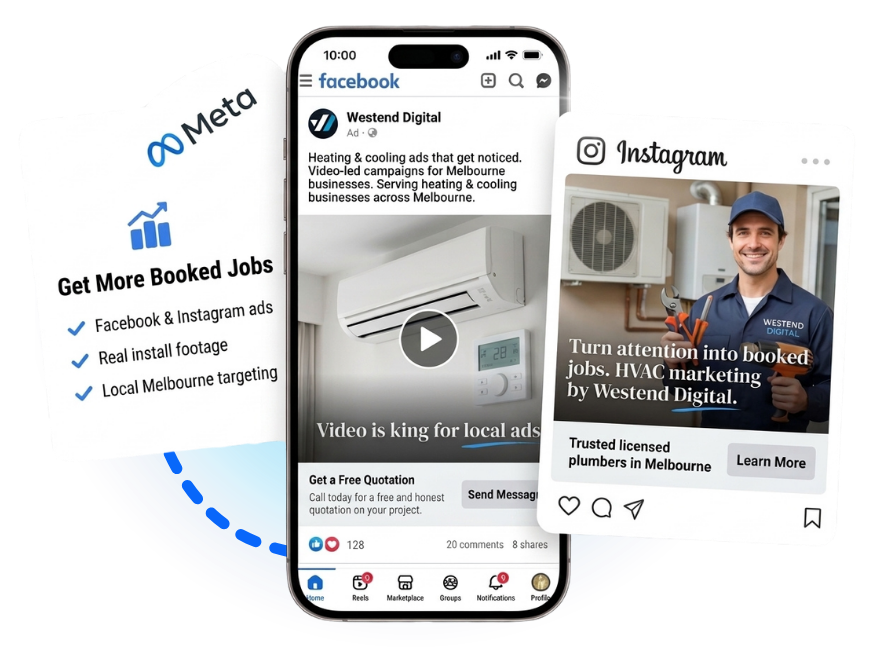
Nobody plans a heater breakdown. They do plan a system replacement. The homeowner who books a $9,000 ducted reverse cycle install in October has been thinking about it since July, asking neighbours, watching prices, and quietly deciding who feels trustworthy. Westend Digital builds Facebook and Instagram campaigns that put your heating and cooling business in front of that person while the decision is still forming, so when they are finally ready to get quotes, you are the name they already recognise.
No lock-in contracts
No jargon-filled reports
90% of Instagram users follow at least one business account
Instagram for Business, cited consistently across 2025-2026 social media research
Marketing for HVAC
Local targeting means the ads only reach people who can actually book you.
Specialist tradie marketing
Real jobsite content, not stock footage
Local targeting and lead tracking
Melbourne based
Working with service businesses across Australia
How Facebook Ads Differ From Google Ads for Heating and Cooling
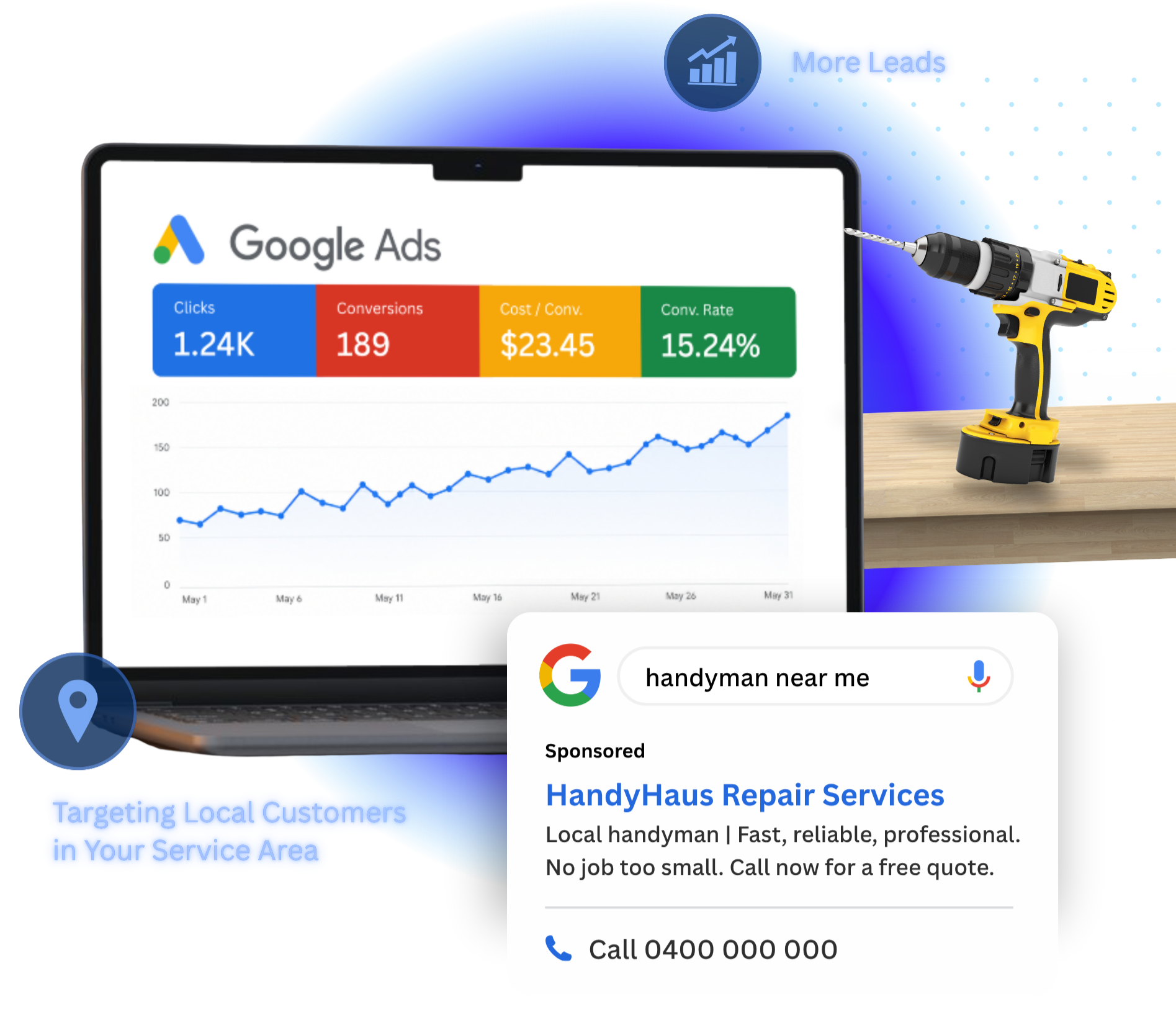
Google Ads and Facebook Ads solve two different problems, and a campaign that treats them the same way tends to underperform on both.
Google Ads: capturing existing demand
Someone already knows their ducted heater has stopped working and is actively searching. The job of the campaign is simply to be present at that exact moment. For emergency repairs and breakdowns, this is the stronger channel and we will say so plainly.
Facebook Ads: winning the decision before the search happens
Heating and cooling is unusual among the trades because it has two completely different types of customer sitting inside one business. There is the breakdown customer, who is urgent, price-sensitive and searching right now. Then there is the replacement customer, who is planning a $3,000 to $15,000 purchase over weeks, comparing systems, and deciding who to trust long before anyone opens Google.
This difference changes the objective, the creative, the funnel, and what a realistic result looks like. It is the reason this page exists as a separate template from the Google Ads version, not a copy of it.
The Two Customers Every Heating and Cooling Business Has
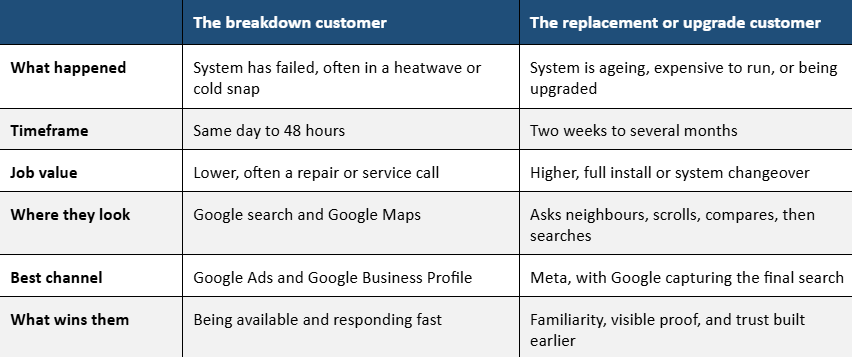
Most heating and cooling businesses market to the first customer only, because that is the customer who makes noise. The second customer is worth considerably more per job and is almost entirely unclaimed on social. Facebook Ads are how you reach them.
Melbourne Seasonality: Why the Quiet Months Matter Most
Most heating and cooling marketing content in circulation was written for the northern hemisphere. It talks about furnaces and freezing winters and gets the calendar backwards for anyone operating in Victoria. Melbourne has its own rhythm, and the campaign should follow it.
The pattern matters because Google demand and Meta opportunity move in opposite directions. When phones are ringing off the hook in a February heatwave, Google is doing the work and Meta adds little. When the diary goes quiet in April and October, there is almost no search demand to capture, which is exactly when creating demand earns its keep.
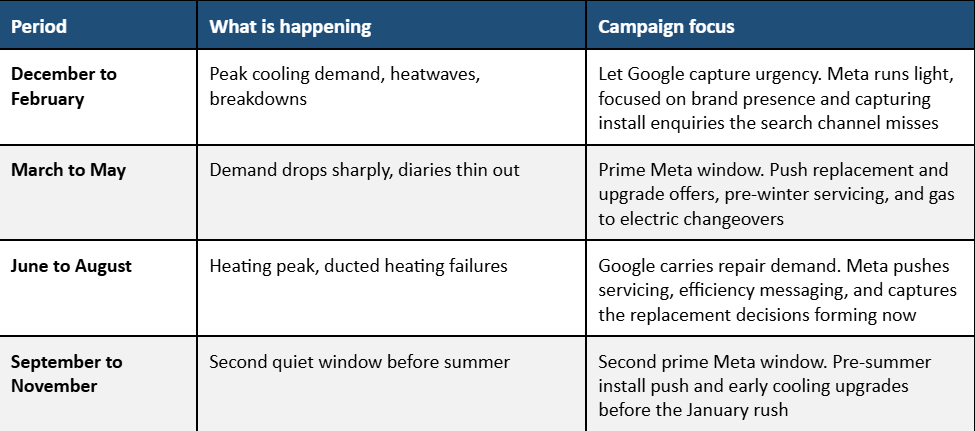
The practical consequence is that a heating and cooling business should not run Meta at a flat budget across the year. The shoulder seasons are when the platform is doing something Google cannot, and they are the months worth funding properly.
Why Meta Ads Works for Handyman Businesses
Visual proof for planned and considered jobs
Before-and-after photos, short video of completed installations, and genuine customer reviews are exactly the kind of content Facebook and Instagram are built to show. This is where Meta Ads earns trust for higher-consideration work such as bathroom renovations and hot water system replacements, often before a homeowner has searched for anything at all.
Retargeting website visitors who did not convert
A Meta Pixel or Conversions API event tracks everyone who visits a plumbing business's website without booking, so a business can serve a follow-up ad to exactly that audience rather than starting again with a completely cold one.
An alternative to relying on Airtasker and hipages
Many handyman businesses get some work through marketplaces like Airtasker or hipages, but every job booked that way comes with a fee and no lasting relationship with the customer. Meta Ads builds a business's own audience and its own repeat customers, rather than renting attention from a platform.
Common Challenges Heating and Cooling Businesses Face With Facebook Ads
Most HVAC businesses that have tried Facebook or Instagram ads before have run into one or more of these problems:
Generic 'we do all heating and cooling' messaging with no specific offer
No real on-site footage
No local proof or suburb context
Weak or vague offers and Slow follow-up on install enquiries
No retargeting and no use of the client's existing customer list
Over-targeting the audience with stacked interests
Running a flat budget year-round instead of funding the shoulder seasons properly
Chasing emergency breakdown work on Meta when Google is the better channel for it
Westend Digital has not yet worked with a heating and cooling business client directly, since the agency is still early in its client base. What can be offered instead is a transparent process and a campaign structure built around how this platform, and this trade's customers, actually behave
Our Process
Discover
Audience mapping, competitor audit, and goal alignment for your service area.
Strategy
Channel selection, campaign structure, and KPI framework.
Execute
Campaigns live, creative and copy built in-house.
Report
Live dashboards and plain-English reporting, not narratives.
Refine
Kill what does not work, scale what does.
What's Included
Campaign build and ongoing management across Facebook and Instagram
Lead form design with qualification questions built for install and service enquiries.
Conversion tracking setup, including Conversions API where the client's site allows it
Customer list and audience setup from the client's existing job data.
Creative direction for on-site video content (production approach to be confirmed based on service scope)
Ad copy and landing pages built around heating and cooling services, not generic templates
Seasonal campaign planning mapped to the Victorian calendar
Monthly reporting in plain English
No lock-in contracts
Meta Ads for Seasonal HVAC Demand
Meta Ads can help HVAC businesses reach homeowners before peak heating and cooling demand begins. Pre-season campaigns can promote air conditioning installations, system upgrades and scheduled servicing before customers are dealing with urgent breakdowns.
Service reminder campaigns can also encourage existing and prospective customers to book maintenance ahead of summer or winter. Where rebates, incentives or energy-efficiency programs are mentioned, advertising should only use current, verifiable offers and clearly state any eligibility conditions rather than making broad savings claims.
FAQs
Frequently Asked Questions
Do Facebook ads work for HVAC and air conditioning businesses?
Yes, but not for everything. Facebook works well for system replacements, upgrades and planned installs, where the homeowner is deciding over weeks rather than hours. For emergency breakdowns, Google Ads and Google Business Profile will usually outperform it, because someone with no heating in July is searching rather than scrolling. The strongest setups use both channels for the jobs each does best.
How much do Facebook ads cost for a heating and cooling business?
Costs vary by suburb, competition, offer, and creative quality. Across all industries, Australian advertisers have recently paid an average cost per lead of around $43 AUD on Facebook, with cost per click averaging under $1 AUD (Superads, 2025 to 2026 data). These are all-industry figures rather than trade-specific ones, so treat them as a directional planning reference, not a guarantee. Cost per lead also matters less in this industry than in most, because job values range so widely.
What kind of creative works best?
Real on-site video usually performs best, especially when the technician explains the job in plain language while the footage shows the work and the result. Ducted changeovers are particularly strong because the before-and-after is obvious to anyone. Captions should be burned in, since most people watch with the sound off.
Should we advertise on Facebook during summer when we are already flat out?
Usually at a reduced level. During a Melbourne heatwave, search demand is doing the work and adding Meta spend to a full diary rarely helps. The shoulder seasons in autumn and spring are where Facebook earns its place, because there is very little search demand to capture and the platform is creating enquiries that would not otherwise exist.
Can Facebook ads generate emergency call-outs?
Not as reliably as Google Ads. Someone whose ducted heating has failed is searching, not scrolling. Facebook is better suited to planned work and to building recognition in a service area before a breakdown happens, so that when it does, your business is already familiar.
Is Meta ads the same thing as Facebook ads?
Yes. Meta is the parent company of Facebook and Instagram, and the advertising platform covers both, along with Messenger placements. Most business owners still say Facebook ads, most of the industry says Meta ads, and they refer to the same system.
Can we advertise the Victorian Energy Upgrades rebate?
Rebate-linked messaging can be effective, because most homeowners do not know the program settings change. We would advise building campaigns around eligibility and timing rather than around a specific dollar figure, since certificate values and program rules move. Any rebate-linked advertising should also be checked against the client's obligations as an accredited provider before it goes live.
Why do our Facebook leads feel lower quality than our Google leads?
Usually because the form is doing no filtering. A lead form with no qualification questions collects everyone who taps, including renters, people outside the service area, and people who are years away from buying. Adding property type, current system, timeframe and postcode questions changes the picture significantly. The other cause is attribution, since Facebook often contributes to enquiries that get recorded as Google or direct.
Do you create the content too?
This is still being finalised as Westend Digital's service scope for this offer. It will be confirmed and updated on this page before publishing, rather than answered ahead of that decision.
Do you require lock-in contracts?
No. Westend Digital does not lock clients into long-term contracts. Campaigns are reviewed and reported on regularly, so the decision to continue is based on results.