
Local SEO in Melbourne: What We'd Check First If Your Business Isn't Showing Up
There's a particular kind of frustration that comes with local search.
You know your work is good. You've got the reviews to prove it. You've filled out your Google Business Profile, added the photos, written the description. And yet when you search for what you do, there's a competitor sitting above you who you're fairly sure isn't better at the job.
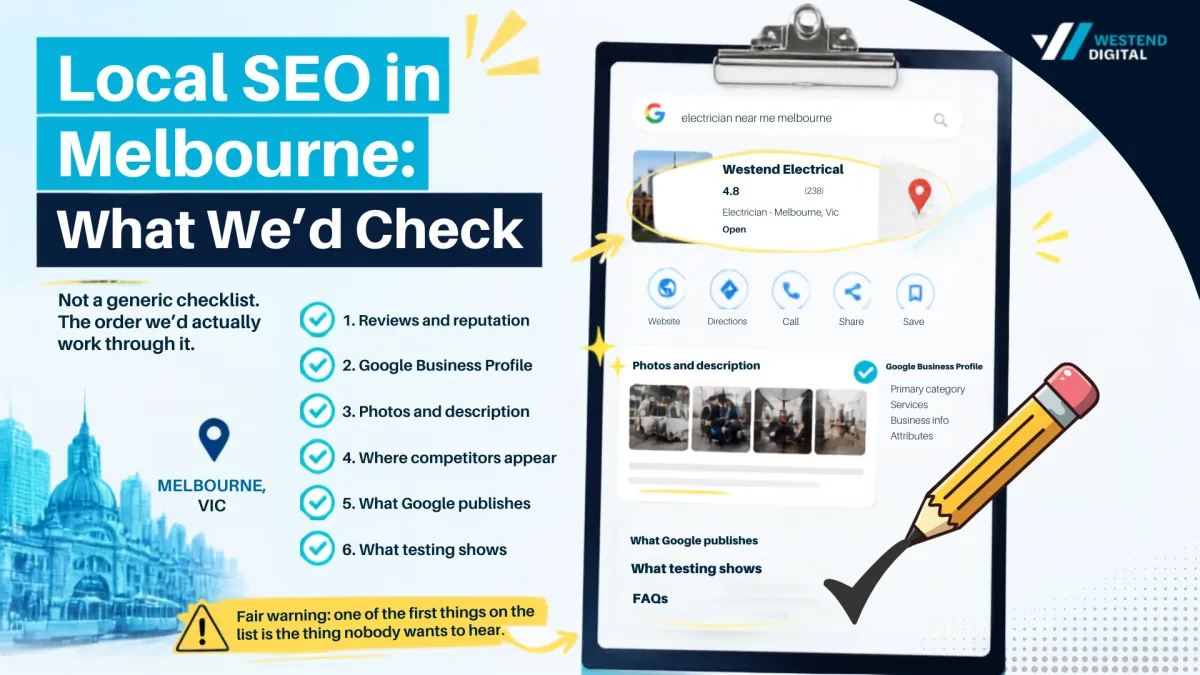
This is the order we'd actually work through it. Not everything that exists in local SEO, and not a generic checklist. Just what we'd check first, and roughly why, based on what Google publishes and what the people who test this for a living have found.
Fair warning: one of the first things on the list is the thing nobody wants to hear.
Before anything else, check what you're actually looking at
Most people diagnose this wrong at the very first step, because they search for their own business from their own office.
That tells you very little. Google personalises results, and it weights local results by how far you are from the business. Sitting at your desk, you're zero metres from your own front door.
What you want to know is whether you show up for someone in the suburbs you actually want work from. For a rough check, search in an incognito window from your phone while you're physically in different parts of your service area. That still isn't a clean test, since incognito doesn't remove all personalisation, but it tells you considerably more than searching from your own office over and over.
The much more useful view comes from a grid-based local rank tracker, which checks your position from dozens of points across a map. That shows you the shape of your visibility rather than one data point.
The shape matters. Most local businesses aren't invisible everywhere. They're visible across a smaller area than they think.
The part nobody wants to hear: distance
Google publishes what drives local results. Its Business Profile Help page states that local results are based mainly on relevance, distance and prominence.
Relevance is how well your profile matches the search, and prominence is how well known your business is, which Google says is influenced by things like how many websites link to you and how many reviews you have. Both of those you can work on. Distance is how far you are from the person searching, and that one you can't do much about.
In Whitespark's 2026 Local Search Ranking Factors survey, the expert panel scored proximity of your address to the point of search as the second most influential factor in the map pack, behind only your primary category. Having a physical address in the city being searched came in fourth.
So a business in Werribee is generally going to struggle to appear prominently for someone searching from Fitzroy, however well optimised the profile is. Google does acknowledge that a more relevant, more prominent business can outrank a closer one, so it isn't an absolute rule, but it's close enough to one that we'd plan around it.
The useful response isn't to fight it. It's to be honest about your realistic catchment and work on ranking strongly across the suburbs you can genuinely service. We'd rather say that upfront than sell six months of work aimed at a result the geography won't allow.
One note on that Whitespark report, since we reference it a few times. It's a survey of 47 local search experts scoring 187 factors, and the author states plainly that none of them have special access to Google's algorithm. It's informed opinion from people who test this constantly, aggregated. Useful, and a different thing from measured data or a confirmed Google rule. We'd treat it as a strong signal, not gospel.
What we'd check on the profile
Now the part you control, roughly in the order we'd look.
Your primary category. This scored highest of all 187 factors in the survey, and in our experience it's also the one most often set vaguely years ago and never revisited. If you're a cosmetic dentist and your primary category is "Dentist," you're competing with every general practice nearby instead of matching the searches you actually want. Additional categories also scored well, so it's worth using them rather than leaving them empty.
Your business hours. This one surprises people. Whether a business is open at the time of the search scored fifth on the panel's list. The report's author describes watching rankings soften in the last hour before closing, then businesses being displaced by competitors who are still open.
So if you take calls until 6 but your profile says 5, you may be giving up visibility during an hour when you're genuinely available. What we wouldn't do is list hours you don't keep. It breaches Google's guidelines, and if someone turns up to a closed shop you've traded a small ranking gain for a one-star review.
Your services list. Google offers predefined services for most categories, and these scored higher than most people expect. Filling them out properly takes about ten minutes.
Your map pin. Worth two minutes to check it's accurately placed at your actual business location, particularly if the listing was created years ago or by someone else.
Completeness generally. Google's guidance is direct here: businesses with complete and accurate information are more likely to show up, and incomplete information can mean the profile doesn't appear for relevant searches at all. Unglamorous, and it matters.
One thing we'd flag rather than recommend. Keywords in the business title scored third in that survey, which tells you practitioners see it working. But adding words to your business name that aren't part of your actual trading name breaches Google's guidelines and carries real suspension risk. It works right up until it doesn't, and reinstatement is a miserable process. We wouldn't do it, and we'd be wary of anyone who suggests it.
What we'd check on the website
This is where a lot of businesses stop, because the profile feels like the whole job.
For local organic results, meaning the normal blue links under the map, the survey's picture looks quite different. A dedicated page for each service scored highest, followed by geographic relevance in your content. Your primary category, the biggest lever in the map pack, drops right down the list here.
As a rule of thumb: your profile carries more weight in the map results, while your website does more of the heavy lifting in the normal organic results.
So we'd check whether you have a real page for each significant service, rather than one "Services" page listing eight things as bullet points. We'd check whether the suburbs you actually work in appear naturally in your content. A business genuinely serving Werribee, Point Cook, Hoppers Crossing and Tarneit has a reason to talk about those areas. That doesn't mean forty near-identical suburb pages, which is a different problem with its own risks.
We'd also look at the page your profile links to, since it carries more weight than most people realise.
Reviews, and what actually matters about them
Google says plainly that more reviews and positive ratings can help your local ranking. That much is confirmed rather than inferred.
The detail underneath is where it gets useful. The expert panel scored high ratings, the number of reviews with text, and how recent reviews are all in the top fifteen factors, plus a separate factor for a steady flow of reviews rather than bursts.
So a large review count on its own isn't the whole story. A profile that keeps attracting genuine reviews can look stronger than one whose review activity stopped years ago. A business with reviews from last month looks alive. One with nothing since 2023 looks like it might have closed.
The practical version is having an actual system for asking, rather than remembering when you happen to think of it. A link sent by text after a job is done will outperform good intentions every time.
Responding matters too, though it's worth being precise about why. Google recommends replying to reviews, and it's obviously good for the customers reading them. But putting keywords into your responses scored close to the bottom of all 187 factors. Respond because it's the right thing to do, not as a ranking tactic.
The part that sits outside your website
This connects to something we wrote about recently on AI search, and it's showing up in local too.
The Whitespark report notes that three of the top five factors for visibility in AI search responses are citation factors, meaning mentions of your business across other sites. The author's summary is that in AI search, mentions are the new links.
For a local business that means industry directories, local media, community involvement, genuine "best of" roundups, reviews on platforms beyond Google. Not bought mentions, which Google explicitly warns against, but the ordinary work of being visible in your own community. It's the least controllable part of this and probably the most durable.
The checklist
Being honest about which of these is quick and which is real work.
Quick fixes, genuinely under an hour each:
Check and correct your primary category, and add relevant additional categories
Fill out the predefined services list for your category
Check your map pin is in the right place
Update your hours to reflect when you're actually contactable, including public holidays
Add recent photos if the most recent ones are years old
Real work:
Building a proper page for each service you offer
Getting genuine suburb-level content onto the site without it reading like keyword stuffing
Setting up a system that asks every customer for a review, consistently
Building genuine local and industry authority through relevant directories, partnerships, coverage and mentions
Fixing name, address and phone number inconsistencies across the directories you're already listed on
What we wouldn't prioritise for rankings
Some commonly sold local SEO tactics scored near the bottom of that 187-factor list.
Geo-tagged photos came dead last. Adding location data to your image files does not appear to do anything for rankings. Social follower count was second last. Google Posts scored low across every measure, so posting weekly updates is unlikely to move your rankings much.
This doesn't mean these things can never be useful. Google Posts can still be worth doing for the customers who read them, and an active social presence has obvious value. It means we wouldn't spend time on them specifically because someone promised they'd improve your map rankings.
One worth stating plainly: participation in Google Ads sits near the very bottom of the survey for both map and local organic rankings, and Google's own documentation says there is no way to request or pay for better local ranking. Running ads does not buy you organic map positions. If someone implies otherwise, be careful.
The panel also flagged some tactics as carrying suspension risk, including keyword stuffing your profile description. They scored AI-generated text and images on profiles as risky too, though that's the panel's read rather than a stated Google rule, and Google's policies are about whether content is accurate, authentic and genuinely represents your business rather than about which tool produced it. The practical version is the same either way: whatever goes on your profile should reflect the real business.
When local SEO won't fix it
Worth saying, because most articles on this topic imply everything is solvable.
If your profile is brand new, it takes time regardless of what you do. If you're genuinely a long way from where your customers search, geography will keep winning. And if you're a service area business without a public address, you're working with fewer of the signals the map pack leans on, though how much that costs you seems to vary case by case rather than being a universal penalty.
You'll also see plenty of overseas advice about Local Services Ads sitting above the map results. Those aren't currently a general Australian-market consideration in the way they are in the US, so for a Melbourne business the immediate competition is still standard Google Ads, the local pack and organic results.
None of that means the work isn't worth doing. It means the goal should be getting the most out of a realistic catchment rather than chasing a position the fundamentals won't support.
Where we'd start
If we were looking at this for a Melbourne business tomorrow: check what your visibility actually looks like from a few real locations rather than from your desk. Fix the primary category, hours and services, because they're high impact and take an afternoon. Then look honestly at whether your website has a page for each thing you actually sell.
That sequence deals with most of what we see going wrong, and none of it needs a retainer to start.
If you want a second opinion on where your local visibility is actually sitting, send us your business name and the suburbs you want work from, and we'll take a look and tell you what we'd prioritise. No pitch attached.
Westend Digital is a Melbourne-based digital marketing agency working with small and medium-sized businesses across trades, healthcare, professional services, and hospitality. If you are setting a budget for your next ad campaign and want a second opinion before you commit, reply to The Westend Brief or visit westenddigital.com.au.