
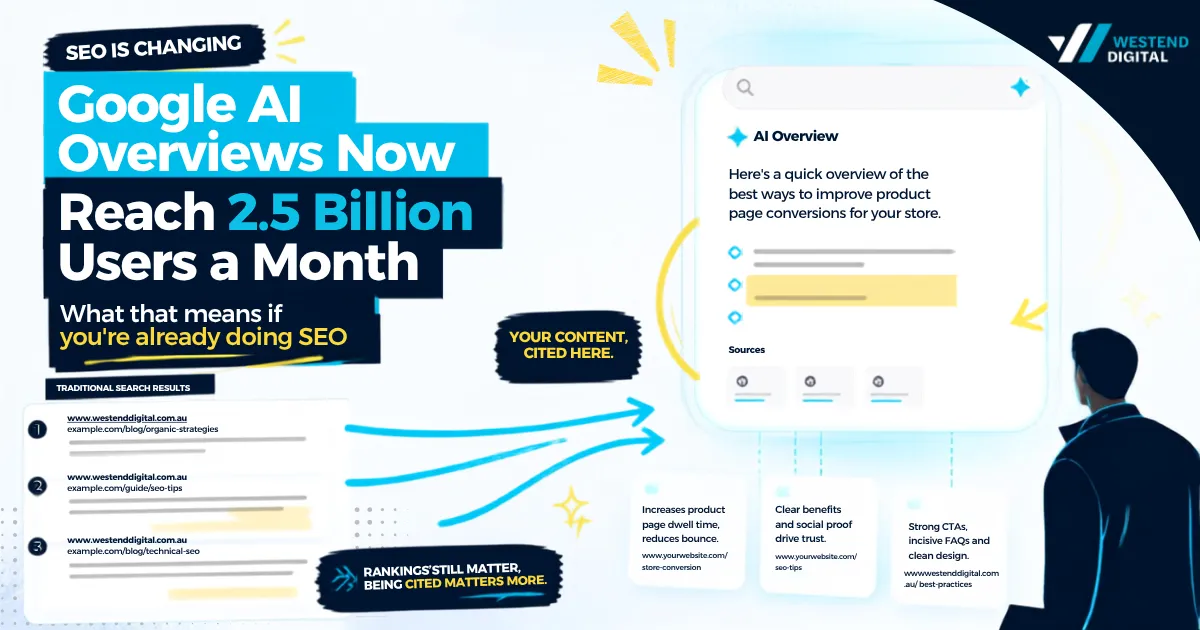
Google AI Overviews Now Reach 2.5 Billion Users a Month: What That Means If You're Already Doing SEO
We were most of the way through writing this article when we realised one of the numbers we'd been leaning on was already out of date.
It wasn't a small adjustment either.
In 2025, roughly three in four websites quoted in Google's AI answers also ranked in the traditional top ten for that same search. In the newer study, fewer than four in ten did.
That was enough to make us stop, go back through the research properly, and rethink part of what we were about to publish. This article is the result of that, including the bits where the honest answer is that nobody knows yet.
Some context on scale before we get into it, because it explains why any of this matters. At Google I/O in May 2026, Sundar Pichai said AI Overviews, those AI-written summaries that now sit above the blue links, had passed 2.5 billion monthly active users. AI Mode, Google's more conversational search experience, had passed 1 billion monthly users within roughly a year of launching. Separately, OpenAI reported 900 million weekly active ChatGPT users as of February 2026.
Those audiences overlap heavily and shouldn't be added together. Plenty of people use all three, and the numbers aren't even measured the same way, since Google reports monthly users and OpenAI reports weekly. What they do tell you is that AI-generated answers are now a normal part of how people look things up, not an emerging experiment.
One more thing worth flagging early. Almost all of the hard data in this article is about Google AI Overviews specifically. ChatGPT, Perplexity and the rest use different systems for finding and citing sources, so findings about Google don't automatically transfer. Where something is Google-specific, we say so.

The number that made us stop
Here's the assumption that changed, and it's worth understanding because a lot of SEO has been sold on the back of it.
The old rule of thumb was straightforward. Get your website ranking near the top of Google, and you'd probably get picked up by the AI answers too. Do the traditional work, and the AI visibility follows.
That was measurably true. In July 2025, Ahrefs analysed 1.9 million citations inside AI Overviews and found that around 76 percent of the pages being cited also ranked in Google's traditional top ten for the same query.
Then in March 2026 they ran it again on a much bigger sample: roughly 863,000 keyword search results pages and around 4 million cited URLs. This time, 37.9 percent of cited pages appeared within the first ten results of any kind, including ads, featured snippets and the People Also Ask boxes. Looking only at standard organic listings, it was 37.1 percent, with 26.2 percent ranking somewhere between positions 11 and 100, and 36.7 percent not ranking in the top 100 at all.
Read that last figure again. On the organic-only measure, more of the cited pages were outside Google's top 100 than inside its top ten.
Now the caveat, because it genuinely matters. Two things changed between those studies. Google moved AI Overviews onto Gemini 3 as the default model in January 2026, and Ahrefs improved how it detects citations, so it can now see more of them than it could before. Ahrefs says plainly that the two datasets aren't directly comparable.
So we wouldn't tell you that SEO suddenly became half as important. The studies aren't a clean before-and-after, and anyone presenting them that way is overselling it. But the change is significant enough that we wouldn't keep giving the same advice either.
What we'd take from that
Google is now regularly using websites that don't appear on the first page for the exact thing the customer typed. Ranking well still helps. It's just no longer the reliable predictor of AI visibility that it was eighteen months ago.
What we wouldn't take from it
That rankings stopped mattering. Google's own documentation is clear that a page has to be indexed and eligible to show in Search with a snippet before it can appear in AI features at all. Traditional visibility is still the entry ticket. It's just not the whole game anymore.
So does this mean the SEO you've already paid for is obsolete?
No.
This is the question we get asked most often at the moment, usually some version of: if AI is changing search, is the money we've already spent going to waste?
The honest answer is that one important assumption about how search visibility works has changed. The fundamentals underneath it haven't. Your site still needs to be crawlable, indexed, fast, useful and credible. None of that has been replaced by anything.
What has changed is where Google looks when it's assembling an answer, which brings us to the most useful thing we found in all of this.
Google may be searching for more than the question you typed
This one is worth understanding properly, because once you see it, the citation data makes a lot more sense.
When somebody asks a question now, Google can quietly run several related searches behind the scenes before writing its answer. It gathers useful material from across all of them, then builds one response out of what it found.
Say a homeowner searches "how much does a home extension cost in Melbourne."
Google might also go looking at council permits, realistic build timelines, the costs people don't budget for, whether extending beats knocking down and rebuilding, how to choose a builder, and what commonly goes wrong on extension projects.
A builder's website might not rank on page one for the original cost question at all. But if that builder has written something genuinely useful about permit delays, or about the difference between renovating and rebuilding, they can still end up being used in the answer.
Google calls this "query fan-out," and confirms in its own documentation that both AI Overviews and AI Mode may use it.
Being careful here, because this is where a lot of AI SEO advice overreaches. Google confirms fan-out exists and describes roughly how it works. Google does not publish the actual fan-out queries it generates for any given response, and it hasn't published its full source-selection process. So this is a mechanism that helps explain the citation pattern, and a plausible route by which a page gets used. It isn't a confirmed ranking rule, and we'd be sceptical of anyone selling it as one.
What this changes for a business website
Here's the part that actually affects how you spend money.
The old approach was to pick your most commercially valuable search term and fight for the top spot. That still helps. It's just no longer the whole job, because the question your customer typed is only the starting point for what Google goes looking for.
There's a broader lesson sitting underneath this, and it isn't really about AI at all.
Businesses tend to build websites around what they want to say. Our services. Our experience. Our accreditations. Meet the team. Why choose us. All of it reasonable, all of it written from the inside out.
Customers turn up with a different list:
● What does this cost?
● How long does it take?
● What usually goes wrong?
● Who is this not suitable for?
● How does it compare with the alternative?
● What happens after I enquire?
● What do I need to have ready?
● What are the costs nobody warns me about?
● How do I choose between two providers who both look fine?
Most of those get answered brilliantly, on the phone, by someone who's been doing the work for fifteen years. Very few of them appear anywhere on the website.
The point isn't to publish more content. It's to get more of the expertise you already have out of the phone call and onto the website.
That's the commercial version of what the citation research is pointing at. The businesses turning up in AI answers tend to be the ones that have genuinely covered the questions customers ask on the way to a decision, not just the one search term with the best volume.
The kind of searches that trigger AI answers in the first place
There's supporting evidence for this. Google's AI answers show up far more often when somebody is trying to understand something than when they're doing a simple lookup.
Ahrefs put numbers around that across 146 million search results pages. AI Overviews turned up on about 57.9 percent of question-type searches, against about 15.5 percent of everything else. So roughly four times as often when somebody's asking rather than looking something up.
Break the questions down and the pattern sharpens. "Why" questions triggered an AI answer most often at around 59.8 percent, yes-or-no questions at 57.4 percent, definition-style questions at 47.3 percent. On Ahrefs' own classification, 99.9 percent of the keywords triggering AI Overviews carried informational intent, though intent categories overlap in practice, so treat that one as directional rather than absolute.
What this does not mean is that you should go through your site turning every heading into a question. We've seen that recommendation doing the rounds and there's nothing behind it. The evidence is about which searches trigger AI answers, not about which page formatting earns a citation. Those are different claims.
What it does mean is building content around genuine customer questions, in the customer's language, because those are disproportionately the searches where an AI answer gets generated at all.
Comparison content, and why it shows up so often
Related to this: list and comparison content, particularly "best X" style articles, accounts for a large share of AI Overview citations in Ahrefs' research.
The wrong conclusion is to start mass-producing "10 Best" listicles. Google's own guidance specifically calls out commodity content as ineffective, and thin comparison pages are exactly that.
The more useful reading is that people ask AI systems comparative questions constantly, because that's what you ask when you're close to deciding. Genuinely useful comparison content fits that need. For an accountant, that might be an honest explanation of when a company structure beats a sole trader setup, and when it doesn't. For a dentist, the real differences between two treatment options including cost and recovery time. For an ecommerce store, a proper comparison of two products you sell, including who each one suits and who it doesn't.
The version of this that works is the one where you're prepared to say when your service isn't the right fit. That's also the version customers trust.
More content is not automatically better content
Worth being clear about this, because the instinct when you hear "cover more questions" is to go and write 40 new pages.
Word count has close to no relationship with whether content gets cited. Ahrefs measured a Spearman correlation of around 0.04, which is effectively nothing. One of their own researchers documented a case where expanding an existing article actually reduced its AI visibility, apparently because the additions pushed it past the original search intent and diluted what the page was about.
If a section exists because someone told you every SEO article needs 2,000 words, that's a different thing from a section that genuinely helps a customer make a decision.
We'd also push back on the opposite conclusion. Short content doesn't win. There's no evidence for that either, and cutting genuinely useful depth out of a page that's doing its job is a bad trade. The sensible position is no arbitrary word-count targets in either direction, and a willingness to remove padding while keeping the detail that earns its place.
What happens away from your website deserves attention too
Another thing that surprised us in the research was how much of the story seems to sit outside your own website. This one is a genuine shift in how we think about SEO strategy.
Put simply: brands that get mentioned more widely across the web also tend to show stronger visibility across AI systems.
The evidence comes from an Ahrefs cross-platform study of 75,000 brands. Mentions on YouTube, including in video titles, transcripts and descriptions, showed the strongest correlation with AI visibility, at roughly 0.737 overall. Branded mentions elsewhere on the web weren't far behind, correlating somewhere between about 0.656 and 0.709 depending on which platform was being measured.
YouTube kept turning up in the other study too. Of the cited pages that didn't rank in Google's top 100 at all, 18.2 percent were YouTube URLs.
Now the important part: correlation is not causation. Nobody has demonstrated that going out and generating another 50 mentions will cause more AI citations. These signals correlated more strongly with AI visibility than traditional backlink metrics did within that dataset, which is a narrower claim than calling them a ranking factor, and we're not going to pretend otherwise.
The more useful interpretation is that broad brand presence across the web is probably reflecting something real underneath: reputation, prominence, being genuinely associated with a topic, third-party validation. Systems trying to work out which sources to trust may simply be picking up the same signals that make a business well known in the first place.
Google draws a firm line here that's worth repeating. Its guidance explicitly warns against chasing inauthentic mentions, noting that its core ranking systems focus on high-quality content while other systems block spam. Buying mentions isn't a strategy, and we wouldn't touch it.
What it does suggest is that search visibility now overlaps considerably with digital PR, credible media coverage, YouTube, industry publications, genuine reviews, subject-matter expert appearances, relevant directories and independent third-party discussion.
Which leads to a slightly uncomfortable conclusion for anyone used to treating SEO as something that happens on their own domain: you can't necessarily manage all of your search visibility from inside your own website anymore.
What happens away from your website deserves attention too
Before going further, the acronyms, because the industry has already produced several and they're being used interchangeably when they shouldn't be.
SEO is the broad discipline you already know: making a website discoverable, indexable, genuinely useful and credible enough to be treated as a worthwhile source in organic search. It was never only about ranking one page for one keyword, though that's often how it gets described.
AEO, answer engine optimisation, is industry shorthand rather than a formal discipline. It generally means work aimed at getting information to surface directly as an answer.
GEO, generative engine optimisation, is the one with an actual academic origin. It was coined in a peer-reviewed paper presented at the ACM SIGKDD conference in 2024, by researchers from Princeton, Georgia Tech, the Allen Institute for AI and IIT Delhi. They built an experimental benchmark called GEO-bench and tested various optimisation methods against it. Some techniques improved generative-engine visibility by up to 40 percent within that benchmark. Worth being precise about what that means: it was measured in an experimental setup, not on live Google or ChatGPT, so it shouldn't be read as a guaranteed uplift on real platforms. The researchers also found effectiveness varied a lot depending on the subject area, so what worked in one industry didn't automatically work in another.
Here's the part we'd underline, though. Google's own guidance, updated in July 2026, is considerably less dramatic than the acronyms suggest. Google's position is that as far as Google Search is concerned, optimising for its generative AI features is still SEO.
That's worth keeping in mind next time somebody tries to sell you GEO as an entirely separate service with an entirely separate budget.
What happens away from your website deserves attention too
This is probably our favourite part of Google's July guidance, because it directly contradicts a fair few things currently being sold as essential.
According to Google:
● You don't need special AI files or machine-readable formats. That includes llms.txt, a file some vendors are selling as necessary. Google says its Search systems ignore it entirely, so it will neither help nor hurt you.
● You don't need special schema markup for AI features. Structured data is still worth doing as ordinary technical SEO, since it supports eligibility for rich results, but there's no secret AI schema.
● You don't need to break your content into small chunks for AI to understand it. There's no ideal page length.
● You don't need to rewrite your content specifically for AI systems, because those systems understand synonyms and general meaning perfectly well.
● There are no additional technical requirements beyond being indexed and eligible to show in Search with a snippet.
Google also cautions against third-party tools that promise ranking success or claim to use internal Google metrics, pointing out that no third-party tool has access to its ranking or AI systems.
For a business owner, the practical translation is this: you don't need to throw away your existing SEO strategy and buy a mysterious new AI package. If someone is selling you a shortcut, they're selling something Google has publicly said doesn't exist.
One genuine caution attached to all of this. Google explicitly warns that creating separate content for every possible query variation, mainly to influence rankings or AI responses, breaches its scaled content abuse spam policy. Covering your customers' real questions properly is the goal. Mass-producing thin pages against a list of predicted sub-queries is a different activity with a different outcome.
If this were our website, here's what we'd do first
Practical section. This is what we'd actually work through, in order.
1. Pick one service. The one that matters most commercially, not the one that's easiest to write about.
2. Write down the questions customers actually ask before they buy. Use their words, not industry terms. The sources are already sitting around you: sales calls, email threads, enquiry forms, proposals, the objections that come up every time, your reviews, and whatever your front desk or estimator gets asked constantly. If your team answers something on the phone every week, that's a strong signal.
3. Group them. Cost, risk, timing, suitability, comparisons, alternatives, process, common mistakes, and what the outcome actually looks like.
4. Audit honestly whether your site answers them. Not "do we mention it," but "would a stranger get a genuine answer." A lot of businesses find they only cover one or two properly.
5. Improve what you already have before building anything new. This is the step people skip. Some of those questions belong on the existing service page. Some belong in an FAQ, some in a comparison piece, some on a pricing page, some in a case study. Very few businesses need 20 new pages, and starting there is usually how you end up with thin content nobody reads.
6. Keep doing normal SEO properly. Technical health, crawlability, indexing, internal linking, credible content, authority, user experience and measurement all still matter. None of this replaces that work.
That gap between what customers ask and what your site answers is the first place we'd look before spending anything on new content.
If this were our website, here's what we'd do first
Measurement is where a lot of AI search conversations go quiet, which is a problem if money is involved.
Google has introduced a Generative AI performance report in Search Console, showing how content is performing in its generative AI features across Search and Discover. Two things to know: it's still rolling out to a subset of sites rather than being universally available, so check whether your property actually has it before building a process around it. And it focuses substantially on impressions and visibility rather than complete commercial attribution. It tells you whether you're being surfaced, not what that surfacing was worth.
Beyond that, we'd look at organic impressions and rankings, growth in branded search volume, any identifiable AI referral traffic in analytics, off-site brand mention tracking, and third-party AI citation monitoring where it genuinely fits how you work.
Then the part that actually matters: leads, enquiries, sales and assisted conversions. Visibility without business impact becomes a vanity metric fairly quickly. Being mentioned by an AI system is not the objective. Getting more of the right customers is.
What we would not do
● Rewrite every page purely for AI.
● Mass-produce question-format headings because somebody said AI prefers them.
● Cut genuinely useful depth out of articles because a tool flagged them as too long.
● Buy brand mentions.
● Assume an llms.txt file will improve your visibility in Google's AI answers, because Google says it ignores them.
● Treat structured data as a guaranteed AI citation tactic rather than as sound technical SEO.
● Assume research about Google AI Overviews automatically applies to ChatGPT or Perplexity. They work differently.
● Buy expensive GEO software before you've defined what you actually need to measure and why.
What we would not do
GEO doesn't replace SEO.
If you already have a solid SEO foundation, you don't need to start again. What's changed is how Google retrieves and assembles information. Ranking for the exact phrase somebody typed is no longer the whole story, because Google is now looking across a wider set of related searches when it builds an answer.
The sensible adjustment is to keep doing the technical work properly, keep publishing genuinely expert content, keep building organic visibility, and pay closer attention to three things: whether you've covered the full range of questions customers ask on the way to a decision, whether your answers are actually clear, and how your expertise shows up across the wider web rather than only on your own site.
And plenty of this is still uncertain. The research is moving fast, the platforms don't behave the same way as each other, and correlation is doing a lot of heavy lifting in a field that would much rather sound certain. We'd rather tell you where the evidence stops and our interpretation starts, because right now that's more useful than any individual tactic.
If you're trying to work out whether your current content actually covers the questions customers ask before choosing you, send us your site and we'll have a look and point out anything obvious. No pitch attached.
Westend Digital is a Melbourne-based digital marketing agency working with small and medium-sized businesses across trades, healthcare, professional services, and hospitality. If you are setting a budget for your next ad campaign and want a second opinion before you commit, reply to The Westend Brief or visit westenddigital.com.au.