Google Ads vs Facebook Ads: Why the Answer Changes Depending on What You Sell
This is one of the first questions we get asked by businesses considering paid advertising. Someone has a budget, they have decided to spend it on ads, and now they want to know where the money should go.
Google Ads or Facebook Ads?
Most articles answering this question say "it depends" and then never explain what it actually depends on.
So here is our attempt at the useful version.
Google Ads vs Facebook Ads: the quick answer
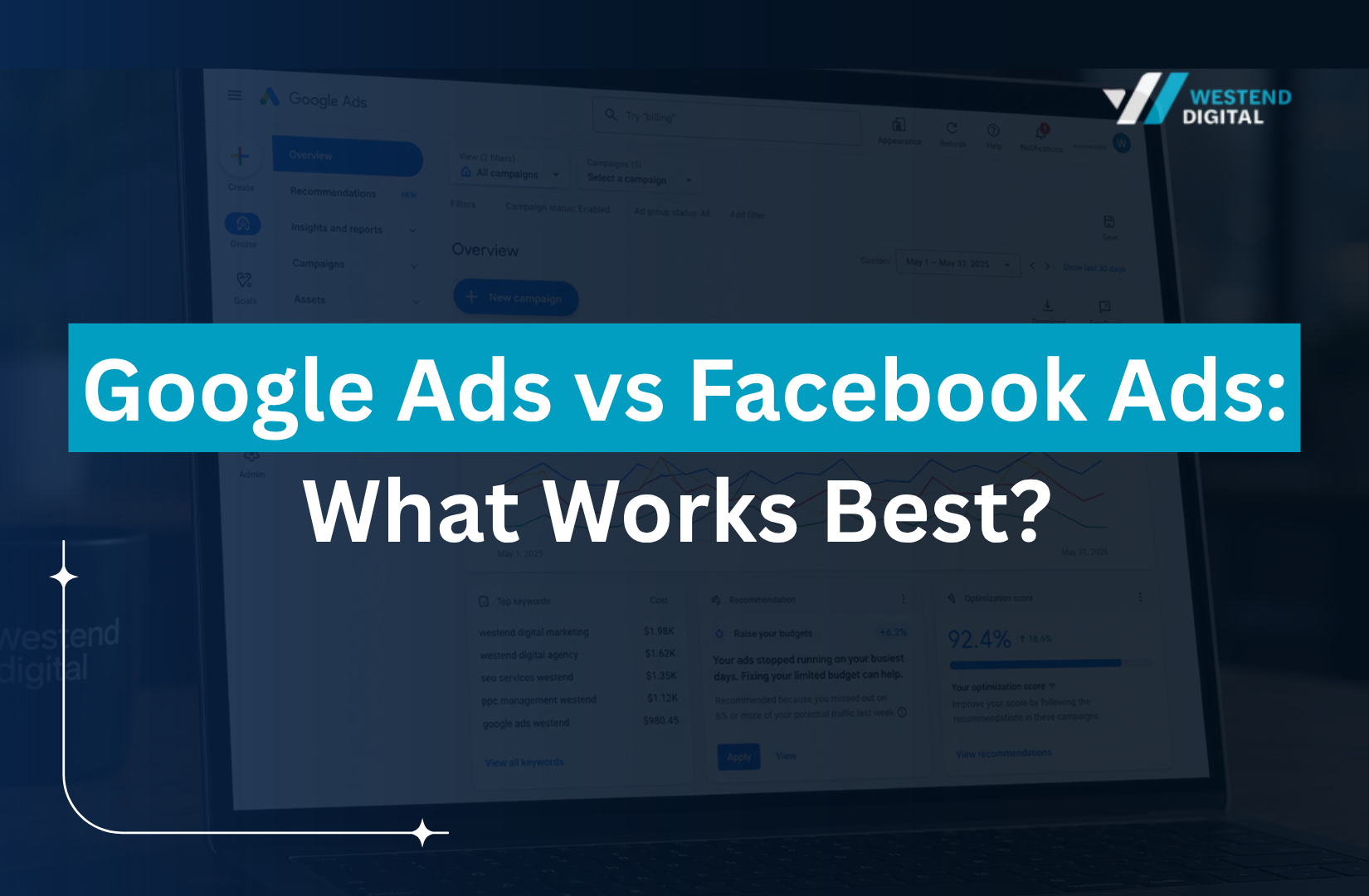
Google Ads is usually the better starting point when people are already searching for the product or service you sell, particularly for urgent, local or high-intent needs.
Facebook and Instagram Ads are usually stronger when demand needs to be created. That includes situations where customers are not actively searching yet, the offer needs explaining, or strong visual creative is needed to get their attention.
Neither platform is automatically better.
The real question is whether your customers already know they need what you sell.
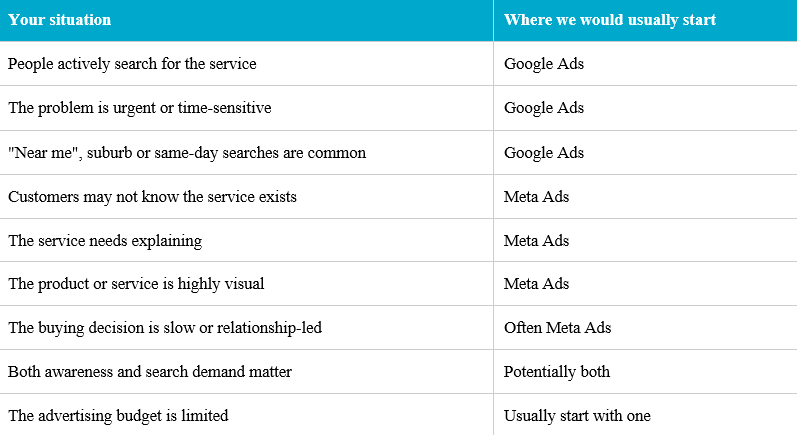
What is the real difference between Google Ads and Meta Ads?
Google Ads and Meta Ads are often described as two versions of the same thing. They are not.
Someone searching "emergency plumber Werribee" at 11pm has already diagnosed their problem, decided they probably need to pay someone and started comparing options. Google is not creating that demand. It is putting your business in front of demand that already exists.
Now compare that with someone scrolling Instagram. They are not looking for your business. They may not have been thinking about your service before your ad appeared, and if you fail to earn their attention quickly, they will keep scrolling.
That distinction matters more than almost anything else. The targeting works differently, the creative works differently, the customer journey is different, the timelines are different, and the reason a campaign fails is usually different too.
When should you use Google Ads?
If people actively search for what you sell, Google is usually where we would start.
The clearest examples are urgent and problem-driven services. Blocked drains, broken hot water systems, being locked out of the house or a car that will not start all have something in common: the customer already understands the problem and wants to solve it.
There is not much demand creation required. You need to appear at the right time, look credible and make it easy for them to contact you.
Google can also work well for considered purchases where people research before making a decision. They might compare suppliers, look for a particular service, check pricing, read reviews or search for businesses servicing their suburb. The intent may not be as strong as an emergency plumbing search, but it is still real intent.
The catch is that people actually need to be searching.
That sounds obvious, but it is one of the most common things we see businesses get wrong. A perfectly structured Google Ads campaign cannot capture search demand that does not exist.
When should you use Facebook and Instagram Ads?
Meta becomes more interesting when people are not actively searching.
There are more businesses in this category than you might think. Some services are unfamiliar. Some solve problems customers have not fully recognised yet. Others address something a customer has been putting off for months, but could respond to if the right message reaches them at the right moment.
This is particularly relevant in industries where decisions are shaped by family conversations, referrals, community networks and trust rather than a straightforward Google search. In disability and community services, for example, search may be only one part of the decision-making process.
Trying to capture all of that through search ads alone can mean fishing where there are not many fish.
Meta can also make sense when the buying decision is slow and relationship-led, when the offer needs explaining before it becomes interesting, or when the thing you are selling is highly visual.
The trade-off is that the creative carries much more of the workload. On Google, somebody has already asked a question. On Meta, you first need to give them a reason to stop scrolling.
A mediocre search ad against the right high-intent keyword may still receive clicks. A mediocre Meta ad against the perfect audience can simply disappear into the feed.
How do you decide between Google Ads and Meta Ads?
Before recommending either platform, we would check one thing first:
Does meaningful search demand exist for what the business sells in the area it serves?
A keyword research tool can quickly show whether people are searching for the service, the language they use and roughly how much commercial intent sits behind those searches.
If enough commercially relevant searches exist to generate a viable number of enquiries at the available budget, Google has something to work with.
If the honest search volume is tiny, no amount of campaign optimisation can manufacture those searches. At that point, Meta may make more sense because the job is not simply capturing existing demand. It is creating awareness and interest.
The search terms themselves can tell you a lot too. Phrases containing "emergency", "near me", "same day", "open now" or "quote" often indicate somebody who is closer to making a decision.
Queries beginning with "what is", "how much does", "how does" or "is it worth" usually suggest somebody is still researching.
Both types of searches can be useful, but they represent different stages of the buying journey. They need different campaigns and different expectations.
Why advertising benchmark tables will not answer this for you
Businesses understandably want benchmark numbers.
What should a Google click cost? What should a Facebook lead cost? What is a good cost per lead?
The problem is not that benchmark data is useless. The problem is how confidently people apply a number from one dataset to a completely different business, market and campaign.
WordStream's 2026 search advertising benchmark is a useful example. It looked at more than 13,000 US-based search advertising campaigns across 23 industries, running between April 2025 and March 2026. The average cost per click across the dataset was US$5.42, while Attorneys and Legal Services averaged US$9.87 per click.
That is a substantial dataset, but it is still US data.
Now compare that with Australian research.
Digital Nomads HQ's Australian Click Price Index reports a median Google Ads CPC of A$3.81 across more than 8,400 Australian service keywords in May 2026. Within the same industry dataset, Legal had a median CPC of A$17.48, Trades A$9.25 and Healthcare A$4.47.
Even location changes the picture, but it is important not to mix the samples. In a separate analysis of 374 commercial "service + city" keywords across six Australian cities, the median CPC ranged from A$13.70 in Adelaide to A$23.21 in Sydney.
Neither the US nor Australian figures are automatically "the right benchmark."
They are measuring different markets, different keyword sets and different samples, and the studies do not even summarise their data in exactly the same way. WordStream reports averages, while the Australian Click Price Index reports medians.
That context matters.
Meta gives us another good example.
WordStream's 2025 Facebook Ads benchmark reports an average CPC of US$0.70 for traffic campaigns. For lead campaigns on the same platform, the average CPC was US$1.92.
Same platform. Very different number.
The reason is not mysterious. The campaigns are optimising for different outcomes.
The same dataset reports an average cost per lead of US$27.66 across Facebook lead campaigns, while Real Estate came in at US$16.61, one of the lowest of any industry measured.
So when someone says, "The average Facebook CPC is X," the next question should be: for what?
What objective? What industry? What market? What audience? What period? What does the study count as a lead?
Without that context, a benchmark looks more useful than it really is.
We would treat published benchmarks as a way of spotting something wildly out of line in an account, not as a target and definitely not as the main reason for choosing between Google and Meta.
Your own numbers, measured properly, beat any table.
Comparing cost per click across Google and Meta is close to meaningless anyway
Even if the benchmark data were perfectly clean, a Google click and a Meta click are not necessarily the same product.
A $6 click from someone searching "emergency electrician Hoppers Crossing" and a $1 click from somebody who paused on a video while scrolling Facebook are not comparable units.
One is a person with a problem right now. The other is a person who may become interested, may need the service eventually or may never take another action.
Judging the platforms by which one produces cheaper clicks will usually make Meta look cheaper and tell you almost nothing about which platform produces more revenue.
Cost per lead gets closer to something useful, but only if you continue measuring what happens after the lead.
A lead is not the end of the measurement chain
Before increasing spend on either platform, we would want to know that the tracking works, the landing page matches the promise made in the ad, and somebody actually follows up the enquiries.
Then we would go further.
Which leads become qualified? Which ones book? Which ones become paying customers? Which customers generate enough revenue to justify what it cost to acquire them?
A $30 lead that never responds is more expensive than a $90 lead that becomes a profitable customer.
This is one of the easiest ways to kill a good campaign and protect a bad one. If all you can see is the headline CPL, the campaign producing cheap, low-quality enquiries can look like the winner.
There is also an attribution problem worth understanding. Google and Meta report conversions using their own attribution systems. Those numbers are useful for campaign management and optimisation, but platform-reported ROAS should not automatically be treated as proof of how much revenue the advertising caused on its own.
Both platforms are, to some extent, marking their own homework.
The closer your measurement gets to qualified leads, actual bookings, sales and customer value, the more useful the Google-versus-Meta comparison becomes.
Should you split your budget between Google Ads and Meta Ads?
A fair number of businesses with limited budgets ask us to divide their spend across both platforms so they are "covered."
We usually push back on that.
Both platforms need enough spend, time and conversion data to provide useful information. Split a modest budget too thinly and you can end up with two campaigns that never collect enough meaningful data instead of one campaign that gets a proper opportunity to work.
If the budget is genuinely limited, we would rather choose the platform that best matches how customers behave, run it properly, measure what happens and then expand once there is evidence to support the next move.
Being on two platforms badly is not a hedge. It is often just a slower way to find out what works.
That does not mean a business needs to choose one platform forever.
Plenty of businesses use Meta to build awareness and Google to capture search demand. Someone may discover a business through an Instagram ad, think about it for a few days, then search for the brand or service on Google when they are ready to act.
The better question is not:
Which platform should we use forever?
It is:
Where should the next advertising dollar go first?
What we would avoid when choosing between Google Ads and Meta Ads
When should you use Facebook and Instagram Ads?
Competitor advertising is useful information, but it is not evidence that the campaign is profitable.
You can see their ads. You cannot see their cost per acquisition, lead quality, close rate, profit margin or whether the campaign is quietly losing money.
Judging campaigns on cost per lead alone
Cheap leads do not automatically mean profitable campaigns.
The real comparison should include qualification rate, booking rate, sales rate and customer value. A higher CPL can be perfectly acceptable if the customers coming through that campaign are more likely to buy.
Assuming Meta is cheaper because the clicks cost less
Different platform, different intent, different customer journey.
The cheap click is only cheap if it eventually contributes to something valuable.
Moving the budget too quickly
Campaigns need enough time and conversion data to produce a useful picture. A short period of inconsistent performance does not automatically mean the platform is wrong.
At the same time, "give it more time" should never become an excuse for ignoring obvious problems with targeting, creative, tracking, the offer or the landing page.
Time helps a sound campaign collect data. It does not repair a bad strategy.
Moving the budget too quickly
A search ad answers a question somebody asked.
A Meta ad has to earn attention nobody offered.
They are different advertising environments, and the creative needs to respect that difference.
Running exactly the same message in exactly the same way across both is one of the easiest ways to conclude that a platform "doesn't work for us" when the actual problem is how it was used.
Moving the budget too quickly
If a business asked us tomorrow whether it should start with Google or Meta, we would work through the decision in this order.
First, check whether meaningful search demand exists for what the business sells in the area it serves. That single check answers the question more often than you might expect.
Second, look at the buying journey. Does the customer already recognise the problem, or does the offer require education and trust before somebody is ready to enquire?
Third, check whether the tracking can tell you which campaigns produce real commercial outcomes rather than simply form submissions. If it cannot, fix that before increasing spend.
Then choose the platform with the strongest case and commit enough budget and time to learn something useful.
Only after that would we start asking whether a second platform should be added.
The honest answer is that this was never really a question about advertising platforms.
It is a question about your customers.
Do they already know they need you?
Google is very good at meeting people who are looking.
Meta is very good at reaching people who are not.
Most businesses already have some idea which of those describes their customers. They just have not framed the advertising decision that way.
A few questions we still get asked
What if Meta produces cheaper leads than Google?
That does not automatically make Meta the better campaign.
Compare what happens after the lead arrives. If Google's enquiries qualify, book or purchase at a much higher rate, the more expensive lead may still produce a lower customer acquisition cost.
The comparison becomes useful only when both platforms are measured against the same commercial outcome.
What if Meta produces cheaper leads than Google?
Absolutely. They often solve different parts of the same problem.
Meta can introduce a business, product or service to somebody before they start looking. Google can capture that person later when their interest turns into active search intent.
The right mix depends on the buying journey, available demand, budget and how well the business can measure activity across channels.
What if Meta produces cheaper leads than Google?
There is no universal number of days.
A campaign spending $30 a day in a niche local market and one spending thousands of dollars nationally will accumulate evidence at very different speeds.
The better question is whether you have generated enough relevant traffic, conversions and downstream customer data to make a sensible decision.
Do not judge a campaign because an arbitrary number of days has passed. Judge it when the evidence is strong enough to support the decision.
What if Meta produces cheaper leads than Google?
Tell us what your business does, where you are trying to reach people and roughly how customers currently find you.
We will give you our read on whether Google Ads, Meta Ads or a combination of both makes the most sense.
No pitch attached.
Westend Digital is a Melbourne-based digital marketing agency working with small and medium-sized businesses across trades, healthcare, professional services, and hospitality. If you are setting a budget for your next ad campaign and want a second opinion before you commit, reply to The Westend Brief or visit westenddigital.com.au.