
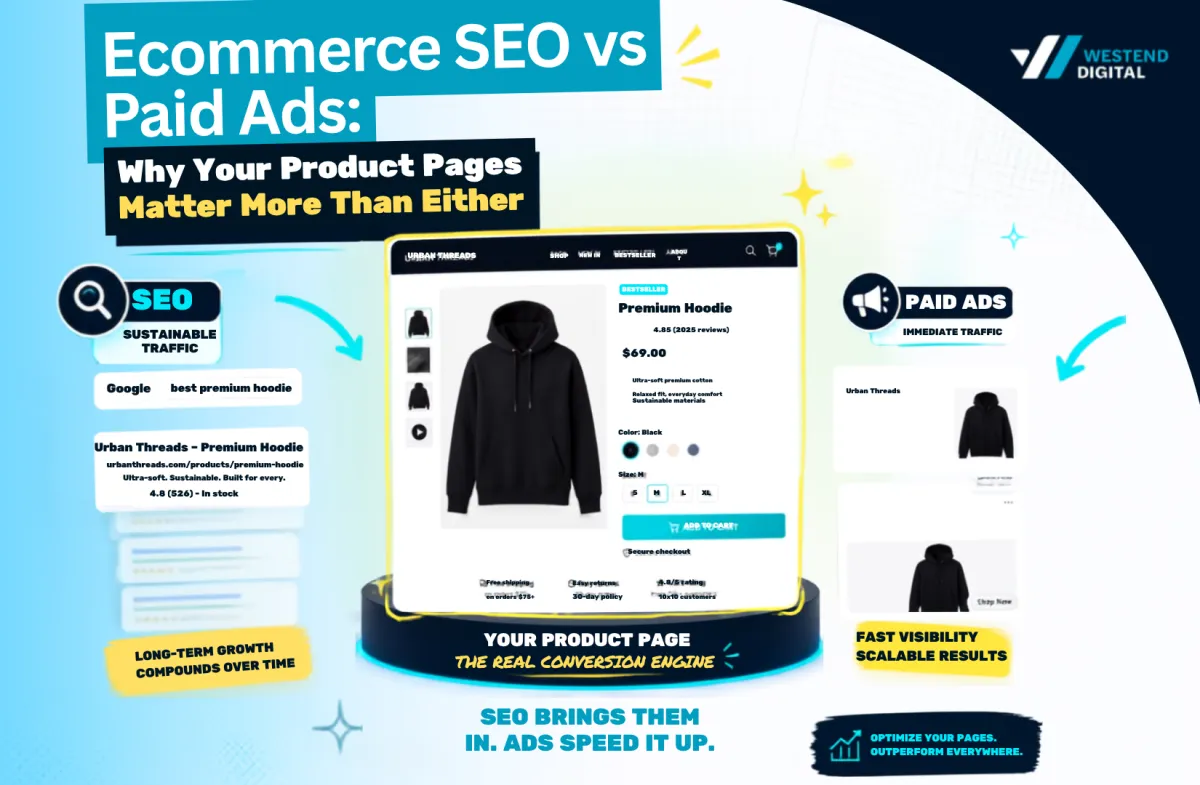
Ecommerce SEO vs Paid Ads: Why Your Product Pages Matter More Than Either
Australian online retail hit AUD 82.6 billion in sales last year, up 14 per cent year on year, with 9.8 million households now shopping online according to Australia Post’s eCommerce Report 2026. That growth is real, but it also means more competition for every click. In the ABS’s final Retail Trade release, covering June 2025, online sales accounted for 12.7 per cent of total retail turnover in original terms, up from 11.9 per cent in May 2025 and 11.6 per cent in June 2024. That release was also the last of its kind: the ABS discontinued the monthly Retail Trade series after this print, so more recent online-share figures are now triangulated from ABS quarterly data, the Monthly Household Spending Indicator, and industry reports like Australia Post’s rather than one single benchmark.
We see a consistent pattern with ecommerce clients who come to us after months of running ads. The traffic is there. The click-through rate looks fine. The conversion rate does not move, and the assumption is almost always that the targeting is broken. Often the real problem is upstream of the ad account entirely: a product page that gives a visitor no reason to trust the store or finish the purchase. Paid ads can buy attention. They cannot buy persuasion.
This matters for the SEO conversation too, because the same weaknesses that suppress conversion rate on a paid landing page can also undermine organic visibility, user experience, and conversion performance more broadly. A thin, duplicated, or slow product page performs badly whether the visitor arrived from a Google ad or a Google search result. Fixing it once improves both channels. That is the case for treating ecommerce SEO as foundational work rather than a slower, cheaper alternative to paid ads

What Paid Ads Can and Can’t Fix
Paid advertising is genuinely good at one thing: putting a qualified visitor in front of your product quickly. It cannot fix what that visitor sees when they land. If a product page has a manufacturer’s stock description, one blurry photo, no reviews, and a three second delay before anything renders on mobile, no amount of audience refinement recovers the lost sale. The ad did its job. The page did not do its job.
This is also an expensive way to discover the problem. Every visitor who bounces off a weak product page after clicking a paid ad cost you money to acquire. The same visitor arriving organically through search costs nothing per click, which is exactly why the underlying page quality issues are worth fixing before spend increases, not after.
The Ecommerce SEO Fundamentals Most Stores Get Wrong
Duplicate and thin product descriptions
Copying a supplier or manufacturer’s product description straight onto a store page is one of the most common issues we see across Melbourne ecommerce sites, particularly stores reselling branded stock. Google’s own John Mueller has said in Search Central office hours that Google will not necessarily penalise a store for using the same description across close product variants, such as different colourways of the same item. That is a narrower statement than it is often treated as. Not being penalised is different from not paying a cost. Duplicate content is not itself a spam violation, but when Google finds multiple near-identical URLs it goes through a canonicalisation process, choosing one representative URL to show in results and folding ranking signals into that choice rather than splitting them across every variant page. In practice that means a store’s own near-identical product pages can end up competing with each other for the same result, on top of duplicated supplier copy giving a visitor no reason to trust that the store actually knows the product. The fix Mueller has pointed to is describing what makes each variant genuinely different, rather than writing a fresh generic description for its own sake.
Category page structure and internal linking
Product pages get most of the attention in ecommerce SEO conversations, but category pages carry a disproportionate amount of the SEO weight. A category page with a short paragraph of genuine buying guidance, sensible filtering, and clean internal links to related categories and best sellers does two jobs at once: it gives Google a page worth ranking for broader commercial searches, and it gives shoppers a path to products they were not searching for by name. Many Melbourne stores treat category pages as pure product grids with no supporting content and thin internal linking between related categories, which leaves that opportunity unused.
Product and review structured data
Google’s Search Central documentation supports two classes of product structured data: product snippets for pages where a visitor cannot purchase directly, and merchant listing markup for pages where they can, which allows price, availability, and review information to appear directly in search results. Review and AggregateRating markup can add star ratings to that listing, but Google is explicit that the reviewed content marked up must be genuinely visible to users on the page, and Google tightened its guidance around incentivised and undisclosed reviews as recently as July 2026. Structured data is not a shortcut around having real reviews. It is a way of making real reviews visible to Google in a format it can use.
Image optimisation and alt text
This is one of the few genuine crossover points between SEO and paid media quality, but it is worth separating the two jobs these do. Compressed, correctly sized images are a page speed fix, and page speed affects both organic performance and landing-page experience on the paid side. Alt text does a different job: it does not speed up the page, it gives Google additional context about what the product actually is and improves accessibility for users on screen readers, which matters most on category and search pages where product imagery does much of the communicating. On the paid side, Google’s own Quality Score guidance treats landing-page experience as one input among several and describes the 1 to 10 score itself as a diagnostic tool rather than a direct auction input, so it is more accurate to say these fixes support landing-page experience and paid conversion performance than to say they mechanically move a quality score.
Mobile site speed
The majority of Australian ecommerce traffic is now mobile, and a slow-loading product page loses visitors before they see the description, the reviews, or the price. This is worth treating as a baseline requirement rather than an optimisation task to get to eventually, because it affects every other fix on this list. A perfectly written product description on a page that takes four seconds to load will not be read.
Where Local Intent Still Matters for Ecommerce
This section is genuinely short, and it should be. Most pure online retailers have limited local SEO surface area, because there is no physical location for Google to anchor local intent to. Local relevance mainly becomes relevant where a store has some physical footprint: click and collect, a showroom, a warehouse pickup option, or same day delivery limited to Melbourne metro. In those cases, it is worth making that physical or delivery-area detail explicit on relevant pages, because it is a genuine differentiator search engines and shoppers can both use. For a store with no physical presence at all, chasing “melbourne” as a keyword on every page is unlikely to be worth the effort. The keyword data backs this up: broader terms like “ecommerce seo” carry more national search volume than the Melbourne-specific version, which suggests most people researching this topic are not filtering by location in the first place.
A Practical Checklist
Being upfront about effort here rather than suggesting everything is a quick win.
Genuine quick fixes:
● Add alt text to product images that are missing it
● Rewrite the five or ten highest traffic product descriptions that are currently duplicated from a supplier
● Add or improve buying guidance copy on top category pages
● Check Google Search Console’s Merchant Listings report for structured data errors on existing markup
Real technical work:
● Implementing or fixing Product and Review structured data across the catalogue, particularly for stores on platforms where this is not automatic
● Resolving duplicate content created by filtered URLs, colour or size variant pages, and pagination
● Mobile page speed work, especially image delivery and script loading order
● Building out category-level content and internal linking architecture across a large catalogue
Common Mistakes When Running SEO and Paid Ads Together
The most common one is budget going entirely to ad spend with nothing allocated to the page itself, which means every dollar spent on ads is being tested against a page that was never optimised to convert. The second is treating SEO as a launch task rather than ongoing work, where a store gets structured data and clean URLs right at launch and then never revisits it as the catalogue grows. The third is measuring the two channels in isolation. A product page that converts better organically will generally convert better from paid traffic too, so conversion rate data from either channel is useful for improving the page as a whole, not just the channel it came from.
The Actual Decision
The honest answer to “SEO or paid ads” is that this is rarely a genuine either/or for a store that wants sustainable growth. Paid ads are the faster way to get traffic in front of a product today. SEO is the slower way to reduce your reliance on paying for every visitor over time, and it directly improves the page paid traffic lands on regardless of which channel you prioritise first. The mistake is not choosing the wrong channel. It is spending on either one before the product page itself can convert the traffic it receives.
If you are increasing ad spend on a store you have not audited at the page level in the last six months, that audit is worth doing before the next dollar goes to ads, not after. If you want a second set of eyes on where your product pages are actually losing sales, that is a conversation we are always happy to have, no obligation attached.
Westend Digital is a Melbourne-based digital marketing agency working with small and medium-sized businesses across trades, healthcare, professional services, and hospitality. If you are setting a budget for your next ad campaign and want a second opinion before you commit, reply to The Westend Brief or visit westenddigital.com.au.