
HANDYMAN BUSINESS MARKETING
Google Ads for Handyman That Turn Clicks Into Booked Jobs
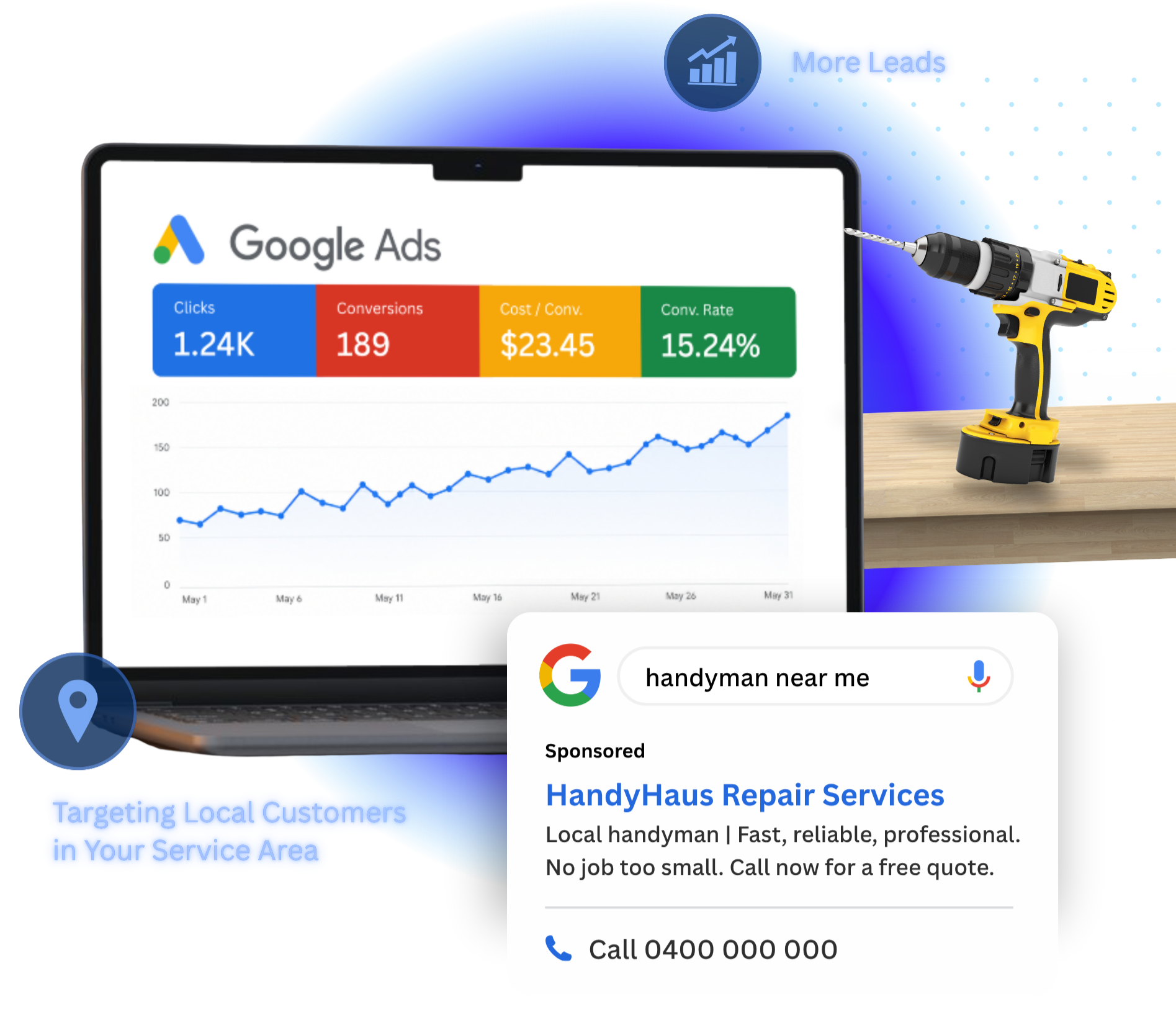
When a fence paling blows down, a door won't latch, or a list of small jobs finally needs doing, people search Google before they call anyone. We build Google Ads campaigns that put your handyman business in front of people who need a job done now, generating qualified leads and booked jobs across your service area.
No lock-in contracts
No jargon-filled reports
97% of consumers read online reviews before choosing a local business
BrightLocal, Local Consumer Review Survey 2026
Verified Industry Benchmarks
Real data to frame your budget expectations
$5.42
Average cost per click across all industries* in Google Ads
WordStream, 2026 Google Ads Benchmarks (13,000+ campaigns)
$8.33
Average CPC for Home & Home Improvement category
WordStream, 2026 Google Ads Benchmarks
8.18%
Average conversion rate across all industries
WordStream, 2026 Google Ads Benchmarks
*Service-industry cost per click in Sydney and Melbourne typically ranges from $4.80 to $7.50 AUD, generally higher than in smaller Australian markets due to greater advertiser competition.
Perth Digital Edge, 2026 Australian market data (as reported by Pixeld)
How Handyman Customers Actually Search
Handyman enquiries generally split into two very different kinds of search, and a campaign that treats them the same way tends to waste budget.
Handyman enquiries generally split into two very different kinds of search, and a campaign that treats them the same way tends to waste budget.
Single job, ready now
A blown-down fence paling, a door that won't latch, a broken gate, or a tap that won't stop dripping prompts a search for same-day or same-week help. These searchers usually want a straightforward answer to “how much” and “how soon,” and they will often book whichever business responds fastest with a clear price.
A list of small jobs
Picture hanging, flat-pack assembly, minor carpentry, gutter clearing, and a dozen other small tasks that build up over months often get bundled into a single booking. These customers tend to compare a couple of businesses, check reviews, and want clarity on the hourly rate or call-out fee before committing, since the job list adds up to a bigger invoice than a single repair.
Google Ads needs to be structured differently for each of these, and a Google Business Profile with strong reviews and an accurate service area supports both.
Why Google Ads Works for Handyman Businesses
Search ads for high-intent queries
Search ads place a handyman business in front of people typing exactly what they need done, at the moment they need it, rather than hoping they come across the business another way. That is the core difference between Google Ads and most other marketing for handyman businesses: it captures demand that already exists instead of trying to create it.
Call-only campaigns for same-day jobs
For jobs people want done today or this week, a campaign built around a single tap-to-call button outperforms one that sends traffic to a website first. A handyman search is rarely followed by a long research session. The business that answers the phone first, with a clear price range, usually wins the job.
Working alongside the Google Business Profile and Local Pack
Paid search and local organic visibility are not competing channels. A well-managed Google Ads campaign and a complete, review-strong Google Business Profile reinforce each other, since both are competing for the same searcher's attention.
Google Ads Strategy for Handyman Businesses
Handyman campaigns need to account for the economics of smaller jobs. A low-value repair can quickly become unprofitable if the advertising cost is too high, so campaigns should be built around minimum call-out fees, service areas and job types that make commercial sense. Multi-job visits can also be more valuable than one-off repairs, particularly when homeowners bundle several small tasks into a single booking.
Landlords and property managers are another important segment, with recurring demand for maintenance, repairs and tenancy-ready work across multiple properties. Dedicated messaging and landing pages can help separate these higher-value repeat enquiries from one-off residential jobs.
Common Challenges Handyman Businesses Face With Paid Ads
Most handyman businesses that have tried Google Ads before have run into one or more of these problems:
Broad keywords capturing DIY researchers and “how to” searches rather than people ready to book a job
No call tracking, meaning there is no clear picture of which enquiries actually came from the ad spend
Ads that promise licensed trade work such as electrical, plumbing, or gas fitting that a general handyman is not licensed to quote or perform, which turns the ad itself into a compliance risk, not just a wasted click
Lock-in contracts with reporting that does not explain what is actually happening
Westend Digital has not yet worked with a handyman business client directly, since the agency is still early in its client base. What can be offered instead is a transparent process, built around how this trade's customers actually search and buy, with full visibility into what is working and what is not.
Our Process
Discover
Audience mapping, competitor audit, and goal alignment for your service area.
Strategy
Channel selection, campaign structure, and KPI framework.
Execute
Campaigns live, creative and copy built in-house.
Report
Live dashboards and plain-English reporting, not narratives.
Refine
Kill what does not work, scale what does.
What's Included
Campaign build and ongoing management
Conversion and call tracking setup
Ad copy and landing pages built around handyman services, not generic templates
Monthly reporting in plain English
No lock-in contracts

FAQs
Frequently Asked Questions
How much should a handyman spend on Google Ads per month?
Cost per click for service-related searches in Melbourne typically falls between $4.80 and $7.50 (Perth Digital Edge, 2026), though the exact figure depends on the suburbs and keywords being targeted. Westend Digital sets a starting budget based on service area and job value, then adjusts it once real campaign data comes in.
How long does it take to see results from Google Ads for a handyman business?
Google Ads can generate calls within days of a campaign going live, since it targets people actively searching for a handyman right now. The first few weeks are used to test and refine targeting, so performance typically improves over the first one to two months.
Does Google Ads work for same-day handyman jobs?
Yes. Call-only campaigns are built specifically for searches where the person wants to call immediately rather than browse a website, such as a broken lock or a fence that needs fixing before the weekend.
Is Google Ads the best marketing for handyman businesses?
It is one of the strongest channels for handyman marketing because it captures people at the exact moment they need a job done. That said, no single channel is the whole answer. The best results usually come from Google Ads working alongside a well-maintained Google Business Profile, genuine reviews, and a website that makes it easy to call or book.
What is the difference between Google Ads and SEO for a handyman business?
Google Ads places a business at the top of search results immediately, for as long as the campaign runs. SEO builds organic visibility over months, but keeps working without ongoing ad spend once established. Many handyman businesses benefit from running both together.
Can Google Ads target specific suburbs in Melbourne's west?
Yes. Campaigns can be built around the specific suburbs a handyman business actually services, rather than spreading budget across an entire metro area.
Is there a limit to the size of job a handyman can take on in Victoria?
Yes. In Victoria, domestic building work over $10,000 (labour and materials combined) requires a registered building practitioner, and work of $20,000 or more must be covered by Domestic Building Insurance. A general handyman business should keep its ad copy and quoted job sizes inside that threshold, or hold the right registration before advertising for larger jobs.
What does call tracking mean for my handyman business?
Call tracking assigns a unique number to a campaign so every call it generates can be identified and measured, giving a clear, honest picture of whether the campaign is actually producing enquiries.