Meta Ads Event Campaign: $299 Spend, 22 Bookings
A real event campaign with the spend, funnel, creative comparison and attribution limits left in.
$299.19 is not a serious advertising budget by most standards.
It is also exactly what we spent promoting a community event in Werribee.
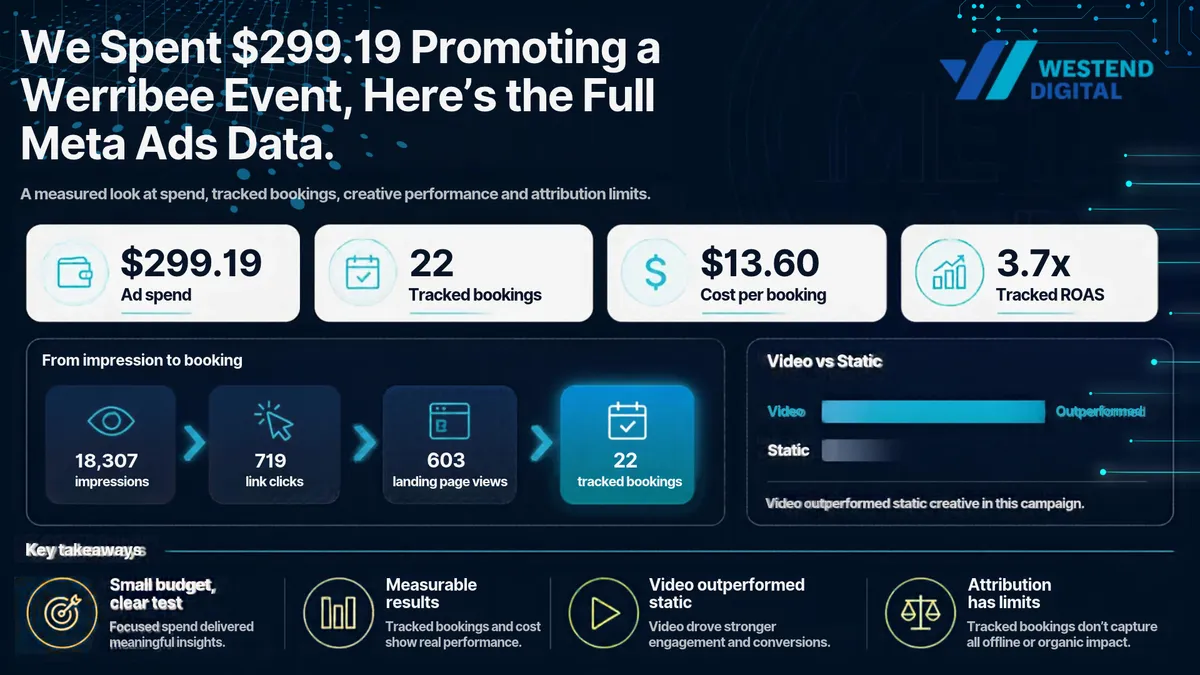
By the end of the campaign, Meta had attributed 22 ticket bookings, $1,100 in tracked ticket sales and a 3.7x return on ad spend.
One video generated 18 of those bookings.
And the event itself ended up full, with 150 confirmed registrations reported by the organiser.
Rather than turn that into a polished success story and skip over the messy bits, we thought it would be more useful to show the campaign properly: what we spent, what people clicked, what reached the landing page, what converted, which creative did the work, and where the dashboard stopped being able to explain the wider result.
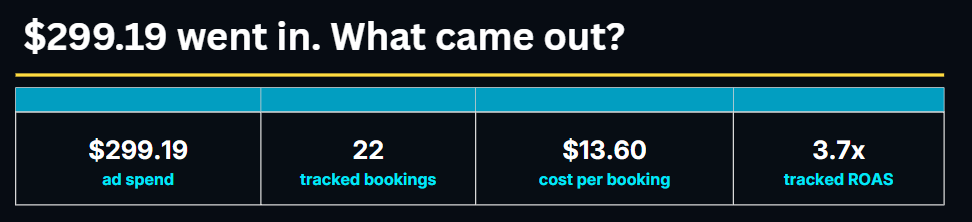
The campaign ran from 1 to 18 October 2026 for the Victorian Bangladeshi Community Foundation (VBCF), a Werribee-based non-profit with an established local community around its school, sports club and cultural events.
Tickets were $50. Meta attributed 22 purchases to the ads, so the tracked ticket value was $1,100.
We optimised for purchases, not cheap clicks
The campaign used Meta's Sales objective and was optimised for the Purchase event on VBCF's event landing page.
That distinction matters. A campaign can generate plenty of inexpensive traffic and still fail to sell tickets. We wanted the platform learning around the action that mattered: a completed booking.
The structure was deliberately simple. One event. One ticket price. One core audience. Two creatives. One conversion action.
The full funnel
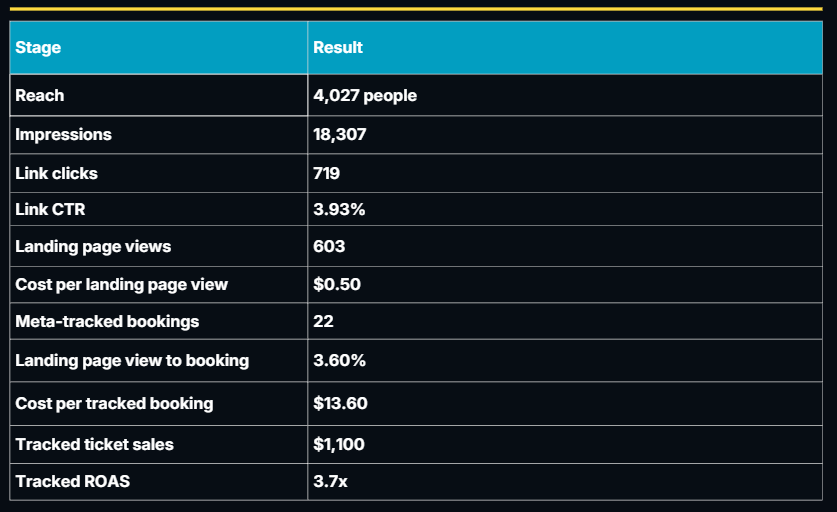
Those numbers are useful because they show the whole path, not just the cheapest metric. A click cost can look great while the booking result is poor. Here, we could see the campaign all the way through to tracked purchases.
The video did most of the work
The campaign ran a video and a poster-style static ad side by side. The result was not close.
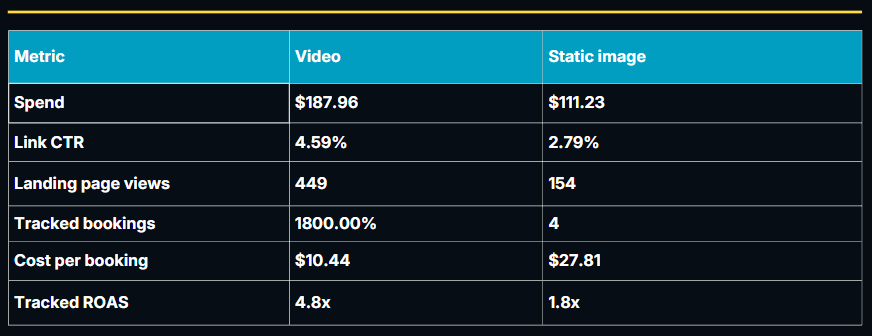
The video delivered 18 of the 22 tracked bookings from 63% of the spend. Its cost per booking was about 62% lower than the static creative.
We would not turn one small campaign into a rule that video always beats static. Meta did not split delivery evenly, and four bookings is a small base for the static ad.
But for VBCF's next event, the direction is obvious enough to act on: video deserves to lead the creative plan.
Then the dashboard stops telling the whole story
Meta attributed 22 bookings to the campaign.
VBCF reported 150 confirmed registrations overall, with the venue at capacity and around 30 more people waiting for confirmation.
That does not mean Meta was responsible for 150 people. It also does not mean the ads influenced only 22.
VBCF's audience is highly connected. People hear about events through family, friends, WhatsApp groups, the foundation's school and sports networks, and direct contact. Someone can see an ad, mention the event to a friend and book later through a completely different path.
Advertising platforms are good at reporting what they can attribute under their tracking rules. They are not a complete map of human behaviour.
So was the campaign successful?
The part we can prove is straightforward
$299.19 in media spend produced 22 Meta-tracked bookings and $1,100 in attributed ticket sales.
That is enough for the advertising to justify itself on the tracked ticket revenue alone.
The wider event turnout is a different story. That belongs to the foundation's community, word of mouth, event promotion and the demand that already existed around the event.
Keeping those two things separate is important. Good case studies should make the result easier to inspect, not harder.
Why we are publishing the dashboard
Agency case studies often reduce a campaign to one large percentage and a congratulatory paragraph.
That is not particularly useful if you are trying to understand whether the work was good.
For this campaign, the budget was small enough that the details are actually more interesting. You can see how much went in, how many people reached the page, how many booked, what the acquisition cost was and which creative carried the result.
There are no enormous budgets here and no attempt to take credit for every person who walked into the venue. Just a real campaign, real numbers and enough context to decide what the result means.
See the complete case study
We have published the full VBCF campaign case study with the detailed results table, creative comparison, screenshots and the measurement limitations.
Read the full VBCF Meta Ads case study: https://westenddigital.com.au/case-studies/vbcf-community-event-meta-ads
Westend Digital is a Melbourne-based digital marketing agency working with small and medium-sized businesses across trades, healthcare, professional services, and hospitality. If you are setting a budget for your next ad campaign and want a second opinion before you commit, reply to The Westend Brief or visit westenddigital.com.au.