Is Organic Social Media Dead in 2026? What Still Works for Small Businesses
"Is organic social media dead?" It's one of the questions we hear most often from business owners across Melbourne's west, usually after months of posting with little to show for it. It's a fair question, and the honest answer has two parts.
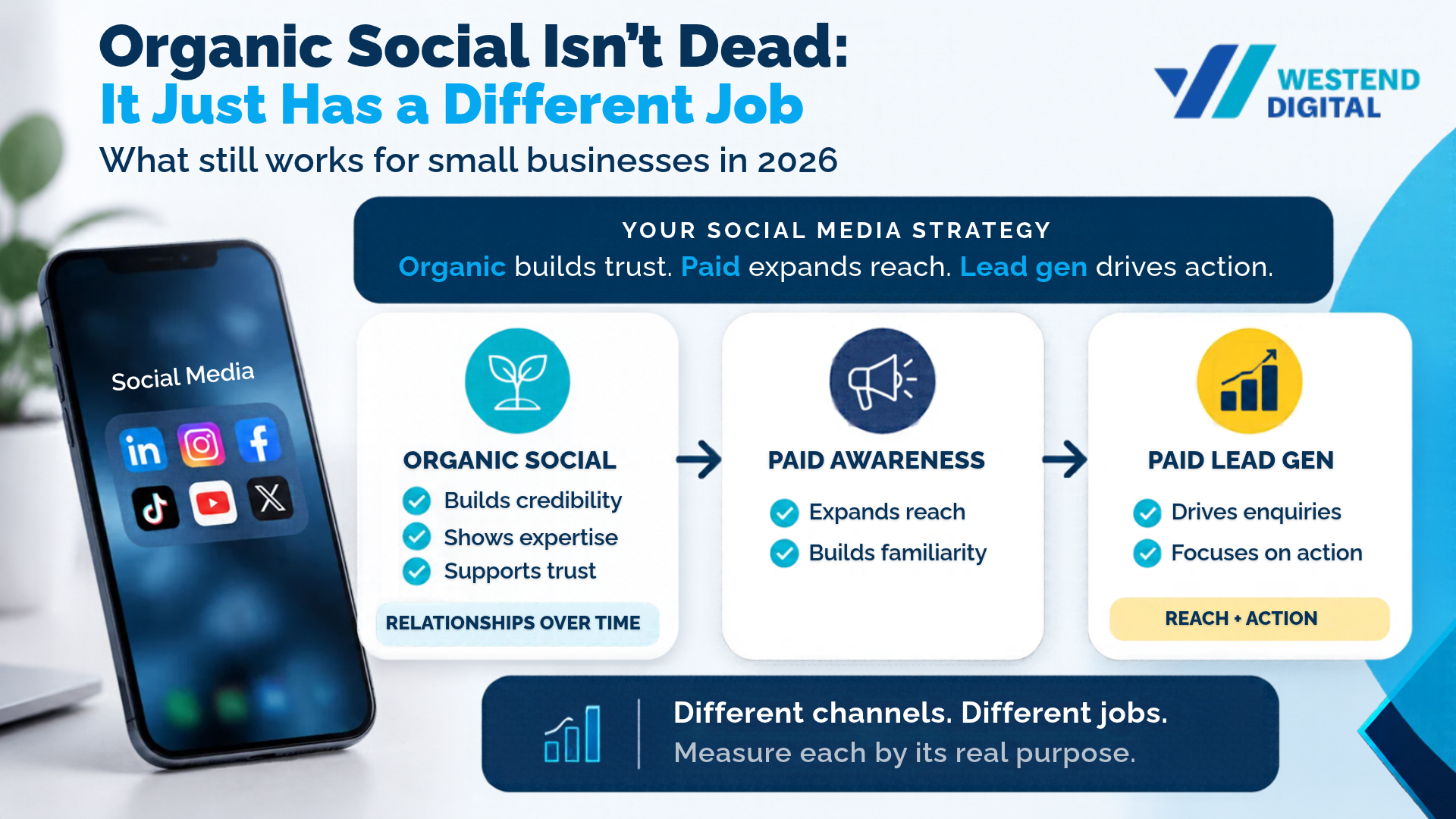
The short answer: no, organic social media is not dead in 2026. It remains useful for building brand credibility, demonstrating expertise, maintaining customer relationships and supporting buying decisions. However, organic content alone is rarely a predictable source of new customers for small businesses. Paid awareness campaigns can extend a brand's reach, while paid lead generation focuses on attracting enquiries. Each serves a different purpose and should be measured accordingly.
This article covers what the Australian data does and doesn't tell us, why business accounts struggle with engagement, what effective social media management looks like, and how to tell whether yours is paying its way.
What the Australian data says, and what it doesn't
DataReportal's Digital 2027: Australia report counts 22.6 million social media user identities in October 2026, equal to 82.8% of the population. Among adults, the figure is 20.1 million, equivalent to 93.3% of Australians aged 18 and over. "User identities" aren't the same as unique people, and DataReportal advises caution when comparing years.
Australians spend real time there too. Meltwater's summary of the Digital 2026 Australia data puts average time on social media at 19 hours and 28 minutes a week. Its 2026 Australia Digital Report found 31.3% of Australians discover brands through social media ads, behind search (37.7%) and ahead of brand websites (25.3%).
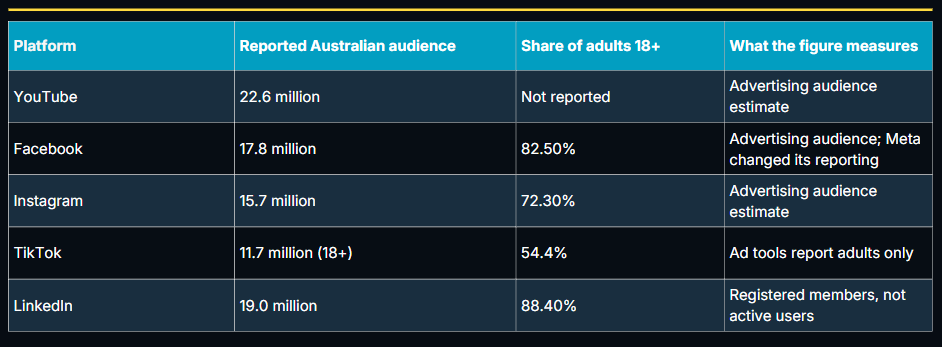
What these numbers don't tell you. They show that the audience is available. They don't show organic reach trends, engagement rates, the cost of winning a customer or whether social media is profitable for any particular business. A large audience is a reason to take social media seriously, not proof that it will pay off for you. That's why the measurement section later in this article matters as much as the statistics.
What has changed in organic reach
Feeds are built on recommendations, not just follows
Meta says its Facebook Feed Recommendations system shows people content "including content from Pages or groups you may not follow", and Instagram recommends accounts people don't follow through Explore and the Reels tab. Your followers no longer see everything you post, but each post can also reach people who've never heard of you.
Why shares matter when reaching new audiences
Instagram's head, Adam Mosseri, has said the three signals that matter most for ranking are watch time, likes per reach and sends per reach, with likes slightly more important for followers and sends slightly more important for non-followers (as reported by Social Media Today). Notice what isn't among the three signals Mosseri highlighted: how often you post. Regular posting gives you more chances to reach people and learn what works, but it isn't one of the signals he named.
Australia's under-16 account restrictions have changed audience access
Since 10 December 2025, age-restricted platforms including Facebook, Instagram, TikTok, YouTube and Snapchat have had to take reasonable steps to stop Australians under 16 from holding accounts (eSafety Commissioner). That doesn't mean every under-16 has stopped seeing social content. But businesses that once spoke directly to teenagers, such as tutoring or junior sport, now need to think about reaching parents instead.
Trust is harder to earn
Meltwater's 2026 Australia Digital Report found 73.8% of Australians are concerned about online misinformation, above the global average of 58.4%. In our view, that raises the value of content that is visibly real: actual staff, actual work, actual customers (with permission).
Why business accounts struggle with engagement
The owner posts on their personal profile and gets 80 likes. The same news on the business page gets four. That gap is real, but it's not quite the penalty many people assume.
The owner posts on their personal profile and gets 80 likes. The same news on the business page gets four. That gap is real, but it's not quite the penalty many people assume.
On Facebook, the feed was deliberately tilted towards people. In January 2018 Facebook announced it would prioritise posts from friends and family, and its then Head of Product said Pages would likely see lower reach, video watch time and referral traffic (Axios). Facebook's recommendation systems have changed a lot since then, but that decision set the direction business pages still work within.
On Instagram, account type isn't the obvious culprit. We're not aware of any published Instagram rule that reduces reach for business accounts, so switching to a personal account is unlikely to fix low engagement.
In our view, most of the gap is human:
• Relationships. Friends engage with you because they know you. A business page starts with no relationship.
• Likes are public. Liking a business post can feel like endorsing an ad in front of friends. Plenty of people will buy from a business without wanting to promote it.
• The content is different. Personal posts are about people and milestones. Business posts are often offers and announcements.
Engagement also isn't the same as reach. A post with few likes can still be seen widely and still lead to an enquiry. The practical fix is to put people at the centre of the page: the founder, the team and real stories, with staff sharing business posts to networks that already trust them, and collaboration posts with partners where it fits.
What effective social media management looks like
When we review a business's social accounts, the same patterns come up: posting in bursts, a feed dominated by promotions, success judged on likes alone, and stopping before there's enough data to learn anything. None of these are about the algorithm.
Consistency: what it does and doesn't do
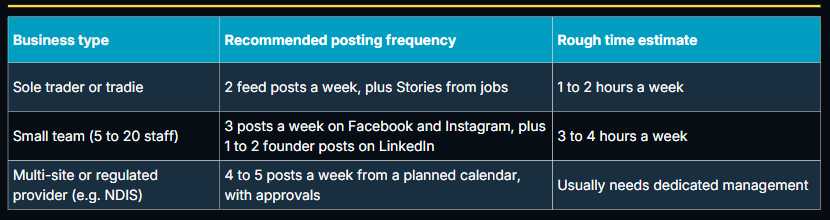
Consistency doesn't guarantee wider distribution. What it does is make content production and performance measurement easier, give you more opportunities to test formats and learn what your audience values, and keep your profile current for prospects. Some prospects check a business's social profiles before they enquire, and a last post from March sends a message, even if you're busier than ever.
Content that tends to work
• People-led content: the founder and team, especially on LinkedIn, which is built around individuals rather than company pages.
• Useful content people pass on: checklists, straight answers to common questions, local guides.
• Real photos and video of real work, produced in batches so you're not creating something new every morning.
• Community and collaboration: partners, suppliers, clients (with permission) and local events.
• Conversation: prompt, thoughtful replies to comments and messages. The comments section is public customer service.
Not every business needs the same level of organic social
The right investment depends on how your customers buy. Three illustrative examples:
• An emergency plumber usually wins work from people searching in the moment, so Google Business Profile and search ads may matter more, with social supporting credibility.
• A renovation business sells to people who research for weeks, so project photography, educational video and before-and-after content can do a lot of work.
• An NDIS provider may see few direct enquiries from social, but real value in community engagement, recruitment, credibility and referral relationships.
Your social profiles also form part of your first impression. They often appear when people search your business name, so an accurate, active presence supports discoverability. How much it influences AI search tools is still uncertain.
Authentic content and the role of AI
We use generative AI in our own work, including some ad creative. It's genuinely useful for drafting ideas and captions, resizing and editing assets, adding subtitles and testing variations. The risk is trust. In the University of Melbourne and KPMG global study, only 30% of Australians said the benefits of AI outweigh the risks, the lowest of any country, and the Australian snapshot found 77% are unsure online content can be trusted because it may be AI-generated.
Research on AI in advertising is mixed. One study found that disclosing AI involvement reduced advertising value and purchase intentions, largely through lower credibility. Another found AI labels made ads seem more novel but less authentic. A third found that clearly explaining what role AI played improved how people rated the ad. These studies looked at advertising, not organic posts, but they point the same way: perceived authenticity matters. Meanwhile, Meta may require a label on AI-generated video that looks real, or realistic audio, that was digitally created or altered.
Our rule of thumb: use AI to work faster behind the scenes, and use real photos and video for anything showing your people, premises, work or results. Never use an AI image in a way that could mislead a customer about what they'll get..
Organic social, paid awareness and paid lead generation do different jobs
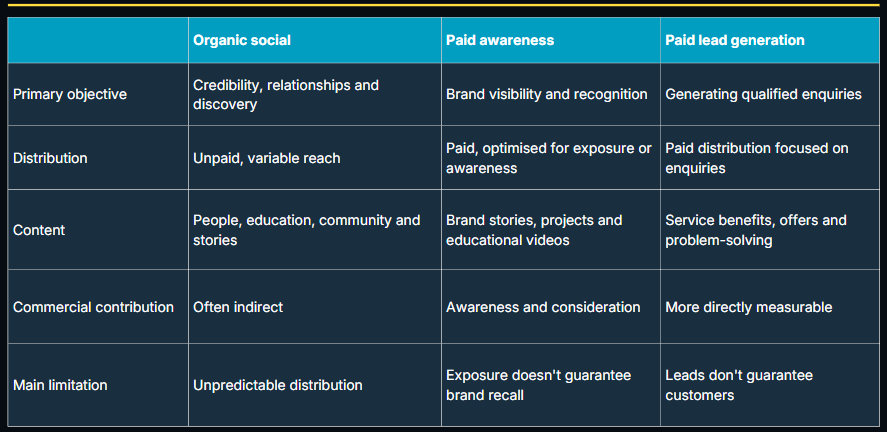
One of the biggest misconceptions about social media management is that every post should generate a customer. For most small businesses, organic social media is better suited to building credibility, demonstrating expertise, maintaining relationships and helping potential customers understand the business. Direct enquiries do happen, but relying on organic content alone for a predictable flow of new customers is difficult.
It also isn't free. Even when you pay nothing for distribution, you're paying for strategy, photography, video, design, copywriting and management, in money or in your own time. The real question is whether that investment does a meaningful job in your customers' buying journey.
Three different investments
Paid brand awareness
Takes content beyond your existing followers. A business might promote a founder video, a completed project or an educational post to a relevant local audience, with visibility and familiarity as the goal rather than immediate enquiries. Paid lead generation asks people to take a specific action, such as requesting a quote or booking an appointment, and needs different creative, objectives and measurement. Organic results can inform paid creative, but organic engagement isn't a reliable predictor of paid conversion performance: a funny team video can earn plenty of organic views and still lose to a plain, service-led ad built for enquiries.
How social media helps without getting the credit
Take a renovation business (an illustrative example). A potential customer hears about it through a referral, searches the company on Google, then visits its Instagram page and sees completed projects and the team behind the work. Feeling more confident, they request a quote through the website. The CRM records the source as "referral". Social media didn't acquire that customer, but it may have helped convert them. That contribution is hard to isolate, and it shouldn't be ignored or overclaimed. The measurement section below shows how to look for evidence of it.
Work out what success needs to look like
If you want to know what social media would need to deliver to recover its cost through sales, start with a simple break-even sum:
Total monthly social media investment ÷ contribution per additional sale = additional sales needed each month to break even
Contribution means the revenue from an additional sale minus the variable costs of delivering it. The investment should include management, content production and any paid promotion for the activity you're evaluating. Two hypothetical examples, not benchmarks, using a total monthly investment of $1,000:
• A renovation business with a $5,000 contribution per job needs 0.2 additional jobs a month, on average, or one every five months.
• A café with an $8 contribution per visit needs 125 additional visits a month (visits, not necessarily new customers).
These calculations show what social media would need to deliver to recover its cost through additional sales. They are not forecasts of what organic content will achieve. Whether those outcomes are realistic depends on your audience, distribution, customer buying behaviour and conversion rates. Where direct acquisition is unlikely, evaluate social media against its role in awareness, credibility and customer consideration instead.
How to measure effectiveness
Judge each type of investment against its own purpose:
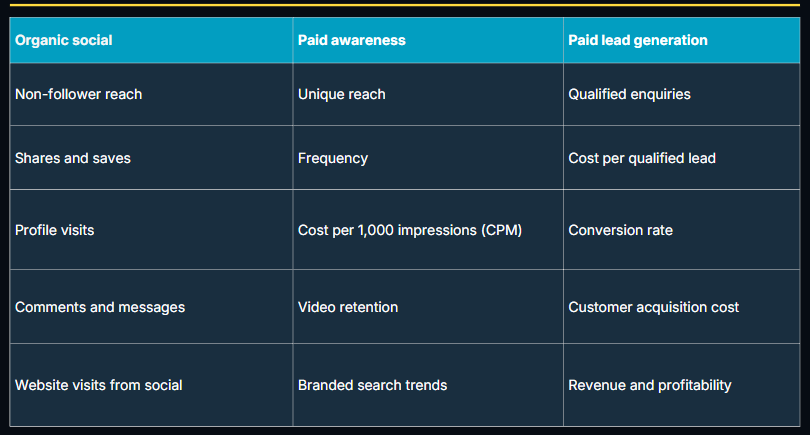
Reach, frequency and video retention tell you how your awareness campaign was delivered, but they do not prove that people remember your brand or are more likely to buy from you.
To find evidence of social media's indirect role:
• Ask two questions when you qualify enquiries or onboard customers: "How did you first hear about us?" and "What helped you decide to contact us?" The first measures discovery. The second shows contributing touchpoints without leading people towards social media as an answer.
• Check GA4 for website visits referred from Instagram and Facebook, and tag links with UTM parameters that separate organic_social from paid_social, so your reports don't combine the activities you're trying to compare.
• Record enquiry sources in your CRM, including where social media played a supporting role.
Branded search impressions in Google Search Console are worth watching, but a rise can't automatically be credited to social media, because referrals, advertising, PR and offline activity all contribute. Formal brand lift studies are rarely practical at small-business budgets, so these simpler signals are usually the realistic option. Three to six months is a useful planning horizon for organic social, with monthly reviews along the way.
Action checklist
Quick fixes (under an hour)
• Update bios, contact details and website links on every profile.
• Pin your most useful post on each profile.
• Reply to outstanding comments and messages.
• Add UTM tags to the links in your bios.
The real work (weeks, not hours)
• Decide what social media is for in your business: awareness, enquiries, recruitment or credibility.
• Choose three to five content themes and a cadence you can sustain, then build a calendar.
• Plan a photo and video session to build a bank of real content.
• Set up monthly reporting using the measures for each type of investment, plus the two enquiry questions.
Avoid
• Buying followers, judging success on likes alone, posting identical content on every platform, deleting fair criticism, and going silent when business gets busy.
The bottom line
Organic social media isn't dead, but it isn't automatic either. It works best when it has a clear job in your business, real people and real work behind it, sensible support from paid advertising, and measurement that goes beyond likes.
Is your social media investment doing enough for your business? Posting regularly is one thing. Knowing what those posts contribute to your business is another. At Westend Digital, we look at your content, audience, advertising and enquiry data together to understand where social media is adding value and where your strategy needs to change. If you're already investing in social media management but aren't seeing the results you expected, bring your recent performance reports and let's look at what the numbers are telling you. Discuss your social media strategy with our team.
Frequently asked questions
Is organic social media still worth it for small businesses in 2026?
For most, yes, but as part of a wider plan. Australia had social media user identities equivalent to 93.3% of the adult population in October 2026 (DataReportal). Whether organic social is worth it for your business depends on how your customers buy and whether you measure its contribution.
Is it worth paying for social media management if my posts don't generate leads?
Social media management can be worthwhile even when it isn't the main source of direct enquiries. It can support customer research, brand recognition and conversion across other channels. But the investment should have measurable objectives. If it produces neither meaningful engagement nor evidence of commercial value over time, the strategy and budget should be reassessed.
What is the difference between organic social media, paid awareness and paid lead generation?
Organic social media uses unpaid content to build relationships, demonstrate expertise and support credibility. Paid awareness campaigns use advertising budgets to reach relevant audiences and increase brand visibility. Paid lead generation focuses on encouraging potential customers to enquire, book or request a quote.
How often should a small business post on social media?
Choose a schedule you can sustain and measure. For many small businesses that's two to three quality posts a week, but the right number depends on your capacity and audience.
Why does my business page get fewer likes than my personal profile?
Mostly relationships and content. Facebook has prioritised friends and family since 2018, and people engage more readily with people they know. Putting real people and stories on the page, and having staff share posts, helps close the gap.
Is it OK to use AI-generated images and video on social media?
Yes, with care. AI is useful for ideas, editing and illustrations. Use real photos and video for your people, work and results, follow Meta's labelling rules for AI-generated video and audio that looks or sounds real, and never use AI in a way that could mislead customers.
How long before I can judge organic social media results?
Use three to six months as a planning horizon, with monthly performance reviews. Assess organic social media against its intended purpose, whether that is brand credibility, audience engagement, customer consideration, recruitment or direct enquiries.
Westend Digital is a Melbourne-based digital marketing agency working with small and medium-sized businesses across trades, healthcare, professional services, and hospitality. If you are setting a budget for your next ad campaign and want a second opinion before you commit, reply to The Westend Brief or visit westenddigital.com.au.
About the author
Imran Abul Kashem is the founder of Westend Digital, a Werribee-based digital marketing agency working with small and medium businesses across Melbourne's west. He is an award-winning photographer, the author of three books and the host of the My Migrant Soul podcast.