Prospecting vs Retargeting: Facebook Ads Strategy
Open almost any Facebook ads account and the retargeting campaign looks like the star. It may have the lowest cost per lead, the strongest reported return and a steady stream of conversions. The prospecting campaign beside it looks expensive.
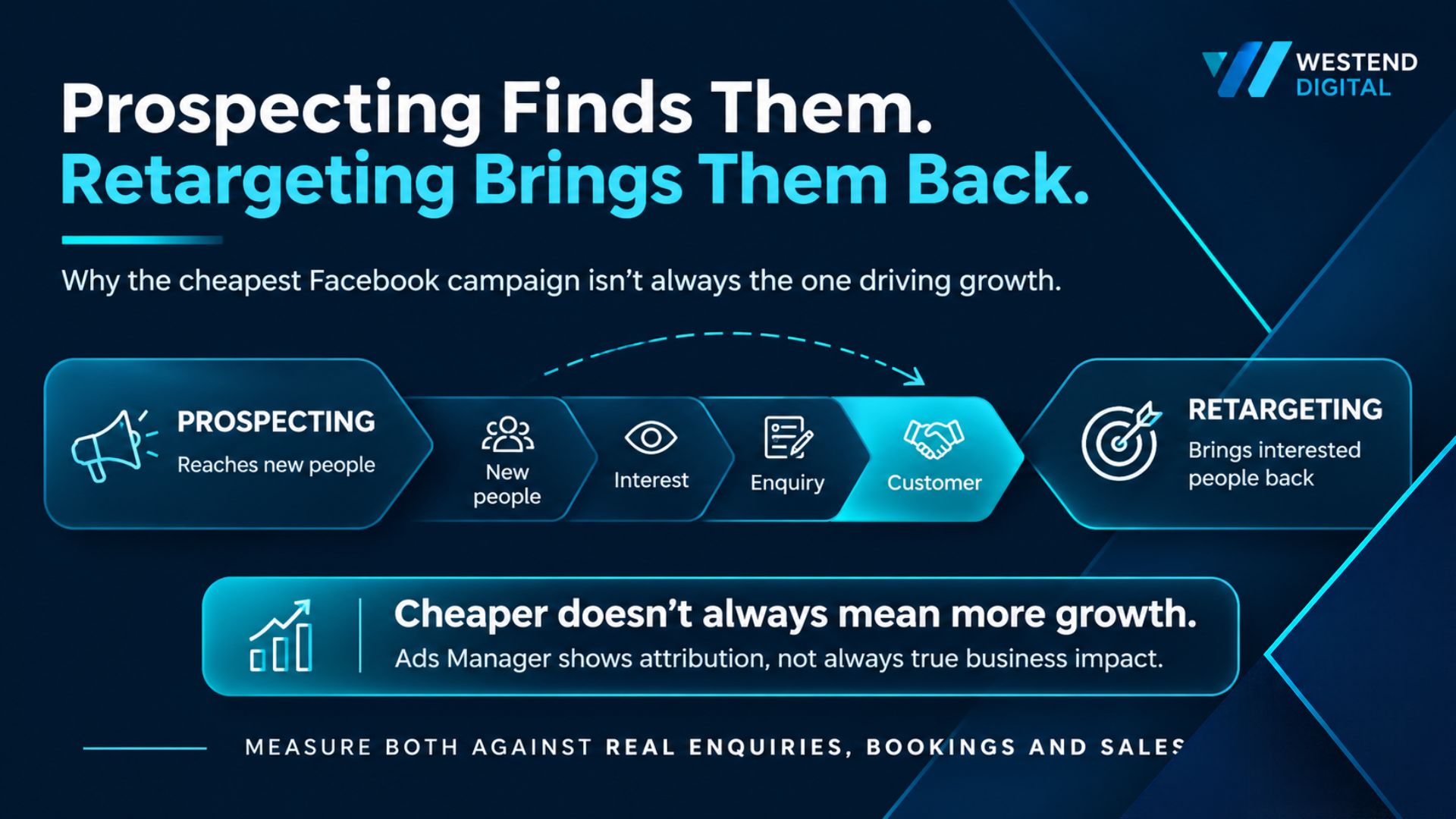
So why not move more budget into retargeting? Because the cheaper-looking campaign isn't necessarily the one bringing new customers into your business. And the numbers in Ads Manager don't tell the whole story.
Prospecting vs retargeting: the short answer
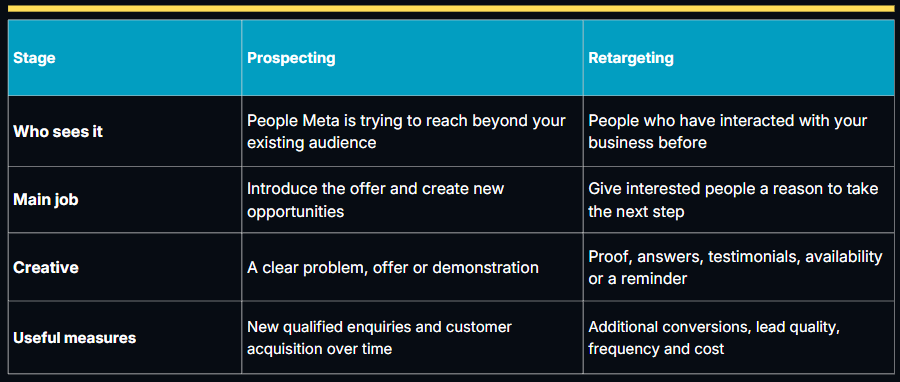
Prospecting introduces your business to potential customers who haven't engaged with it before. Retargeting reaches people who have already shown interest, such as website visitors, video viewers or past enquirers. Retargeting can report a lower cost per lead because it starts with a warmer audience. But an attributed lead is not automatically an extra lead caused by the ad. A useful Facebook ads strategy measures both together against real enquiries, appointments and sales.
For a Melbourne service business, or any business advertising across Australia, the question is not which campaign has the prettiest row in Ads Manager. It's whether the whole system is bringing in more worthwhile business.
One important distinction: prospecting isn't the only way people become familiar with your business. Someone might first find you through Google, a referral, an organic post, or a shopfront. Retargeting can reach those people too, if they're in an eligible audience.
How prospecting works on Meta now
Prospecting used to mean building long lists of interests and demographics. Those inputs still have uses, but broad targeting and Advantage+ Audience give Meta more room to decide who sees an ad. That makes your creative and conversion data especially important.
• Show the right problem. A short video of a real job, a plain-English explanation, or a specific local offer gives people a reason to stop scrolling. The ad needs to make sense to the person you want to reach.
• Choose a useful optimisation event. If Meta is asked to find form submissions, it will optimise towards people likely to submit forms. If your business needs booked appointments, track what happens after the form too, so you can judge lead quality.
• Give changes time to settle. Early results can move around. Constantly changing budgets, audiences and creative makes it harder to tell which decision helped. Review performance over a sensible window, not after one disappointing day.
Prospecting may have a higher reported cost per lead because it is reaching people with less existing intent. That doesn't make it wasteful. If those enquiries turn into valuable customers, it may be doing the work your business needs most.
How retargeting works, and where it helps
Retargeting, also called remarketing, is advertising to people who have already interacted with your business. Depending on your setup and eligibility, that could include website visitors, people who watched your videos, Facebook or Instagram engagers, and people who opened a lead form without submitting it.
These people often need different information from a first-time viewer. Someone who has already visited your website probably doesn't need another introduction. They might need a review, a short case study, an answer about pricing, or a clear way to book.
Think of a hypothetical Melbourne landscaping business. Prospecting might show a 20-second video explaining how it transforms a small backyard. Retargeting might show before-and-after photos, customer feedback and a quote-request link. The business should then check which enquiries became actual site visits and jobs, not just which ad got the last click.
Retargeting is useful, but it has a limit. If the warm audience is small, increasing spend can mean showing the same ads to the same people too often. It cannot be your entire growth plan.
Why retargeting can take too much credit
Ads Manager reports attributed conversions. Depending on your settings, Meta can credit a lead or sale after someone clicks or views an ad within an attribution window. That tells you which conversions Meta associated with the advertising. It doesn't, by itself, prove the ad caused every one of them.
Imagine someone visits your website twice, reads reviews, saves your phone number and plans to call on Friday. On Thursday, they see a retargeting ad. If they call within the attribution window, the ad may receive credit even if they were going to contact you anyway.
The missing question is incrementality: how many extra leads or sales happened because the advertising ran? One way to estimate that is a randomised holdout test, comparing a group eligible to see the ads with a comparable group that isn't shown them.
Hypothetical example. Suppose Meta attributes 100 leads to a retargeting campaign that spent $1,000. Ads Manager would show $10 per attributed lead. A well-designed lift test might estimate that the campaign generated 40 additional leads compared with not advertising. In that simplified example, cost per incremental lead is $25. The test estimates the extra results across groups; it doesn't identify which individual leads would have happened anyway.
Most small businesses won't have enough volume for a meaningful lift study every month. You can still make better decisions by comparing total spend with qualified enquiries, booked appointments and sales in your CRM. Just don't call that a causal experiment.
Advantage+ can blur the prospecting and retargeting split
A broad or Advantage+ campaign isn't automatically a pure prospecting campaign. Meta may find that people who already know your business are more likely to convert, so some delivery can go to them.
In a published test, Meta ads specialist Jon Loomer found that 35.4% of spend in one Advantage+ Audience setup reached his defined engaged or existing-customer segments. It was a small test across his own audience, not a benchmark for Australian advertisers. The useful lesson is to check audience overlap instead of assuming a broad campaign reaches only new people.
Meta also has an Audience Segments reporting breakdown for eligible Sales campaigns. Loomer's reporting walkthrough notes that this breakdown is not generally available in the same way for Leads campaigns, and that undefined or unmatched people can appear as New or Unknown. Check what your account actually supports before relying on the numbers.
For service businesses running lead campaigns, CRM records, recent customer exclusions where available, campaign settings and lead quality may be more useful than a segment report that doesn't apply to the objective you're using.
How much budget should go to prospecting and retargeting?
There isn't a universal 80/20 split. The right balance depends on the size of your warm audience, how quickly people make decisions, your budget and the value of a new customer.
If you're a small local business with only a few hundred recent website visitors, a large retargeting budget is unlikely to make sense. If you have a busy website, a long buying cycle and enough qualified traffic, retargeting may have more room to contribute. Automated campaigns can also reach warm people already, so don't assume you need a separate retargeting ad set just because a guide says so.
Start by protecting enough budget to reach new potential customers. Then let audience size, frequency, lead quality and actual sales tell you whether retargeting deserves more or less.
A practical Facebook ads strategy for service businesses
1. Start with the business outcome. Decide whether success means qualified enquiries, booked appointments, jobs won, or purchases. A cheap form submission is only the first step.
2. Build creative for different levels of familiarity. Introduce the problem and offer to new people. Show proof and answer objections for people who have already engaged.
3. Use exclusions where your setup allows. Avoid repeatedly advertising a new-customer offer to people who have just enquired or purchased. Check whether an audience input is a firm control or only a suggestion in your campaign type.
4. Watch audience size and frequency. If your warm pool is small, don't force a separate retargeting budget that simply repeats the same message to the same people.
5. Connect advertising to your CRM. Track submitted, contacted, qualified, booked and won where relevant. Review the total cost per meaningful outcome, not only platform-reported leads.
6. Test one important change at a time. Keep a record of what you changed, why you changed it and when. Use a holdout or lift study if your budget and volume support a credible test.
If you're using customer lists or website tracking, make sure your collection, notices and permissions are appropriate for your business and applicable requirements. This deserves particular care in health, disability and other sensitive sectors.
Before you shift budget, check these four things
• Is prospecting still bringing new, qualified people into the pipeline?
• Are warm audiences large enough to support the retargeting spend without excessive repetition?
• Do the results in Ads Manager line up with actual enquiries, bookings and sales?
• Are you measuring additional business, or only which ad received the credit?
The bottom line
Prospecting and retargeting do different jobs. Prospecting gives more people a reason to discover you. Retargeting gives interested people a reason to come back. Both can help, but the cheaper-looking campaign is not automatically the one growing your business.
Before you move budget, look at the whole journey from first impression to actual customer. That's where a sensible Facebook ads strategy starts.
Want a second opinion on how your Facebook and Instagram campaigns are structured and measured? Talk to Westend Digital about a Meta ads review.
We don't use lock-in contracts. That doesn't mean we expect instant results. Advertising channels need time to collect useful data, and we'll be upfront about what can realistically be judged and when.
Frequently asked questions
What is the difference between prospecting and retargeting on Facebook?
Prospecting aims to reach potential new customers. Retargeting reaches people who have already interacted with your business. They work best when judged together against qualified leads and sales, rather than compared only by cost per result.
Is remarketing the same as retargeting?
Usually, yes. In everyday advertising language, both describe reaching people who already know or have interacted with your business.
Does retargeting work for small local businesses?
It can, particularly when people take time to compare providers. But a small warm audience can be saturated quickly, so watch frequency and avoid forcing spend into retargeting.
How much should I spend on Facebook retargeting ads?
It depends on scope, channels, content requirements and ad budget. Ask for an itemised quote separating agency fees, production, technology and media spend.
Do I need the Meta Pixel for retargeting? Can an agency guarantee new participants?
You generally need appropriate website tracking to build website-visitor audiences. You may be able to retarget people who engaged with your Facebook or Instagram content or opened a Meta lead form without a website Pixel.
Can Advantage+ campaigns reach existing customers?
Yes, automated delivery can include people who already know your business, depending on your campaign settings and available controls. Check your account's audience options and reporting rather than assuming broad targeting means new people only.
Westend Digital is a Melbourne-based digital marketing agency working with small and medium-sized businesses across trades, healthcare, professional services, and hospitality. If you are setting a budget for your next ad campaign and want a second opinion before you commit, reply to The Westend Brief or visit westenddigital.com.au.